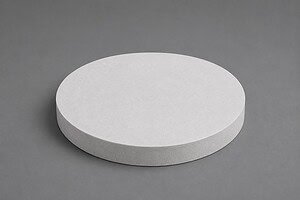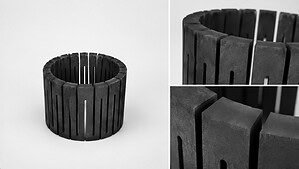
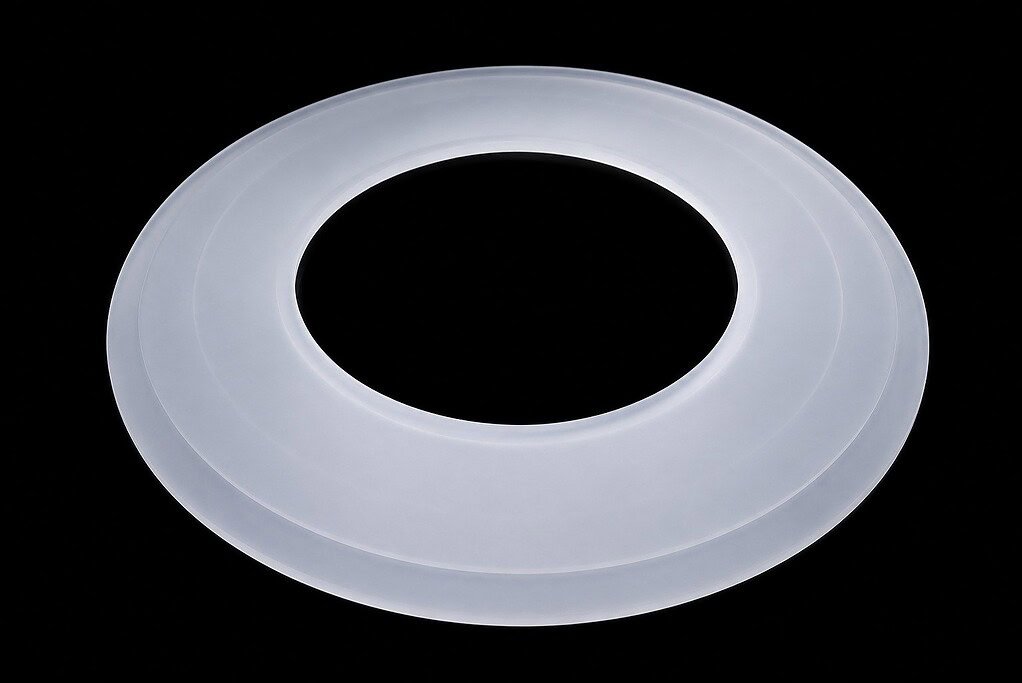
A fused quartz glass ring. 420 mm outer diameter, 300 mm inner bore, 18 mm thick. The ring has to come out intact — one piece, no cracks, edges clean enough to go straight into grinding and polishing.
At this size, that is not a given. Fused quartz is brittle. The larger the workpiece, the longer the diamond wire’s contact arc, and the more lateral force builds up along it. Uncontrolled, that force produces chipping at the entry and exit zones — or starts subsurface microcracks that only show up downstream, during thermal cycling or polishing.
This case walks through how VIMFUN cut the ring, and why the process choices matter at 420 mm diameter.
The Application: Fused Quartz Rings for Semiconductor and Optical Systems
Fused quartz is one of the few materials that can satisfy a demanding combination of requirements simultaneously: near-zero thermal expansion (0.55 × 10⁻⁶/°C), high chemical purity, UV transmission, and dimensional stability under thermal cycling. Those properties make it a standard material for components inside semiconductor processing equipment, optical assemblies, and high-cleanliness industrial systems.
Ring and disc geometries in this size class appear across several application categories:
- Semiconductor equipment — quartz rings used as chamber components, diffusion tube fixtures, and process isolation elements in wafer fabrication
- Optical systems — large aperture optical blanks and ring mounts where dimensional stability and surface integrity are the specification
- High-purity process systems — flow control and isolation components where contamination from cutting residue cannot be tolerated
For all of these, the cut surface quality matters directly. The ring does not go through extensive rework before use — what the wire leaves behind is the starting condition for the next process step. That constrains the cutting process: edge chipping has to stay within tolerance, subsurface damage has to be minimal, and the coolant system has to be compatible with the clean-process requirement.
The customer’s specification for this cut: ring structure fully intact, edge chipping below 0.2 mm, no visible cracks, surfaces ready for subsequent grinding and polishing.
The Challenge: Large Quartz Glass Ring Cutting at 420 mm Diameter
Fused quartz sits at approximately 570 HV Vickers hardness. Fracture toughness (K₁c) is around 0.75 MPa·m⁰·⁵ — well below most advanced ceramics, and low enough that edge stress concentrations translate directly into chipping or crack initiation. Fused quartz material properties are well documented in the materials literature; the cutting challenge is not the material in isolation, but the combination of material properties and workpiece scale.
Three factors compound at 420 mm diameter:
Contact arc length. When the diamond wire cuts through this ring, it engages the quartz across a contact arc that grows with workpiece diameter. Lateral cutting forces accumulate along that arc. On a small workpiece — 50 mm or 60 mm diameter — those forces are manageable and the wire stays on path. At 420 mm, the same forces acting over a longer arc increase the risk of wire deflection at the edge transitions. The entry and exit points of each cut pass are where the geometry is most asymmetric and where chipping initiates first.
Thermal gradient. Fused quartz has low thermal conductivity — approximately 1.4 W/m·K, compared to 170 W/m·K for aluminum. Heat generated in the cut zone does not move quickly into the surrounding material. On a long cut through a large-diameter ring, the temperature differential between the cut zone and the bulk quartz builds over time. Thermal gradients create tensile stress. On a material with K₁c of 0.75 MPa·m⁰·⁵, tensile stress is how subsurface microcracks start — not necessarily visible at the surface, but capable of propagating during subsequent processing.
Coolant constraint. This ring goes into semiconductor equipment. Oil-based cutting fluids — standard for many quartz cutting setups — introduce organic contamination that is not acceptable in that application context. The cutting process has to run on water-based coolant, which changes both the lubrication dynamics at the wire-quartz interface and the downstream cleaning requirements.
None of these individually makes large quartz glass ring cutting impossible. Together, they set a narrow operating window where process parameters have to be dialed in before the first cut.
The Approach: SH60-R Diamond Wire Saw and 0.50 mm Wire
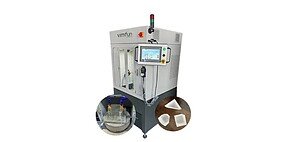
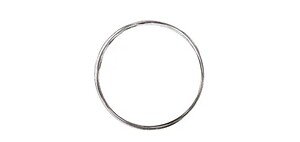
VIMFUN ran this cut on the SH60-R endless diamond wire saw, equipped with a 0.50 mm electroplated diamond wire loop.
Wire selection. The 0.50 mm wire diameter was chosen to keep the kerf narrow — approximately 0.55 mm finished kerf width — minimizing material loss on a large-value quartz ring while keeping cutting force at the wire-material interface low. For brittle materials at large scale, lower force per unit area at the cut zone is what keeps stress concentrations below the threshold where chipping initiates. The endless loop format (see electroplated diamond wire loop) presents consistent diamond abrasive surface throughout the cut — no degradation gradient from start to finish, which matters on a 110-minute cut where wire condition affects the last pass as much as the first.
Fixturing. Before cutting, the ring was mounted using soft tooling — fixtures that distribute clamping force uniformly across the ring face without concentrating load at any single contact point. On fused quartz, localized clamping stress at the edge can initiate fracture before the wire starts. Soft-contact fixturing eliminates that risk. Setup included alignment verification, wire tension check, and cutting path confirmation before the machine started.
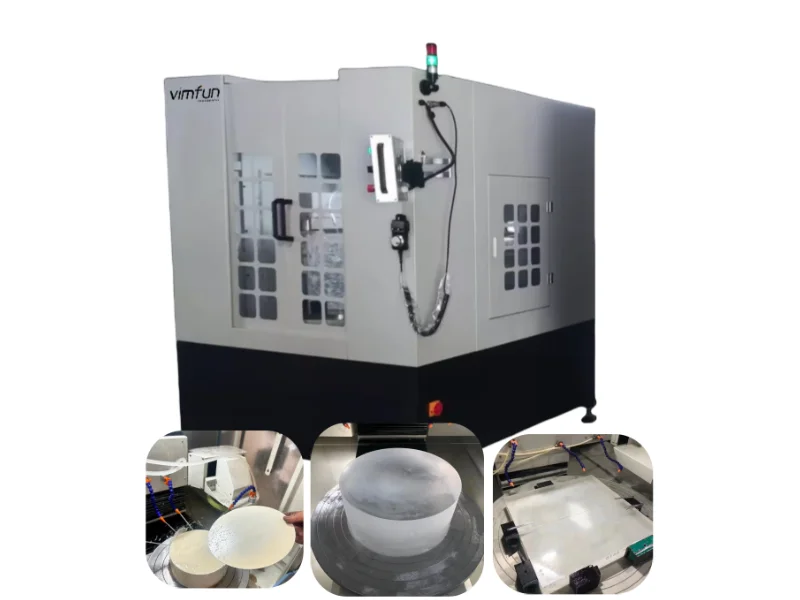
SH60-R
- Max Workpiece Dia (mm): 600
- Max Workpiece Height (mm):400
- Rotate Cutting Technology
- Horizontal Cutting Technology
- Siemens System
Process Parameters
| Parameter | Value |
|---|---|
| Workpiece | Fused quartz glass ring |
| Outer diameter | 420 mm |
| Inner diameter | 300 mm |
| Thickness | 18 mm |
| Machine | VIMFUN SH60-R Endless Diamond Wire Saw |
| Diamond wire | Ø 0.50 mm electroplated diamond wire |
| Wire type | Endless (closed-loop) diamond wire loop |
| Wire speed | 35 m/s |
| Wire tension | 150 N |
| Feed rate | 3 mm/min |
| Coolant | Filtered deionized water, continuous recirculation |
| Total cutting time | ~110 minutes |
| Kerf width | ~0.55 mm |
Wire speed, tension, and feed rate interact directly with surface quality and edge condition on brittle materials. See wire speed, tension, and feed rate for how these parameters are balanced, and wire tension calibration for the calibration protocol that keeps tension stable across the full cut duration.
Feed rate selection. At 3 mm/min, the wire has sufficient time to fracture material cleanly in the kerf rather than tear through it. On fused quartz, clean fracture at the cut interface is what produces a smooth, low-damage surface. Higher feed rates are possible — but on a large brittle ring where the cost of a failed cut is high, the conservative feed rate trades cycle time for a more predictable result.
Coolant system. Filtered deionized water ran continuously throughout the 110-minute cut. DI water serves two functions here: it removes heat and glass particles from the cut zone in real time, and it keeps the workpiece and machine free from organic contamination — compatible with the semiconductor application requirement. The cooling and lubrication setup used filtration to keep particle concentration in the coolant low, preventing re-entry of glass debris into the active kerf.
The Result: Ring Intact, No Visible Cracks
The 420 mm fused quartz ring was cut in approximately 110 minutes. Inspection results:
| Measurement | Result |
|---|---|
| Total cutting time | ~110 min |
| Finished kerf width | ~0.55 mm |
| Edge chipping | < 0.2 mm at entry and exit zones |
| Visible cracks | None |
| Ring structural integrity | Intact — no fracture during cutting or handling |
| Surface condition | Ready for downstream grinding and polishing |
The cut surface required no remediation before the next process step. Dimensional accuracy was confirmed within the customer’s specification for subsequent machining.
For a fused quartz ring going into semiconductor equipment, those results mean: no crack propagation risk during thermal cycling, no chipping particles entering the process environment, and a clean starting surface for grinding and polishing. The 0.55 mm kerf is narrow enough that material loss is not a constraint for this geometry. The downstream operations start from a stable, predictable baseline.
Why Low Feed Rate and Narrow Kerf Work on Large Brittle Quartz
It comes down to stress at the cut interface. Chipping on fused quartz initiates when localized stress at the kerf edge exceeds the material’s fracture toughness. The goal of the process setup is to keep that stress below threshold across the full cut — including the entry and exit transitions where geometry is asymmetric and risk is highest.
Two parameters carry most of that responsibility:
Narrow kerf, lower contact force. The 0.50 mm wire limits the contact area between the diamond abrasive and the quartz. A narrower contact means less force distributed across the kerf face. Less force per unit area means stress at the kerf edges stays below the point where it initiates chipping or subsurface damage. This is the tradeoff that makes 0.50 mm wire the right choice for this application — not throughput, but force management at scale.
Controlled feed rate. Slow feed gives the wire time to fracture the quartz cleanly in the kerf zone rather than shear through it. The difference between clean fracture and shear tear at the cut front is what separates a 0.55 mm smooth kerf from one with chipping and a rougher surface. At 3 mm/min, the process stays on the clean-fracture side of that boundary.
Continuous DI water cooling handles the thermal side: it removes heat from the cut zone continuously, preventing the gradient buildup that would generate tensile stress in the bulk material over the course of a 110-minute cut. Glass particles cleared from the kerf in real time also prevent secondary abrasion from debris re-entering the active cut zone. For the full coverage of how coolant and lubrication interact with wire performance on quartz and optical glass, see cooling and lubrication.
This process logic extends to other large-format brittle materials — optical glass, advanced ceramics, sapphire — wherever the combination of scale and brittleness demands force control rather than throughput optimization. Parameter envelopes shift material by material. The underlying mechanics do not. For a broader reference on quartz and silica glass behavior under mechanical loading, see AZoM on fused quartz applications.
For background on the diamond wire saw platform behind this cut, see wire saw cutting overview.

Industries and Applications
Large quartz glass ring cutting serves manufacturers across several sectors:
- Semiconductor fabrication equipment — chamber rings, process tube components, isolation rings, and quartz fixtures for wafer handling and thermal processing
- Optical systems — large aperture optical element blanks, ring mounts, and precision optical glass components requiring low subsurface damage
- Photonics and laser systems — beam path components and optical ring mounts where surface integrity affects transmission performance
- High-purity industrial systems — flow control and process isolation components where material purity and clean cutting are both required
For related cases in hard brittle materials at large scale, see our large alumina ceramic ring cutting case study covering a 300 mm Al₂O₃ ring, and our silicon carbide ring cutting case study for a small SiC seal ring with tight edge geometry requirements.
Can We Cut This for Your Application?
If your application involves fused quartz, optical glass, or advanced ceramics in ring, disc, or plate form — especially at diameters above 100 mm — the same process approach applies. Wire diameter, tension, and feed rate adjust for your specific geometry and tolerance specification.
To get a feasibility assessment, send us:
- Material and grade — fused quartz, crystalline quartz, optical glass grade, or other specification
- Workpiece geometry — OD, ID, and thickness, with a drawing if available
- Edge and surface requirements — chipping tolerance, Ra target, or downstream process standard
- Coolant constraints — oil-based acceptable, or water-based only
- Production intent — sample cut, small batch, or volume production
We return a process assessment within 3 business days. For geometries within our cutting envelope, we can run a sample piece before production commitment.
VIMFUN’s endless diamond wire loop platform handles quartz glass, optical glass, advanced ceramics, sapphire, silicon, graphite, semiconductor materials, and rare earth magnets. Large-format and precision small-part applications both fall within the equipment range.