
Germanium Lens Manufacturing — One-Stop from Cutting to Coating
Optical-grade Ge runs $1,800–$2,400 per kilogram. When one boule is worth more than the saw cutting it, kerf width stops being an engineering detail and becomes the BOM line that decides profitability. We deliver the full chain — wire saw, centering, spherical grinding, polishing, AR coating — under one technical owner.
Germanium looks easy on paper. In practice, three things make it punishing.
It's expensive — and getting more so
Defense and thermal imaging demand pulled Ge prices up sharply during 2023–2024. Every millimeter of kerf is a real dollar figure. A 5 mm-wide cut through a $2,000/kg boule wastes a measurable percentage of revenue per slice.
It chips along (111) planes
Single-crystal Ge cleaves cleanly along its (111) faces. A core drill grinding through the boule throws off micro-chips on the exit face every time. Exit-side chip zones of 0.3 to 0.8 mm on cored pucks are common — all material the lens grinder removes before shaping.
Damage hides until polish
Ge absorbs in the visible. Subsurface damage from a poor cut doesn't show up until the lens reaches the polishing stage, by which point you've put grinding hours into a part that's going to scatter. Reference: Crystran Ge datasheet.
From raw Ge ingot to coated lens, under one engineering owner.
Three things differentiate this chain from buying each machine separately: the same engineering team owns the tolerance budget end-to-end; fixturing carries through stations; one quote, one delivery window. For shops setting up a new IR optics line, this collapses a 6-vendor RFQ into a single technical conversation.

What happens at each station, with the parameters that actually matter.
Ingot to Rod — squaring and core replacement
Most Ge boules arrive as 100–300 mm diameter cylinders, between 100 and 400 mm long. The first job is either to square the boule for rectangular optics or to extract smaller-diameter rods from a large boule. This is where the endless wire saw replaces the coring drill.
Instead of grinding away a 5–10 mm annular ring around the core, our SGI 40 contour wire saw traces the perimeter of each rod with a 0.42–0.5 mm loop. Kerf loss per cut runs around 0.5 mm. On a 200 mm boule, that's the difference between getting four 80 mm cores out of one boule or five.
Contour cutting speed runs at 4–8 mm/min along the perimeter, so extracting a Φ34 mm rod (perimeter ≈ 107 mm) takes roughly 18 minutes per rod at the typical 6 mm/min setpoint.
| Wire diameter | 0.42 – 0.5 mm |
| Wire tension | 110 – 140 N |
| Wire speed | 40 – 60 m/s |
| Contour feed speed | 4 – 8 mm/min |
| Cooling | White mineral oil |
| Typical kerf | 0.5 – 0.6 mm |

Rod to Puck — cross-section slicing
Once we have cylindrical rods, the next step is slicing them into pucks — typically 5 to 15 mm thick depending on whether the final lens is a meniscus, plano-convex, or full aspheric blank. The SGI 40 used in Step 1 switches into slicing mode; shops with high-volume straight-cut needs may add the SGSM40 as a dedicated slicer.
In straight-slice mode the wire travels through the rod diameter rather than tracing a perimeter, so feed speed runs faster — 10 to 20 mm/min on Ge. A single straight cut through a Φ180 mm rod takes about 12 minutes at the upper end of that range.
Sliced pucks come off the wire saw with surface roughness in the Ra 0.6–1.2 µm range — fine enough that the first grinding step removes very little stock. TTV on production runs sits in the 8–15 µm range across a 50 mm puck, comparable to good ID-saw output at maybe one-third the kerf loss.
| Wire diameter | 0.35 – 0.42 mm |
| Wire tension | 100 – 130 N |
| Wire speed | 30 – 50 m/s |
| Slice feed speed | 10 – 20 mm/min |
| Cooling | White mineral oil |
| Surface roughness Ra | 0.6 – 1.2 μm |
| TTV (typical) | 8 – 15 μm |

Edge Grinding and Centering
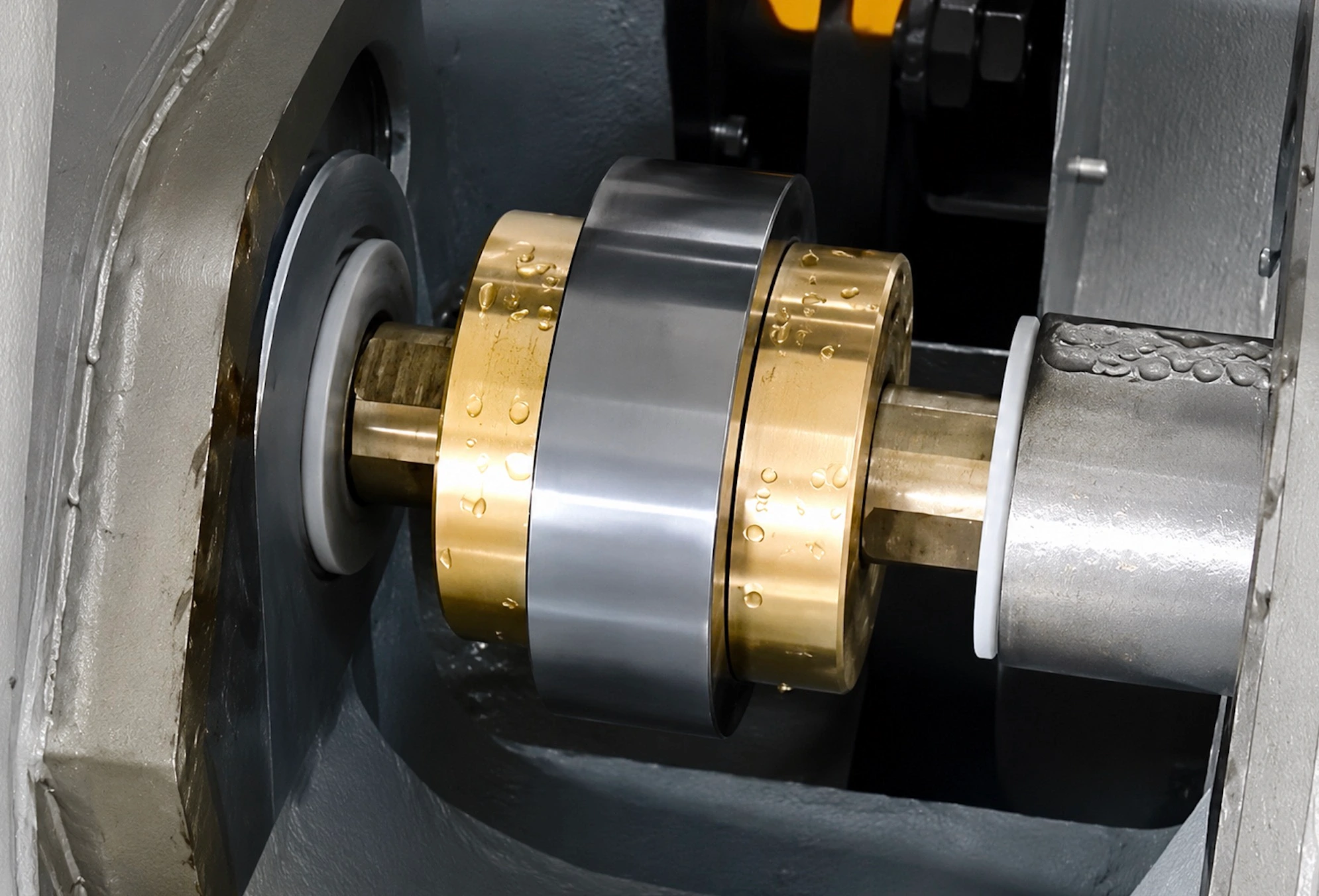
After slicing, the pucks move to our sister company's centering facility for edge processing. This step grinds the puck OD round and chamfers the corners — and it happens before spherical surface generation, not after. The reasoning is mechanical: a centered cylindrical OD gives the spherical grinder a predictable rotational reference, which means the surface comes off the next machine already concentric with the lens edge.
Cycle time runs 1 to 3 minutes per part depending on diameter, chamfer spec, and stock removal. For Ge lenses used in athermalized thermal imaging assemblies, decentering tolerance is often specified to 30 arc seconds or tighter — anything sloppier and the cold image shift gets visible to the user.
Spherical Surface Grinding
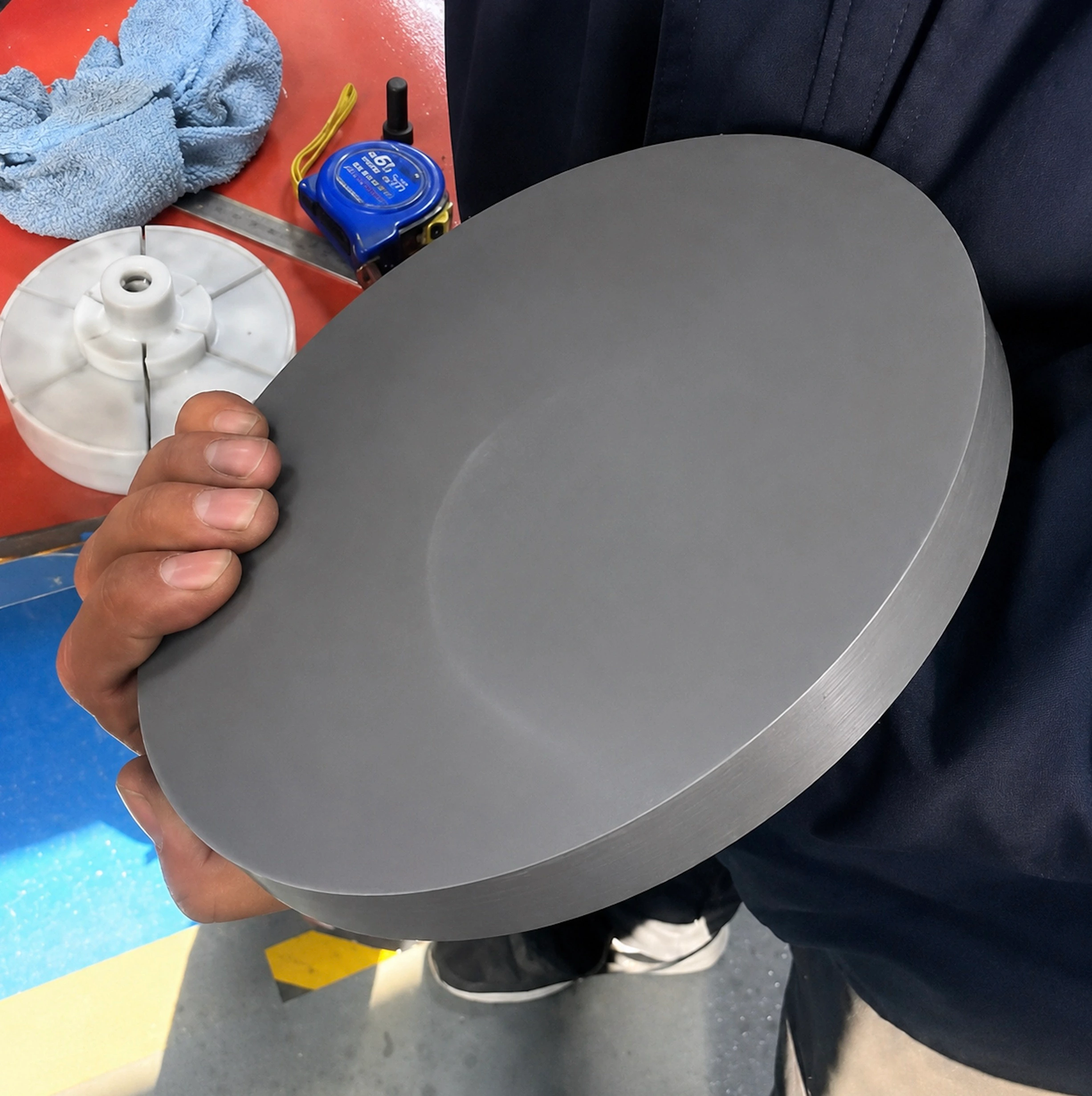
With the puck OD centered and chamfered, the next step generates the spherical (or aspheric blank) surface. Both grinder models handle convex (CX) and concave (CC) profiles as well as plano surfaces without changing the spindle setup — useful for double-sided lenses and meniscus geometries.
The grinder uses bonded diamond pellet tools running against a rotating puck on a precision spindle. Typical stock removal is 0.2 to 0.5 mm per side from the as-cut surface. Because the wire-sawn pucks come in with low TTV and minimal subsurface damage, cycle time per surface drops to around 5 minutes on standard spherical generation.
For aspheric germanium lenses (common in compact thermal imaging modules), the grinder runs CNC-controlled trajectory profiling. Sag tolerance on the as-ground surface is typically ±5 µm, leaving the polisher to handle the final figure.
Polishing and AR Coating
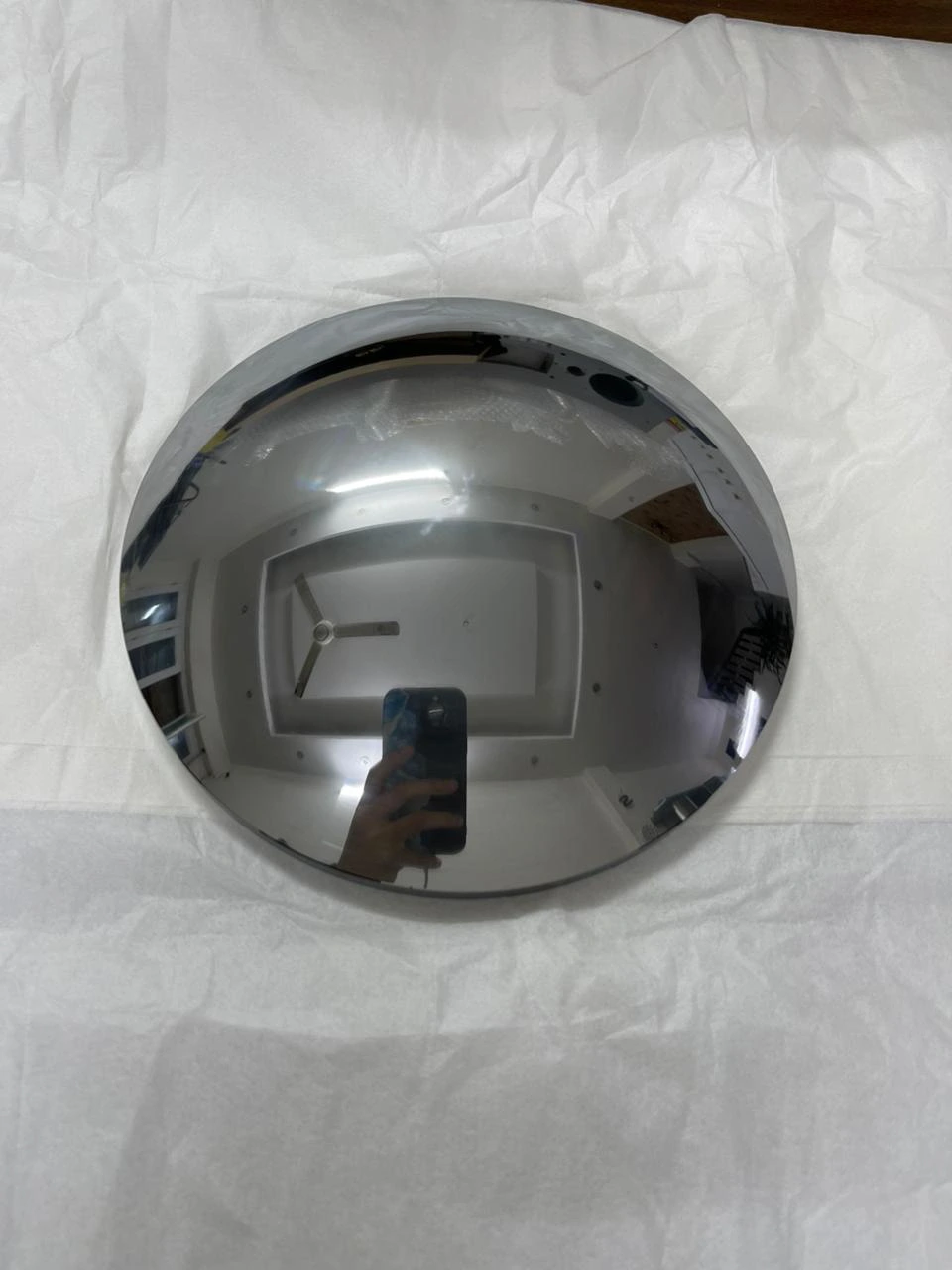
Most Ge lenses in production end up with a broadband anti-reflective coating. Bare germanium reflects about 36% per surface at IR wavelengths because of its high refractive index (n ≈ 4.0 at 10 µm). Without AR coating, a single-element Ge lens loses more than half its incident energy before light reaches the detector.
Cycle time runs around 3 minutes per surface on standard spherical work; aspheric figures take longer depending on tolerance. Final surface roughness reaches Ra < 5 nm for high-end thermal imaging.
DLC vs BBAR coatings. Standard BBAR multilayers scratch easily on Ge — soft material, hard reality. DLC (diamond-like carbon) trades a small amount of transmission (maybe 2–3% per surface) for much better abrasion resistance. For lenses that face outward in a vehicle or handheld thermal camera, DLC is usually non-negotiable.
How long does a Ge lens actually take?
For a typical mid-size thermal imaging lens — Φ50 mm biconvex Ge element — the integrated line clocks roughly as follows. Slack included for material handling between stations.
| Stage | Machine | Cycle Time |
|---|---|---|
| Contour cut, extract Φ50 rod from larger ingot | SGI 40 | ~26 min |
| Slice rod into one puck (single straight cut) | SGI 40 | ~5 min |
| Edge grind + chamfer | C-120L | 1–3 min |
| Spherical surface generation (side 1) | G-100 | ~5 min |
| Spherical surface generation (side 2) | G-100 | ~5 min |
| Re-chamfer (if needed) | C-120L | ~1 min |
| Polish (side 1) | Aspheric Polisher | ~3 min |
| Polish (side 2) | Aspheric Polisher | ~3 min |
| AR coat (DLC or BBAR) | Coating chamber | batch (50+/run) |
Total machining time per Φ50 mm Ge lens across all chip-removal stations, excluding coating. Coating runs as batched loads; per-lens contribution drops to minutes when the chamber is full.
Aspheric figures take longer than spherical by 2 to 3×, depending on departure from best-fit sphere and final figure tolerance. We size grinder and polisher capacity to your part mix during quoting.
The honest comparison. Wire doesn't win on everything.
For shops weighing whether to switch from traditional methods, the engineering tradeoffs that matter most.
| Factor | Coring Drill + ID Saw | Endless Wire Saw (Vimfun) |
|---|---|---|
| Kerf loss per cut | 5 – 10 mm drill / 0.3 – 0.5 mm ID | 0.4 – 0.6 mm |
| Edge chipping (exit face) | 0.3 – 0.8 mm typical | < 0.1 mm typical |
| Throughput per hour | Higher for small parts | Lower for tiny parts, better on large ingots |
| Tooling cost per cut | Lower (resin-bonded blade) | Higher (diamond wire loop) |
| Max practical workpiece | ~150 mm Ge | 300 mm+ Ge (extend the loop) |
| Setup time | Fast | Moderate (wire loading) |
| Subsurface damage | Moderate to high | Low |
| Material saved per 200 mm boule | Baseline | $200 – $600 |
Three deployments — three continents, three end markets.
They span very different industries, but share the same engineering pain: Ge material is expensive, tolerance budgets are tight, and managing five separate equipment vendors creates more problems than it solves.
Sunny Optical
Sunny Optical Technology Group is one of the largest optical component manufacturers globally — smartphone lenses, automotive ADAS, thermal imaging optics.
Sunny operates more than 30 Vimfun diamond wire saw machines, with a substantial fleet dedicated specifically to germanium lens production. At that volume, two metrics dominated over raw cutting speed: wire consumable cost per lens, and station-to-station handling consistency.
Thermal Imaging OEM
A major Turkish thermal imaging manufacturer purchased a complete integrated Ge lens line: SGI 40 wire saws, C-185L centering, G-250 spherical grinding, and the Aspheric Polishing Machine — configured, commissioned, qualified under one technical scope.
The decision driver wasn't headline price. It was supply chain shortening (direct China–Turkey vs. multi-vendor European sourcing) combined with material yield gain on imported Ge stock.
Precision Optics Group
A Netherlands-based optical systems company runs the integrated Vimfun + sister-company solution for industrial and scientific IR optics, supplying European instrument and sensor makers.
Cited reasons for the integrated chain over piecewise sourcing: lower kerf loss on imported Ge raw material, reduced fixturing handoffs between cutting and grinding, and single-vendor accountability for tolerance flow-through.
What engineers actually ask before specifying this line.
Our standard SGI 40 takes ingots up to Φ350 mm × 400 mm long. For larger boules we build custom frames — the wire saw scales by lengthening the loop, not by replacing the machine. Largest custom build to date: 1200 mm working envelope.
For most production lines we configure the following:
| Stage | Machine | Working Range |
|---|---|---|
| Ingot contour + rod slicing | SGI 40 | Ingot Φ ≤ 185 × 400 mm |
| Edge grind + chamfer (small) | C-120L | Φ 1.8 – 120 mm |
| Edge grind + chamfer (large) | C-185L | Φ 50 – 185 mm |
| Spherical grinding (small) | G-100 | Φ 10 – 100 mm |
| Spherical grinding (large) | G-250 | Φ 80 – 250 mm |
| Polishing | Aspheric Polisher | Φ ≤ 300 mm |
| AR coating | DLC or BBAR chamber | Batch |
Small thermal imaging shops typically need just SGI 40 + C-120L + G-100 + polisher. Large defense optics shops add C-185L and G-250.
Yes. Poly-Ge actually cuts a touch easier than single crystal because there's no preferred cleavage plane. Same parameters work.
Roughly comparable to optical glass — 7 to 10 days at 8 hours/day, depending on tension and feed. Ge is softer than sapphire or quartz, so wire wear is moderate.
Yes, all our standard diamond wire loops are made in-house. Lead time on loops is about 7 days. We use thread-coated (continuous) plating for germanium — gives the best surface finish on brittle semiconductors.
End-to-end on a finished Ge lens, our germanium lens manufacturing chain holds: diameter ±0.02 mm, center thickness ±0.025 mm, decentering 30 arc seconds, surface figure 1λ at 633 nm reference. Tighter is possible on specific specs — talk to engineering. We document deliverables in ISO 10110 format for design data exchange.
Same wire saw platform, different problems per market.
The integration angle matters more in some sectors than others — for thermal imaging at consumer volume, batch coating economics dominate; for defense optics, traceability across stations matters most.
Thermal Imaging Modules
Automotive ADAS, building inspection, electrical thermography. Volume-driven, coating cost critical.
Defense & Security Optics
Uncooled microbolometer modules, weapon sights, surveillance. Traceability and DLC durability matter.
Industrial Sensors
Gas analyzers (Ge windows for FTIR), process monitoring. Lower volumes, higher tolerance asks.
Medical IR Diagnostics
Handheld thermal imagers for vascular and inflammatory imaging. Mid-volume, ergonomic format.
Research Labs
IR spectroscopy, custom optical assemblies. Single-piece accuracy over throughput.
Custom / Other
Beam splitters, beam expanders, custom-format windows. Send drawings, we'll quote.
Send a drawing. We send back numbers.
If you're sizing up a germanium lens manufacturing line — new build, retrofit, or capacity expansion — these are the questions we'll work through together:
- Boule diameter and length range — drives wire saw frame size
- Finished lens diameter, thickness, curvature spec — drives grinder & centering machine selection
- Surface roughness and coating requirements — drives polishing and coating capacity
- Volume per month — drives whether you need one cell or parallel lines