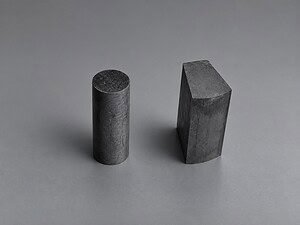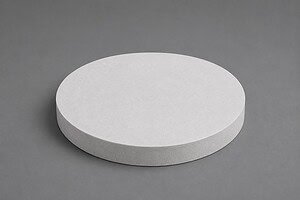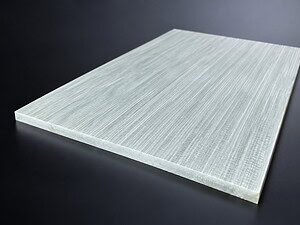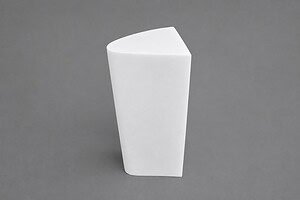
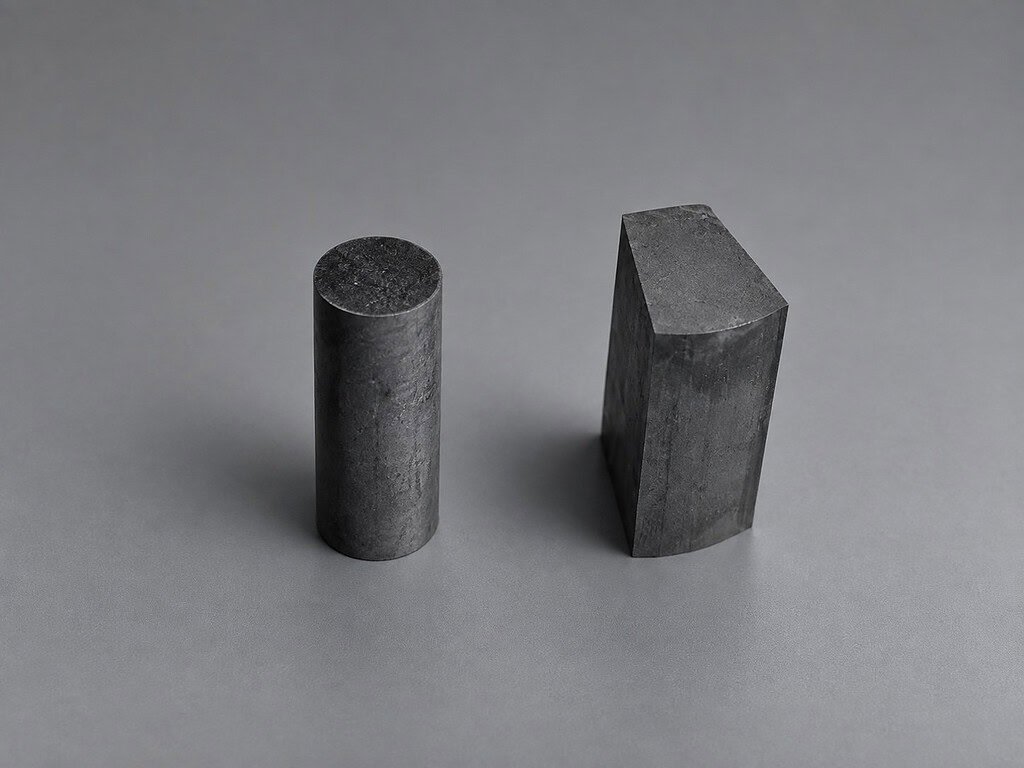
A European motor manufacturer sent us two NdFeB blanks and a DXF file. The ask: cut custom contour profiles that match the drawing exactly, with no chipping and a surface finish that goes directly to grinding without rework. This is what happened.
The Application — Custom NdFeB Profiles for Motor Design
High-performance electric motors don’t use rectangular magnets. They use arc segments, crescent profiles, and multi-faceted polygons — geometries that follow the rotor curvature to maximize flux density and minimize cogging torque. The closer the magnet shape matches the air gap geometry, the better the motor performs.
Standard flat cuts don’t get you there.
If you’re sourcing NdFeB blanks and sending them to a generic cutting service, you’ll typically get rectangular slices. That’s fine for simple applications. For traction motors, servo drives, or high-efficiency generators where each magnet geometry is tuned to a specific rotor design, you need a machine that can actually follow a drawing — not just cut in straight lines.
The customer in this case had exactly that requirement. The blanks were already sintered NdFeB, and the target profiles were non-rectangular contours that couldn’t be approximated by multiple straight cuts without introducing geometric error at the transitions. They needed continuous-path contour cutting.
For context on how NdFeB properties compare to other magnetic materials in cutting, see our overview of ferrite and SmCo magnet cutting.
The Challenge — Cutting NdFeB to a Drawing
NdFeB is hard and brittle. Sintered grades typically measure HRC 55–60, comparable to hardened tool steel in terms of hardness, but with almost none of the toughness. The material fractures rather than deforms. That combination — high hardness, low fracture toughness — is what makes it difficult to cut, and what makes contour cutting harder than flat cutting.
A straight cut through NdFeB is already demanding. The wire has to maintain consistent tension and speed to avoid wire bow and surface chatter. Now imagine executing a curved path through that same material. As the cutting direction changes, the wire engagement angle shifts. If the motion control system isn’t compensating precisely, you get variation in wire-to-material contact geometry, which shows up as surface waviness or, worse, micro-cracking along the cut edge.
The dimensional tolerance requirement was ±0.05 mm — typical for motor magnet applications where air gap consistency directly affects motor efficiency. That’s a tight window for any hard material, and for a contoured path through NdFeB specifically, it rules out any approach that relies on manual setup or approximated toolpaths.
There’s also the material cost to consider. Sintered NdFeB blanks — especially in larger sizes or high-grade alloys — are not cheap. A scrap rate above a few percent is commercially unacceptable. That means the process has to be right before you put the first blank on the machine, not after you’ve cut your way through three rejects figuring out the parameters.
Tight tolerances, hard material, expensive blanks. Contour cutting under those conditions requires a machine designed for it.
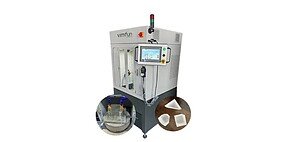
NdFeB Contour Cutting on the VIMFUN SVI Saw
The VIMFUN SVI series is a vertical-orientation diamond wire saw with a CNC motion control system that supports continuous-path contouring. The practical workflow for this application is straightforward: import the customer’s DXF file into the machine’s control software, the system generates the cutting path, and the saw executes it.
That sounds simple, and in operation it mostly is. The engineering behind it is less simple.
The SVI’s contour cutting function works by driving the X and Y axes simultaneously under coordinated CNC control, so the wire follows the DXF geometry rather than a single linear axis. The wire speed, tension, and feed rate are maintained throughout the contour, including during direction changes. This is the part that matters for surface quality: if tension drops during a curve, the wire deflects and the cut deviates from the intended path.
For the NdFeB blanks in this job, the process parameters were:
| Parameter | Value | Notes |
|---|---|---|
| Wire speed | 45 m/s | Consistent through full contour path |
| Wire diameter | 0.35 mm | Balances kerf loss and wire stiffness on contoured paths |
| Wire tension | 100 N | Maintained via closed-loop servo control |
| Coolant | Water-based cutting fluid | Continuous flood |
Actual parameters depend on workpiece grade, geometry, and blank dimensions — trial cuts are recommended before production runs.
Wire selection for this job used diamond wire loops at 0.35 mm diameter. On contoured paths, wire stiffness matters more than on straight cuts — the wire must resist lateral deflection as the cutting direction changes through the curve, which is why tension control is especially critical here.
One honest caveat: contour cutting is slower than flat cutting on the same material. A straight-line cut through a 30 mm NdFeB blank might take 10–20 minutes depending on grade. A complex contour of the same depth takes longer, because the coordinated axis motion places additional constraints on the feed rate ceiling. If your production schedule assumes flat-cut cycle times, the first contour job will come in slower than expected. Factor that in.
The other practical requirement: you need a DXF file. If the magnet geometry exists only as a physical sample or a hand sketch, someone has to convert it to a proper drawing before the machine can use it. That’s not a machine limitation — it’s the nature of drawing-to-part manufacturing.
Results — NdFeB Contour Cutting Geometry and Surface Quality
The cut profiles matched the DXF geometry within ±0.05 mm across the full contour length. No dimensional drift, no accumulation of error through the curved sections. The SVI’s motion control held position throughout, including at the tighter-radius sections of the contour where feed rate is naturally lower.
Surface roughness on the cut faces measured Ra 0.4–0.8 μm. That range is typical for NdFeB cut with a fine diamond wire under optimized conditions, and it’s directly grindable — the customer’s downstream grinding operation didn’t require any pre-treatment or intermediate lapping step. According to Arnold Magnetics’ SmCo vs. NdFeB material comparison, NdFeB’s magnetic performance is sensitive to temperature — which is why diamond wire cutting’s absence of heat-affected zone matters. No recast layer, no localized demagnetization at the cut face.
No chipping at the entry or exit edges. No subsurface cracking visible under inspection. The brittle fracture mode that makes NdFeB difficult to cut with abrasive wheels or EDM didn’t manifest here, because diamond wire cutting keeps the cutting forces low and localized. Vacuumschmelze’s VACODYM NdFeB product range documents the material’s sensitivity to mechanical stress — sintered NdFeB has a fracture toughness around 2–3 MPa·m^0.5, comparable to glass, which is why process control during cutting matters so much.
For anyone wondering about surface quality optimization in more detail — particularly how wire parameters interact with surface finish on hard brittle materials — see our dedicated page on surface quality optimization.
The blanks produced two finished contour parts each, with no rejects. Given the blank cost, that outcome was the actual measure of success. Contour cutting on these parts took roughly 30–40% longer per part than an equivalent flat cut would have — that’s the honest trade-off for the geometry flexibility. For a customer who needs a custom profile that can’t be approximated by straight cuts, that cycle time premium is the right call. For simple rectangular cuts, a flat-cut setup is faster and there’s no reason to use contour mode.
Send Us Your Drawing
If you have NdFeB magnet profiles that require contour cutting — arc segments, crescent shapes, polygonal geometries, or any non-rectangular form — send us the DXF file and we’ll review the geometry, confirm whether it’s within our SVI’s cutting envelope, and provide a cutting plan with estimated parameters.
For complex or unusual profiles, we can run a trial cut before committing to a full production run.
Contact: daria@endlesswiresaw.com
You can also watch the NdFeB contour cutting process in this video demonstration:

For a broader view of hard and exotic materials we cut regularly, see the cutting materials guide.