In modern industrial processing, cutting ultra-hard, brittle, or expensive materials demands exceptional accuracy, minimal material waste, and flawless surface integrity. While conventional tooling—such as circular saws, bandsaws, and abrasive slurry systems—often causes severe kerf loss, thermal damage, and edge chipping, precision diamond wire saws have emerged as the definitive solution for high-value material slicing.
However, when evaluating diamond wire technology, it is essential to distinguish between two completely different industrial categories:
- Heavy Construction and Quarry Wire Saws: Heavy-duty machines that use thick diamond bead cables (typically 8–11 mm in diameter) at lower linear speeds to demolish reinforced concrete structures, cut bridge piers, or extract massive granite blocks in outdoor quarries.
- Precision Endless Diamond Wire Saws (Industrial Manufacturing): High-precision workshop and laboratory machines that utilize ultra-fine high-tensile core wires embedded with micro-diamond abrasives, running continuously in high-speed closed loops (typically 30–60 m/s or higher [待确认]). These systems are specifically engineered for clean, micro-crack-free slicing of advanced industrial materials such as semiconductor silicon, optical glass, quartz, sapphire, technical ceramics, and graphite.

The Core Advantages of Using a Precision Diamond Wire Saw
For manufacturers and research facilities processing delicate or high-purity substrates, endless diamond wire saws deliver fundamental technical advantages over conventional cutting methods:
1. Ultra-Narrow Kerf Loss and Maximum Material Yield
Conventional circular saw blades, inner-diameter (ID) blades, and bandsaws require substantial blade thickness to maintain structural rigidity, turning wide sections of valuable stock into unrecoverable kerf dust. In contrast, diamond wire saws utilize thin high-tensile core wires. By significantly minimizing kerf loss, manufacturers maximize the number of usable wafers, coupons, or blanks extracted from expensive raw ingots—such as monocrystalline silicon, synthetic sapphire, optical quartz, and high-purity ceramics.
2. Minimal Cutting Forces and Shallow Sub-Surface Damage (SSD)
Brittle materials like optical glass, fused silica, and technical ceramics are prone to micro-cracking and chipping when subjected to high shear forces from rotating milling cutters or abrasive blades. A high-speed endless diamond wire saw removes material through continuous, gentle micro-grinding. Because cutting forces are extremely low, edge chipping is practically eliminated, and sub-surface damage (SSD) depth is kept exceptionally shallow. This dramatically shortens downstream grinding, lapping, and chemical-mechanical polishing (CMP) cycles.
3. Cold Mechanical Processing with Zero Heat-Affected Zone (HAZ)
Thermal cutting technologies (such as lasers or Electrical Discharge Machining) induce localized thermal stress, recast layers, or micro-fractures, which can degrade crystalline lattices and ruin sensitive optical substrates. Diamond wire sawing is a cold mechanical process. Accompanied by continuous, pressurized liquid coolant flushing, frictional heat is dissipated immediately. The workpiece undergoes zero thermal shock, zero micro-structural phase changes, and zero surface tempering.
4. Exceptional Surface Finish and End-Face Flatness
Because endless diamond wire loops operate in a continuous unidirectional loop without periodic direction reversals, wire vibration and harmonic striations are avoided. The cut surface exhibits high geometric Flatness, excellent Perpendicularity, and uniform surface roughness, providing dependable reference planes for subsequent metrology or assembly fixturing.
5. Clean, Environmentally Compliant Operation
Traditional multi-wire slurry sawing relies on loose silicon carbide (SiC) or diamond slurries mixed with oil or glycol, requiring complex recycling infrastructure and creating hazardous sludge. Fixed diamond wire saws eliminate loose slurry entirely, utilizing clean water-based coolant and closed-loop filtration systems to streamline post-cut washing and simplify environmental compliance.

Primary Materials Processed by Industrial Diamond Wire Saws
Precision diamond wire saws are engineered to slice a comprehensive spectrum of hard, brittle, non-metallic, and advanced composite materials:
- Semiconductor & Photovoltaic Materials: Monocrystalline (Cz/FZ) and polycrystalline silicon ingots, gallium arsenide (GaAs), indium phosphide (InP), and germanium blocks.
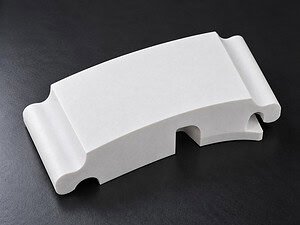
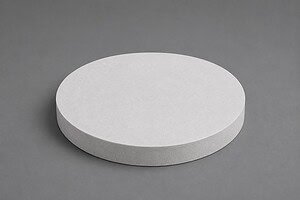
- Advanced Technical Ceramics: Sintered and pre-sintered alumina, zirconia, silicon carbide (SiC), boron carbide, and piezoelectric ceramics.
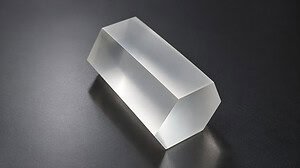
- Optical Glasses & Fused Quartz: Borosilicate glass, fused silica quartz tubes, optical prisms, laser crystals (Nd:YAG), and synthetic sapphire boules.
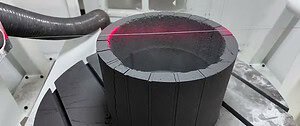
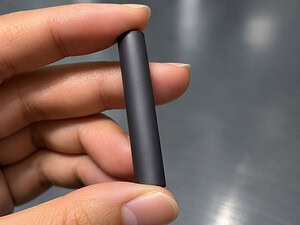
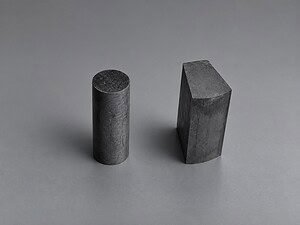
- Graphite & Carbon Composites: High-density isostatic graphite EDM electrodes, carbon-carbon composite blocks, and semiconductor hot-zone components cut with sharp, chip-free edges.
Comparison: Precision Endless Wire Saws vs. Conventional Cutting Methods
| Feature | Precision Endless Diamond Wire Saw | Circular Saw / Blade | Laser / Thermal Slicing |
|---|---|---|---|
| Kerf Width | Ultra-thin core wire; minimal material loss | Thick rigid blade; substantial kerf loss | Narrow kerf, but vaporizes material with high energy |
| Edge Chipping | Practically zero; gentle micro-grinding | High risk of chipping on brittle corners | Thermal stress micro-cracks on brittle substrates |
| Thermal Effect | Cold mechanical cut; zero Heat-Affected Zone (HAZ) | Friction-induced localized heating | Significant recast layer and thermal shock |
| Material Compatibility | Hard, brittle, non-conductive, and crystal materials | Limited on ultra-hard ceramics and sapphire | Limited on transparent glasses; reflective metals |
| Surface Flatness | High flatness and perpendicularity via continuous loop | Blade deflection causes dished cut profiles | Thermal taper across thick sections |
Selecting the Right Diamond Wire Saw Solution
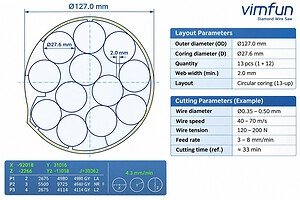
When selecting a diamond wire cutting system, evaluate key process factors including workpiece dimensions, required cutting speeds, surface roughness targets, and automated downfeed controls. Vimfun (manufactured by Zhengzhou Shine Smart Equipment Ltd.) specializes in precision endless diamond wire cutting machinery, providing solutions ranging from compact laboratory desktop saws to large-capacity industrial sectioning and 2D contouring systems.
To evaluate our complete line of industrial equipment, explore our dedicated Diamond Wire Saws category page or contact our application engineering team for customized trial cutting and process validation.
Frequently Asked Questions (FAQ)
- How does an industrial diamond wire saw differ from a construction wire saw?
Construction wire saws use thick diamond-bead ropes at lower linear speeds to demolish concrete, bridge pillars, and quarry stone blocks. In contrast, industrial precision diamond wire saws use ultra-fine endless diamond wire loops running at high speeds (30–60 m/s [待确认]) to achieve chip-free, micron-level precision cutting on semiconductors, optics, ceramics, and graphite. - Why does diamond wire sawing deliver higher material yield?
Because the wire diameter is significantly thinner than conventional circular blades or bandsaws, kerf loss (the volume of material turned into dust during cutting) is dramatically reduced, resulting in more usable wafers or blanks per raw block. - Does diamond wire cutting cause heat damage or thermal cracking?
No. Diamond wire cutting is a purely mechanical micro-grinding process. When operated with continuous liquid coolant flushing, frictional heat is removed immediately, preventing heat-affected zones, thermal micro-cracking, or lattice disruption in delicate crystals. - Can diamond wire saws cut both conductive and non-conductive materials?
Yes. Unlike Electrical Discharge Machining (Wire EDM) which requires electrical conductivity, diamond wire saws cut mechanically and are fully compatible with electrically insulating materials (such as optical glass, quartz, and technical ceramics) as well as conductive materials like graphite and silicon.