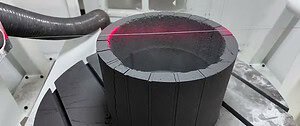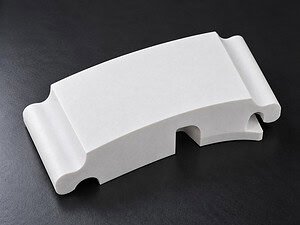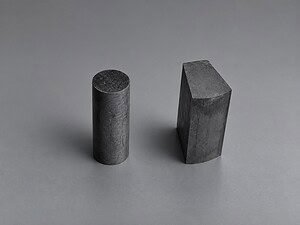
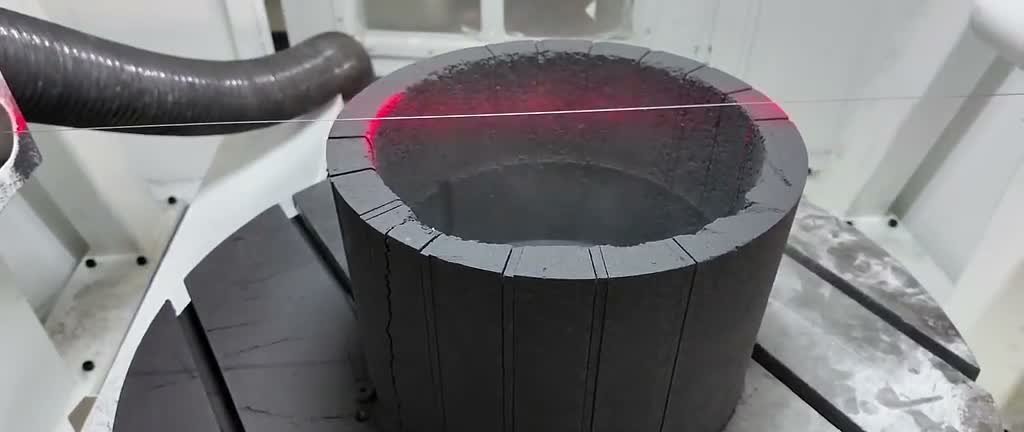
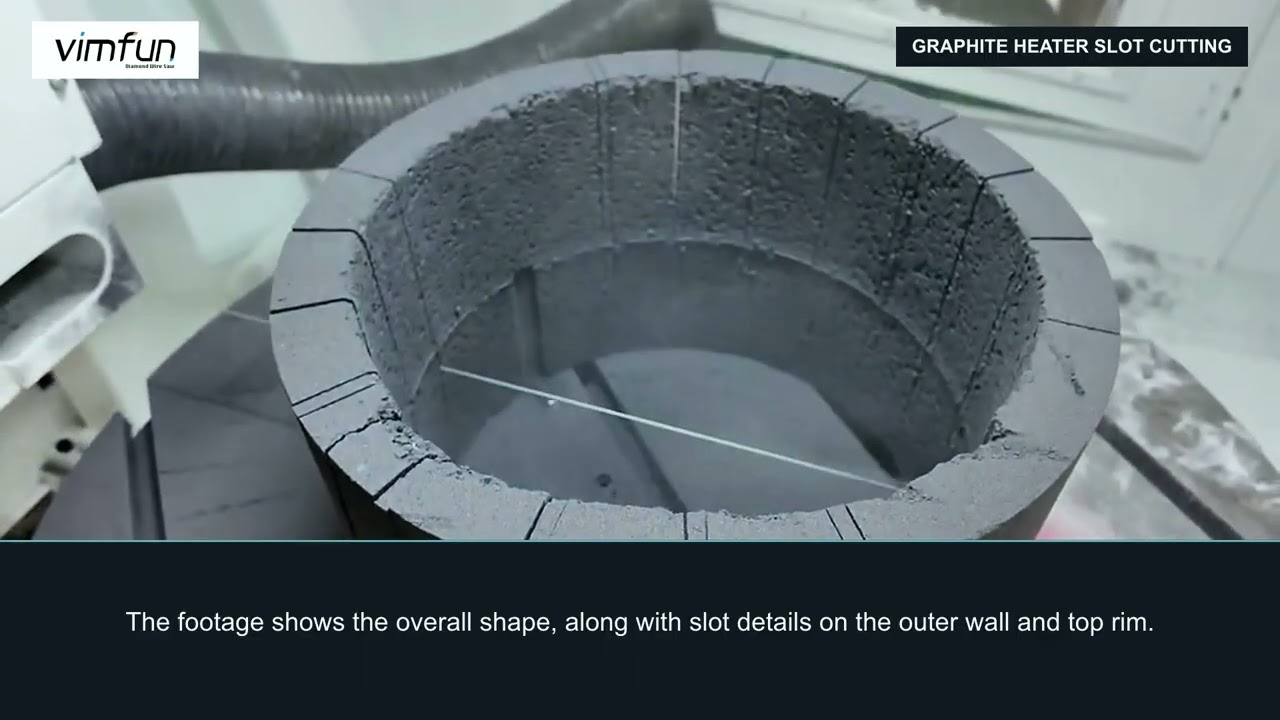
The VIMFUN SVI 250-80 endless diamond wire saw is shown machining slots in a cylindrical graphite heater for a thermal-field assembly. The cutting wire works through the graphite wall, while the video presents the overall component shape and slot details along the outer wall and upper rim.
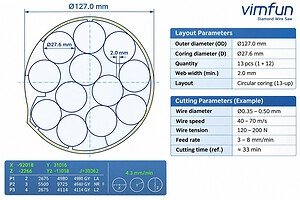
For engineers evaluating graphite heater slotting, the starting point is the component drawing. Outer diameter, height, wall thickness, slot width, and spacing all need to be considered when selecting the fixture and planning the cutting path.
This demonstration shows the machining application. It does not provide measured slot tolerances, cutting time, or the actual wire settings used during filming.
Graphite Heater Slotting Starts with the Component Drawing
Graphite heating elements are used in semiconductor and other high-temperature equipment. Toyo Tanso identifies graphite’s machinability into complex shapes as one of the properties supporting its use in semiconductor heating elements. See its graphite heater application overview.
For a cylindrical heater, the slot arrangement must follow the thermal-field design. A similar-looking component may have a different wall thickness, slot pattern, or dimensional requirement. Those differences need to be captured before machining begins.
The drawing review should establish:
| Drawing information | What to confirm before cutting |
|---|---|
| Outer diameter and overall height | Workpiece fit, loading clearance, and fixture arrangement |
| Inner diameter or wall thickness | Available support areas and the wall section being cut |
| Slot width and tolerance | Required opening and how it will be measured |
| Slot length and termination | Where each cut starts and stops |
| Slot count and spacing | Positioning requirements around the cylinder |
| Uncut sections and connection features | Areas that must remain intact |
| Graphite grade | Material information for the trial cut |
A photograph can show the general shape. A dimensioned drawing defines the machining task.
Graphite Heater Slotting on the VIMFUN SVI 250-80
In this application, the VIMFUN SVI 250-80 uses an endless diamond wire to machine the graphite wall and form the required slots.
Diamond wire cutting removes material through the abrasive action of diamond particles carried by the wire. VIMFUN’s diamond wire saw overview explains the cutting principle and the different machine configurations.
The supplied demonstration focuses on three features: the cylindrical workpiece, the slots along the outer wall, and the openings visible at the upper rim. These views help illustrate the application, but dimensional acceptance still requires inspection against the drawing.
For another heater design, machine suitability should be reviewed using the actual workpiece dimensions and required cutting path. The model used in this demonstration does not, by itself, establish compatibility with every cylindrical graphite heater.
Wire Diameter and Speed: General References
The following values are general graphite machining references supplied with this demonstration. They are not measured operating parameters from the video or confirmed specifications for this particular setup.
| Item | VIMFUN demonstration information or general reference |
|---|---|
| Demonstrated machine | VIMFUN SVI 250-80 |
| Workpiece | Cylindrical graphite heater |
| Operation | Slot cutting in the graphite wall |
| Reference diamond wire diameter | 0.6–1.0 mm |
| Reference wire speed | 40–70 m/s |
| Actual wire diameter and speed in the video | Not reported |
| Feed rate and wire tension | Not reported |
| Measured slot width and tolerance | Not reported |
These ranges provide context for a process discussion. The selected settings should be confirmed for the machine, wire, graphite grade, and component geometry through trial cutting.
The reference wire diameter must not be presented as a measured slot width. If the drawing specifies a narrow slot tolerance, record the finished opening during the trial rather than assuming that the nominal wire diameter proves compliance.
Wire speed also needs to be considered alongside feed rate and tension. VIMFUN’s guide to wire speed, tension, and feed rate discusses these variables together.
Planning the Fixture and Cutting Path
For this type of component, fixture planning should begin with the areas available for support and clamping.
The setup review needs to answer practical questions: Where can the cylindrical body be held? Can the wire reach the required slot positions without interference? Does the proposed sequence leave enough access and support for the remaining cuts?
For graphite heater slotting, a useful review sequence is:
- Identify the locating surfaces. Establish how the workpiece will be positioned relative to the drawing datums.
- Check support and clamping locations. Review them against the wall thickness, slot pattern, and connection features.
- Trace each cutting path. Confirm entry, travel, and stopping positions, including clearance around the fixture.
- Review the slot sequence. Check whether completed slots affect access or support for subsequent cuts.
- Define the trial inspection. Agree on the dimensions and edge conditions that must be checked.
These are setup considerations for a new component. The supplied video description does not specify the fixture design or cutting sequence used in the demonstration.
What to Check During Trial Cutting
A trial cut should establish whether the proposed setup produces the required geometry on the specified graphite material.
Depending on the drawing, inspection may include slot width at agreed locations, slot length, spacing, position, and the condition of the entry and exit edges. Any remaining uncut sections should also be checked against the design.
Record the wire specification and operating settings alongside the inspection results. This connects the observed result to a defined setup and gives the next process adjustment a clear basis.
Toyo Tanso’s graphite manufacturing process overview includes machining-accuracy inspection after machining. For the heater shown here, no corresponding dimensional inspection report has been supplied, so the video should be treated as a machining demonstration.
Frequently Asked Questions
Can an endless diamond wire saw cut slots in a cylindrical graphite heater?
Yes. The supplied demonstration shows the VIMFUN SVI 250-80 machining slots in a cylindrical graphite heater. Suitability for another component requires a review of its drawing, dimensions, fixture access, and slot geometry.
What wire diameter and speed were used?
The actual settings used during filming were not reported. The accompanying technical references are 0.6–1.0 mm wire diameter and 40–70 m/s wire speed for general graphite machining. They should not be quoted as this demonstration’s measured parameters.
What slot accuracy can the process achieve?
No measured slot accuracy was provided for this demonstration. The required tolerance should be defined on the drawing and checked through trial cutting and dimensional inspection.
What information should be sent for an application review?
Send the component drawing, graphite grade if available, outer diameter, height, wall thickness, slot dimensions, spacing, and tolerances. Include any restrictions on clamping surfaces or edge condition.
Discuss Your Graphite Heater Drawing with VIMFUN
Need to machine slots in a cylindrical graphite heater?
Send your drawing to VIMFUN with the required slot width, spacing, and component dimensions. We can discuss the machining requirements, review the proposed fixture and cutting path, and determine what needs to be checked through trial cutting.
About VIMFUN
VIMFUN supplies endless diamond wire cutting equipment for graphite and other hard or brittle materials. The machine featured in this application is the VIMFUN SVI 250-80.