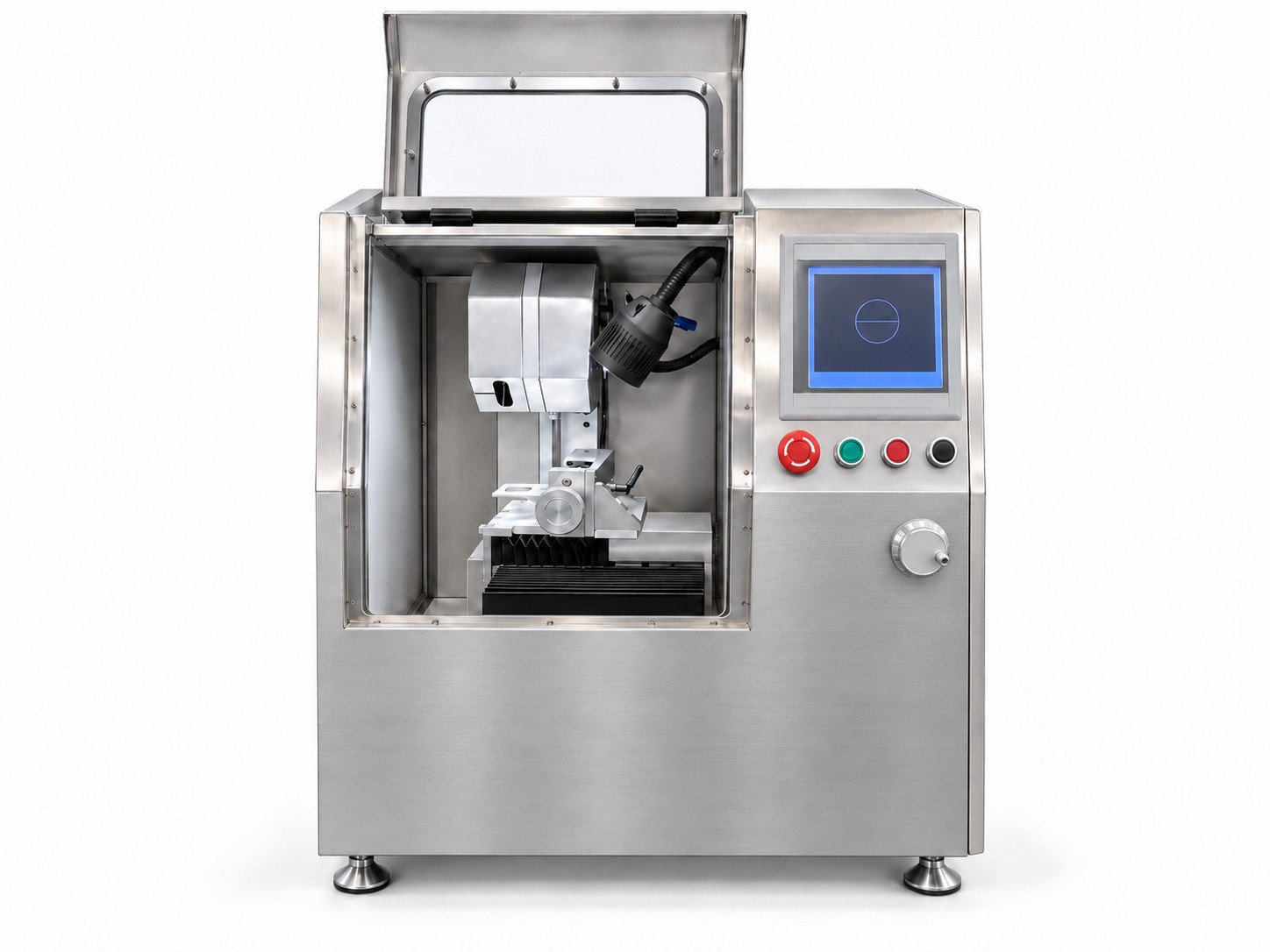
SV 12 Benchtop Vertical Diamond Wire Saw
The SV 12 is a benchtop vertical diamond wire saw for CNC slicing and shape cutting of small hard and brittle parts up to 120 × 120 × 120 mm. It is built for laboratories, R&D samples and small-part production. The wire runs upright, the workpiece is held in a vise on a servo-driven X–Y worktable, and the machine runs on single-phase 220 V at about 1.5 kW.
Its structure and functions follow our larger endless wire saws; only the working envelope is reduced to the 120 mm class. If you need to cut small samples without tying up a large machine, this vertical diamond wire saw fits on a lab bench.
Key Advantages of the SV 12
- Fits on a lab bench. About 750 × 560 × 700 mm and 50 kg, single-phase 220 V, no machine foundation.
- Easy wire alignment. On a vertical diamond wire saw the wire stands upright, so you look down to align it and watch the cut.
- Slicing and shape cutting in one machine. CNC with servo X/Y; contours imported from DXF.
- Manual mode for hands-on work. Test cuts, edge trimming and splitting irregular stock without a program.
- Standard vise clamping. Blocks, short rods and irregular blanks are clamped directly, without bonding to a plate.
- Endless wire, one direction. Up to 50 m/s with no reversal pauses; 0.01 mm axis repeatability.
- Ready to use on arrival. Commissioned before shipment, CE certified, 1-year warranty.
See the SV 12 in Action
Explore the SV 12 benchtop vertical diamond wire saw in the product video below.
SV 12 Key Specifications
All values below are for the standard configuration of the SV 12 vertical diamond wire saw.
| Parameter | Specification |
|---|---|
| Model | SV 12 |
| X/Y guide rails | 120 × 120 |
| Worktable X travel | 120 mm |
| Worktable Y travel | 120 mm |
| Maximum cutting size | 120 × 120 × 120 mm |
| Diamond wire diameter | 0.35–1.0 mm (compatible) |
| Wire speed | 0–50 m/s |
| Cutting accuracy | 0.1 mm |
| Repeatability | 0.01 mm |
| Spindle motor power | 1.5 kW |
| Drive | Servo motors |
| Control | CNC |
| Power supply | 220 V, single-phase, 50/60 Hz |
| Total power | Approx. 1.5 kW |
| Overall dimensions (L × W × H) | Approx. 750 × 560 × 700 mm |
| Machine weight | Approx. 50 kg |
| Shape-cutting programming | DXF import |
| Cooling | Water cooling or dry cutting |
| Operating interface | English |
How the Vertical Diamond Wire Saw Works
The endless diamond wire passes vertically through the cutting zone and runs continuously in one direction, at an adjustable speed of 0–50 m/s. The wire stays in place; the workpiece moves. It is clamped in a vise on the worktable, and servo motors drive the table in X and Y, each with 120 mm of travel.
Two motion modes cover most work on a vertical diamond wire saw:
- Two-axis interpolation: X and Y move together, the table follows a 2D contour, and the wire cuts that shape.
- Single-axis stepping: one axis feeds through the part while the other steps by a set amount, producing slices of a set thickness.
The CNC system runs both modes automatically, and the machine can also be operated by hand. For the basics of how a diamond wire saw removes material, see our overview. The SV 12 is the benchtop member of our vertical wire cutting machine range.
Vertical Wire vs. Gantry Benchtop Wire Saws
Our other benchtop models — the desktop precision CNC wire cutting machine SG 15 and the desktop wire cutting machine SGR 15 — are gantry type: the wire is horizontal and cuts into the workpiece from above. On the SV 12 the wire is upright and the workpiece moves in the horizontal plane. That changes two things in daily use.
The shape is laid out in the horizontal plane. The part contour is simply the X–Y path of the worktable. Looking down, the operator sees the wire and the workpiece relative to each other, which makes wire alignment and watching the cut easy.
Manual cutting is more flexible. Without a program, the workpiece can be pushed directly towards the wire for test cuts, edge trimming or splitting irregular stock.
Neither layout is better in general. A vertical diamond wire saw suits shape work and hands-on sample preparation; a gantry machine suits parts bonded to a plate and sliced from above.
What the Specifications Mean for Your Parts
Three numbers deserve a closer look before you choose a machine.
0.01 mm Repeatability vs. 0.1 mm Cutting Accuracy
These two numbers describe different things. The 0.01 mm repeatability is how consistently the worktable returns to the same position — the execution capability of the axes. The 0.1 mm cutting accuracy describes the finished part. The two differ by a factor of 10. The gap comes from wire bow (the wire lagging and bending in the feed direction during cutting), wire vibration, variation in kerf width and chipping of the material itself.
When selecting, use 0.1 mm as the reference level for finished dimensions, not 0.01 mm as the part tolerance. The tolerance achievable for a specific material and size on this vertical diamond wire saw is determined by test cutting.
Wire Speed 0–50 m/s: Where to Work
On a vertical diamond wire saw like the SV 12, 50 m/s is the upper limit, not the normal working point. At 50 m/s, 3,000 m of wire passes through the cutting zone every minute. The endless wire runs continuously in one direction, without the pause a reciprocating wire makes at each reversal. Higher wire speed means the same section of abrasive passes through the kerf more often and each diamond grain takes a smaller cut, which generally helps reduce chipping; wire wear and heat increase accordingly. Our guide to wire speed, tension, and feed rate explains how these settings interact.
Bench Space, Weight and Power: 0.42 m², ~50 kg, 220 V
The footprint is about 0.75 × 0.56 m, or 0.42 m² — roughly one lab bench top. The machine weighs about 50 kg; with the workpiece and cooling water, the real load is higher. Use a sturdy bench rated for at least 100 kg, with a top no smaller than 750 × 560 mm, level and free of wobble: bench vibration is transmitted directly to the wire and shows on the cut surface. The machine is about 700 mm high, so check the clearance above and the working height.
Power is single-phase 220 V, 50/60 Hz, about 1.5 kW in total. No separate foundation is needed to install the vertical diamond wire saw.
Vise Clamping for Small and Irregular Stock
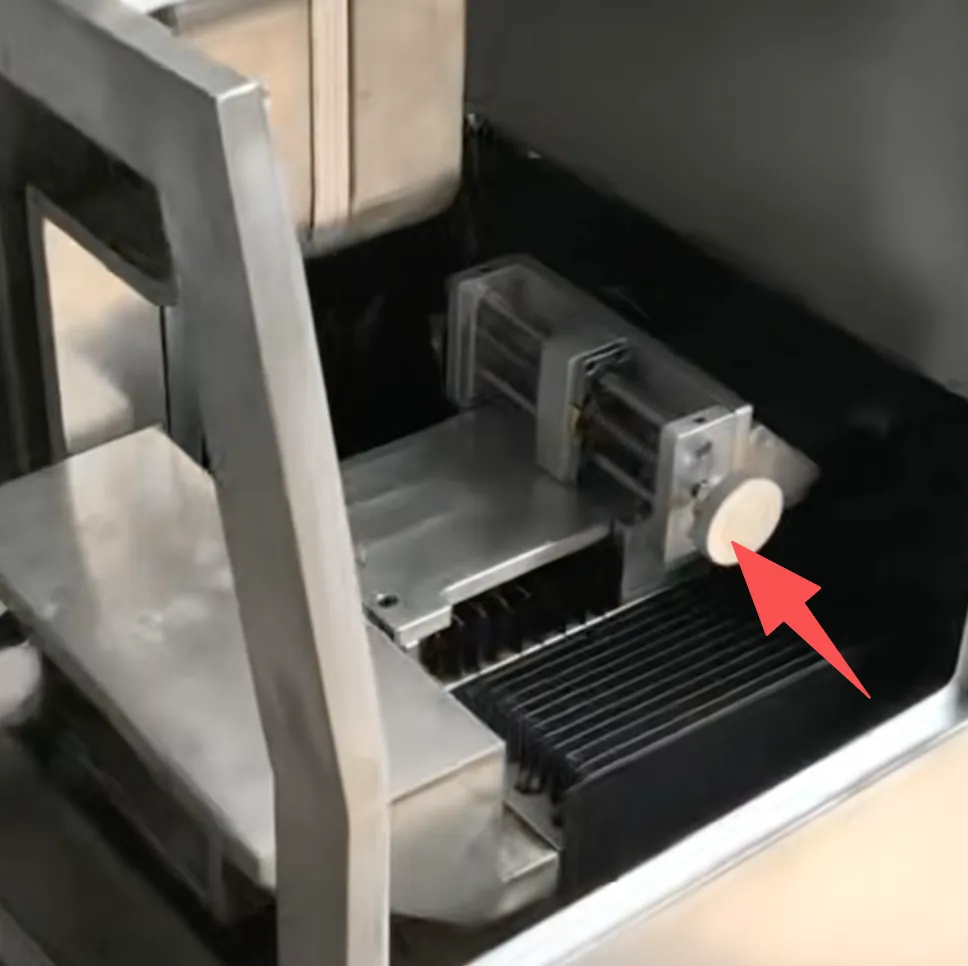
A vise is standard on the SV 12 vertical diamond wire saw. It holds blocks, short rods and irregular blanks directly, so you skip the bonding-to-plate step and change parts quickly. The vise opening and clamping height are less than 120 mm.
For very thin or very brittle workpieces, or parts that cannot take clamping force, we still recommend bonding them to a backing block and clamping the block. Our article on fixture design and mounting methods covers the options in more detail.
Materials and Typical Parts
The cutting tool is a diamond wire, so in principle any material softer than diamond can be cut. Typical materials and parts for this vertical diamond wire saw:
| Material | Typical parts / uses |
|---|---|
| Optical glass, quartz | Small windows, test-sample slices, small irregular parts |
| Single-crystal silicon, germanium and other IR materials | R&D sample slicing, small block blanking |
| Alumina, silicon carbide and other technical ceramics | Test blocks, small irregular parts |
| Graphite | Small electrode blanks, samples |
| Sapphire, jade and hardstone | Splitting small pieces, sampling |
Specific materials are confirmed by test cutting. For larger graphite electrodes and carbon parts, see our dedicated graphite cutting site.
Cutting Modes: Slicing, Shape Cutting and Manual Trimming
| Processing type | Axes used | Description |
|---|---|---|
| Slicing to set thickness | Feed on X or Y + stepping on the other axis | Set slice thickness and count; slices are cut automatically in sequence |
| Shape cutting | X and Y interpolation | Cuts along a 2D contour; side walls perpendicular to the worktable |
| Manual splitting / trimming | Manual X and Y movement | Test cuts, splitting irregular stock |
Shape-cutting programs are created by importing the part contour as a DXF file. In every mode the cut faces are perpendicular to the worktable, because the machine has two linear axes and no tilt.
Sample Results
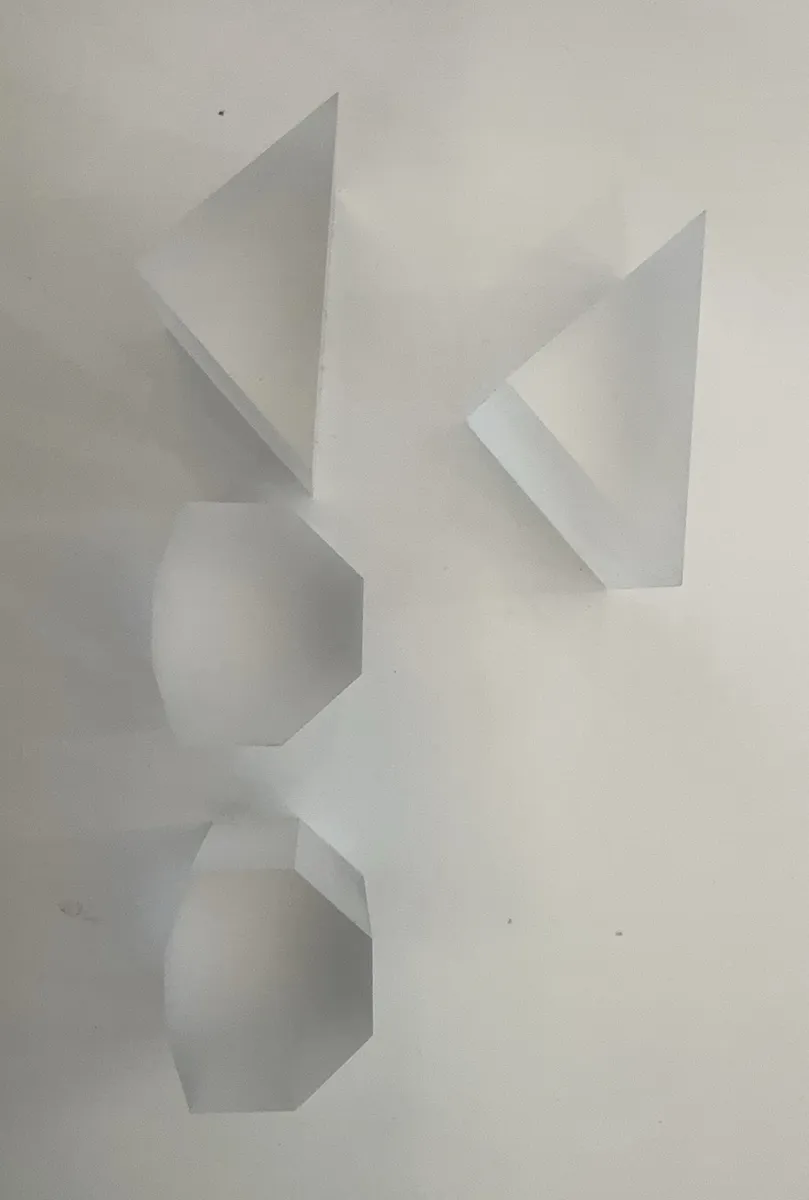
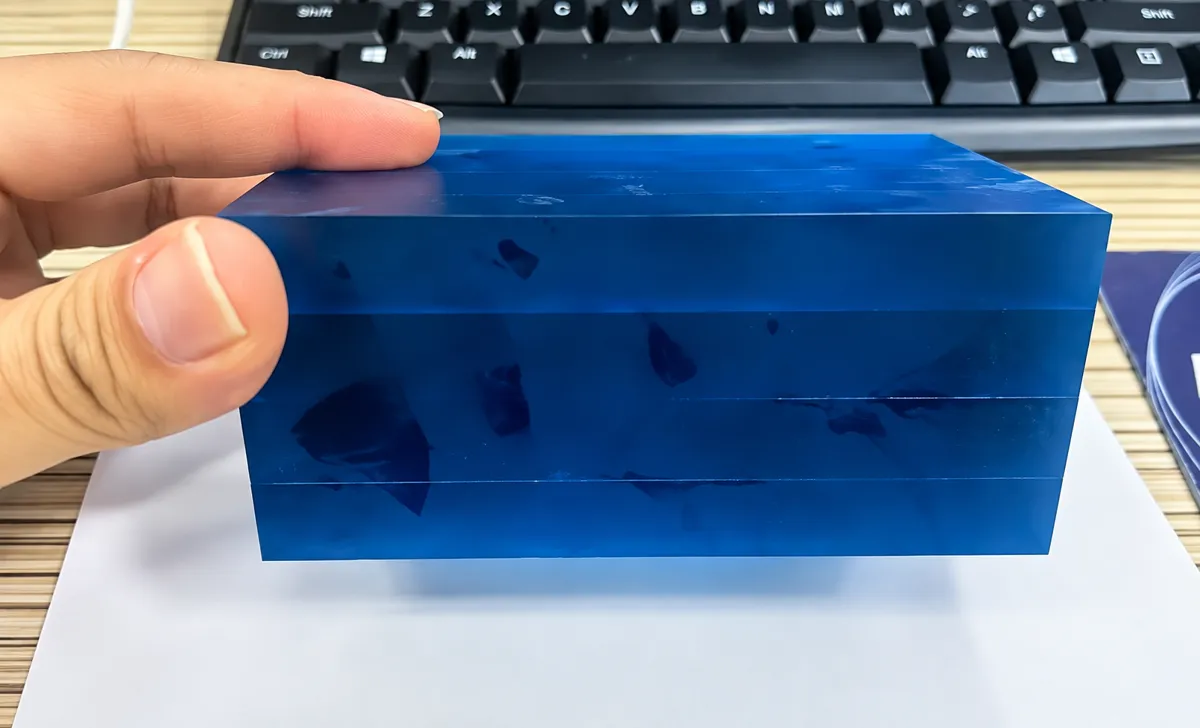
Sliced and shape-cut samples from the SV 12 vertical diamond wire saw. Send us your own material for a test cut.
Compare Our Benchtop Wire Saws
How the SV 12 vertical diamond wire saw compares with our other compact machines. Click a model to open its product page.
| Model | Structure | Working envelope (mm) | Wire Ø (mm) | Main functions | Weight |
|---|---|---|---|---|---|
| SV 12 (this page) | Benchtop, vertical wire | 120 × 120 × 120 | 0.35–1.0 | Slicing + shape cutting (DXF import), vise clamping | Approx. 50 kg |
| SG 15 | Benchtop, horizontal wire, cuts from above | 150 × 150 × 150 | 0.35–0.6 | Slicing + shape cutting, adhesive mounting | Approx. 60 kg |
| SGR 15 | Benchtop, horizontal wire, cuts from above | 150 × 150 × 150 | 0.35–1.0 | 4-axis control (X, Y + 2 rotary axes): polygon and multi-angle slicing | Approx. 100 kg |
| SGD 52 | Benchtop, horizontal wire, cuts from above | Ø 52 | 0.35–1.0 | Cut-off only, manual cutting (not automated) | Approx. 25 kg |
| SGI 20 | Floor-standing | 200 × 200 × 220 | 0.35–1.0 | Slicing + contour cutting (DXF import), batch production | Approx. 580 kg |
Need inclined or rotary cuts? See the SGRT 20 multi-axis diamond wire saw.
From Lab Parameters to Production
The SV 12 is a stand-alone machine for laboratories and small batches. Use this vertical diamond wire saw in R&D to establish cutting parameters for a material, then transfer those parameters to a large endless wire saw or a multi-wire saw for volume production. If you need a complete line — lapping, polishing, inspection — tell us the part size and output. Browse our benchtop and lab wire saw models for other compact options.
FAQ
What materials can the SV 12 cut?
The SV 12 vertical diamond wire saw cuts optical glass, quartz, silicon, germanium, technical ceramics, graphite, sapphire and other hard and brittle materials. In principle anything softer than diamond; specific materials are confirmed by test cutting.
What tolerance can I expect on finished parts?
Use the 0.1 mm cutting accuracy as the reference level for finished dimensions. The 0.01 mm figure is axis repeatability, not part tolerance. The tolerance for your material and size is set by test cutting.
How is a shape-cutting program created?
Import the part contour as a DXF file. The CNC then interpolates X and Y to follow it, and the side walls come out perpendicular to the worktable.
Can a vertical diamond wire saw cut internal holes?
Not directly. The endless wire is a closed loop and cannot be threaded through a pre-drilled hole. Internal contours need auxiliary equipment, purchased separately.
What kind of bench does it need?
This vertical diamond wire saw needs a level, stable bench rated for at least 100 kg, with a top of at least 750 × 560 mm and enough clearance above the 700 mm machine height.
Can it cut dry, or is coolant required?
Both are possible: the SV 12 supports water cooling or dry cutting. Tell us your material and we will suggest which to use.
What is the lead time?
Standard lead time is 30 working days. The machine is commissioned before shipment and is ready to use once plugged in.