Precision glass cutting across optical components, fused silica, borosilicate, and semiconductor glass wafers requires meticulous risk management. While endless diamond wire saws exert significantly lower cutting forces (< 1.5 N) than traditional abrasive slurry saws or circular diamond blades, operating an ultra-high-speed diamond wire loop (traveling at linear speeds of 20 to 60 m/s) introduces specific mechanical, health, and operational hazards. Implementing robust safety precautions when using a glass wire saw protects personnel from catastrophic wire snapback, mechanical entanglement, and airborne respirable crystalline silica (RCS), while safeguarding expensive optical substrates against micro-cracking and exit chipping.
For an overarching operational overview, explore our foundational engineering guide on the safest way to use a glass wire saw. Below, our technical team details the critical hazard controls, PPE protocols, machine safeguards, and pre-operational verification workflows required for zero-incident industrial glass processing.
1. Hierarchy of Hazard Controls in Industrial Glass Wire Sawing
Adhering to international safety standards (such as ISO 12100 for machinery safety and OSHA general industry guidelines) requires establishing an engineering-first hierarchy of hazard mitigation rather than relying solely on procedural care:
- Elimination & Substitution: Replace reciprocating slurry wire saws with continuous diamond wire loops running unidirectional kinematics. Continuous loops eliminate severe shock reversals, reducing cyclic fatigue and wire snap probability by over 70%.
- Engineering Safeguards: Interlocked physical enclosures, transparent high-impact polycarbonate viewports, and active wire-tension monitoring systems isolate moving components during high-speed runs.
- Administrative Protocols: Standardized Operating Procedures (SOPs), machine pre-flight checklists, and strict Lockout/Tagout (LOTO) protocols during wire changes or maintenance.
- Personal Protective Equipment (PPE): Targeted protective equipment specified strictly to avoid rotating machinery entanglement hazards.
2. Mandatory PPE & The Entanglement Hazard Myth
A prevalent and dangerous misconception in amateur sawing manuals advises operators to wear thick, loose-fitting leather or cotton work gloves when operating saws. In industrial wire sawing environments, wearing loose gloves near rotating wire pulleys, tensioning drums, and high-speed diamond wire loops creates a catastrophic mechanical nip-point entanglement hazard that can pull hands into pinch points within milliseconds.
Operators must adhere to strict industrial PPE guidelines:
- No Loose Clothing or Heavy Gloves: Loose sleeves, neckties, rings, jewelry, and bulky gloves are strictly prohibited around operating wire saw kinematics. Wear form-fitting, short-sleeved or banded-cuff apparel.
- Handling Sharp Glass & Raw Wire (Offline Only): During glass substrate loading/unloading or wire re-stringing when the machine is completely de-energized, operators must wear form-fitting EN 388 Level 4/5 cut-resistant gloves or tight nitrile gloves to protect against razor-sharp glass edge fractures and electroplated wire micro-abrasions.
- Eye and Face Protection: Wear ANSI Z87.1 certified impact-resistant safety glasses with side shields, or a full-face polycarbonate visor when setting up wet cutting systems to shield against high-velocity aerosolized droplets and accidental micro-spalls.
- Respiratory Safety: When dry cutting specialized non-glass ceramics or performing enclosure maintenance, wear NIOSH N95 or P100 half-face particulate respirators to prevent inhalation of micro-debris.
3. Engineering Safeguards & Interlock Architecture
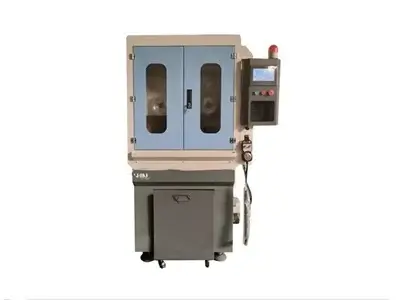
Modern industrial CNC diamond wire saws feature multi-layered active and passive safety interlocks designed to prevent unauthorized access and instantly arrest machine kinematics during mechanical anomalies:
| Safety Mechanism | Detection Mechanism | Reaction Time | Operational Risk Mitigated |
|---|---|---|---|
| Interlocked Enclosure Doors | Dual-channel magnetic/optical safety interlock switches (EN ISO 14119) | < 30 ms | Prevents operator contact with 20–60 m/s moving wire, flying debris, and high-pressure coolant spray. |
| Optical Wire-Break Sensor | Through-beam infrared optical sensor continuously monitoring wire trajectory | < 50 ms | Instantly cuts spindle power and applies dynamic regenerative braking if the wire snaps, preventing wire whiplash. |
| Pneumatic Tension Interlock | Digital pressure switch & closed-loop pneumatic feedback transducer | Continuous | Halts feed if pneumatic tension drops below operating threshold (preventing wire derailing from pulley grooves). |
| Dual Emergency Stop (E-Stop) | Category 4 / PL e safety relay circuit with latching mushroom buttons | Immediate (< 20 ms) | Decouples servo power, vents pneumatic axis drives, and applies failsafe mechanical spindle brakes. |
4. Wet Cutting vs. Respirable Crystalline Silica (RCS) Management
Fused silica, quartz crystal, optical glass, and borosilicate generate microscopic dust during mechanical abrasive shearing. Inhaling dry glass swarf can cause chronic lung inflammation, irreversible silicosis, and severe respiratory injury. OSHA standard 29 CFR 1926.1153 sets the Permissible Exposure Limit (PEL) for respirable crystalline silica at 50 μg/m³ over an 8-hour time-weighted average.
To ensure total environmental safety:
- 100% Wet Flood Cooling: High-purity deionized water or water-soluble synthetic cutting fluids must be delivered directly at the wire-workpiece contact zone. Continuous fluid flood suppresses 99.8% of respirable glass dust at the source, transforming airborne hazards into harmless wet slurry.
- Thermal Shock & Glass Shattering Prevention: Beyond airborne safety, constant fluid lubrication dissipates localized frictional heat. Because glass has low thermal conductivity and high brittleness, dry cutting generates steep thermal gradients that induce catastrophic thermal shock fracturing, sending glass shards across the cutting chamber.
- Slurry Sedimentation & Centrifugal Separation: Effluent coolant containing glass swarf must pass through localized multi-stage sedimentation tanks or centrifugal separators before recycling or disposal. Glass sediment must never be allowed to dry into cake form inside open workspace pans.

5. Substrate Fixturing: Preventing Exit Chipping & Explosive Ejection
Optical glass, Zerodur, and laser crystal ingots possess high elastic modulus and minimal fracture toughness. Improper mechanical clamping induces localized compressive stress concentrations that can cause the glass blank to spontaneously crack or shatter when the wire penetrates the material.
- Avoid Direct Metal-to-Glass Mechanical Clamping: Never clamp raw glass directly with metal chuck jaws or hardened steel vise plates. Use vacuum chucking plates or thermo-reversible bonding waxes (such as Crystalbond 509) to bond the glass securely to an aluminum or phenolic fixture plate.
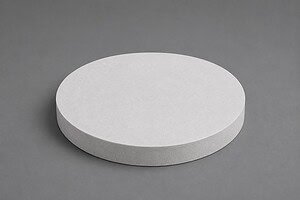
- Sacrificial Backing Substrates: At the exit boundary of the cut, the tensile stress field ahead of the diamond wire can cause edge breakout or severe spalling. Bonding a sacrificial glass, graphite, or composite backing plate to the bottom/exit face ensures the wire transitions smoothly out of the workpiece without chipping fragile edges.
- Verify Workpiece Rigidity: Ensure zero vibration or cantilever flex in the workpiece mounting. Any lateral oscillation will pinch the high-speed diamond wire, triggering high wire bow angles, severe kerf wander, and wire fatigue fracture.
6. Pre-Operational 7-Point Safety Verification Protocol
Before initializing automated CNC glass slicing cycles, certified operators must execute this 7-point pre-flight checklist:
- Wire Loop Surface Inspection: Inspect the endless diamond wire loop under magnifying loupe. Verify uniform diamond grit distribution, absence of core wire kink, and zero coating stripping at the welded joint.
- Guide Wheel & Pulley Runout: Check rubber/polyurethane pulley rims and ceramic guide rollers. Ensure wire grooves are free of embedded glass swarf, groove wear depth is < 0.2 mm, and radial runout is < 0.01 mm.
- Tensioning System Calibration: Confirm pneumatic regulator pressure is set to factory specification (typically 1.2–2.5 N·m corresponding to wire core diameter ∅0.35 mm to ∅0.65 mm). Verify smooth carriage travel without mechanical binding.
- Coolant Nozzle Alignment: Verify twin coolant delivery jets impinge symmetrically onto both the wire entry and exit kerf points. Check fluid flow rate (≥ 3.0 L/min) and ensure no nozzle blockage.
- CNC Travel Envelope & Limit Switches: Dry-run the programmed toolpath to ensure clearance between the wire bow, workpiece clamp, and machine structural casting. Verify X/Z axis optical limit switch responsiveness.
- Interlock Safety Function Test: Physically open the enclosure door while in setup mode to confirm spindle motor drive immediately cuts power and engages the mechanical lock.
- Exit Backing Verification: Ensure sacrificial support substrate is fully supported beneath the cut plane to absorb the final wire exit stroke.
7. Industrial Machine Solutions for Safe Glass Processing
Vimfun designs and manufactures fully enclosed, high-precision endless diamond wire sawing systems equipped with complete CE-certified safety architectures, closed-loop tension control, and automated fluid filtration:
CNC Glass Cutting Wire Saw SG 20
The SG 20 CNC Glass Cutting Wire Saw is engineered specifically for precision optical glass, fused silica, and sapphire slicing. Featuring a fully interlocked stainless-steel chamber, precision dual-axis servo feed, and integrated water recirculation, the SG 20 achieves cutting kerf losses down to 0.35 mm with surface roughness Ra < 0.2 μm, all within an isolated, mist-free enclosure.
Prism Cutting Wire Saw SG40-R
The SG40-R Prism Cutting Wire Saw incorporates a high-rigidity CNC rotary indexing table designed for multi-angle prism cross-sectioning and pyramid shaping. Equipped with high-resolution closed-loop angular feedback, programmable wire speed from 10 to 50 m/s, and zero-backlash pneumatic tensioning, the SG40-R ensures clean facet angles without mechanical edge micro-cracking.
CNC Internal Contour Wire Saw SVO 20
For internal profile cutting and custom glass aperture machining, the SVO 20 CNC machine provides vertical contour wire sawing capabilities. Its continuous wire routing architecture enables tight-radius curve profiling in specialty glass plates, quartz tubes, and ceramic substrates without manual wire feeding risks.
Elevate Your Glass Cutting Safety & Precision
Upgrading your optical fabrication or glass cutting facility with modern endless diamond wire technology dramatically reduces operator risk while maximizing material yield. Send your glass samples to our state-of-the-art laboratory for our complimentary free diamond wire test cutting service to validate cutting speeds, edge quality, and kerf loss parameters before machine deployment.