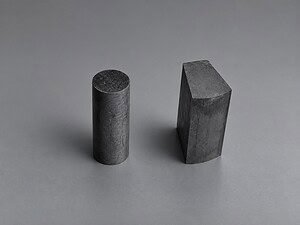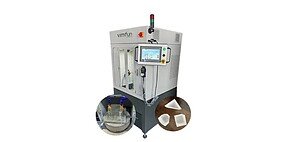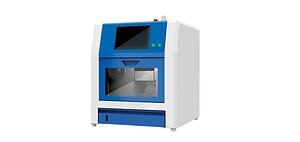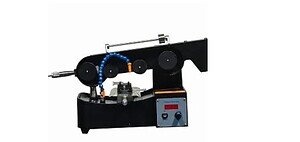
Samarium cobalt is the magnet material nobody talks about — until the application requires 300 °C operating temperature, or the environment is too corrosive for NdFeB, or the magnet needs to hold stable flux in a satellite for 15 years without maintenance. Then SmCo is suddenly the only option.
The problem is that SmCo is expensive, brittle, and unforgiving during machining. Raw material costs run 3–5× higher than equivalent NdFeB grades, which makes every millimeter of kerf loss hurt. And unlike NdFeB, SmCo has essentially zero ductility at the grain boundary level — micro-cracks that start at the surface during cutting can propagate through the entire cross-section if the process isn’t controlled carefully.
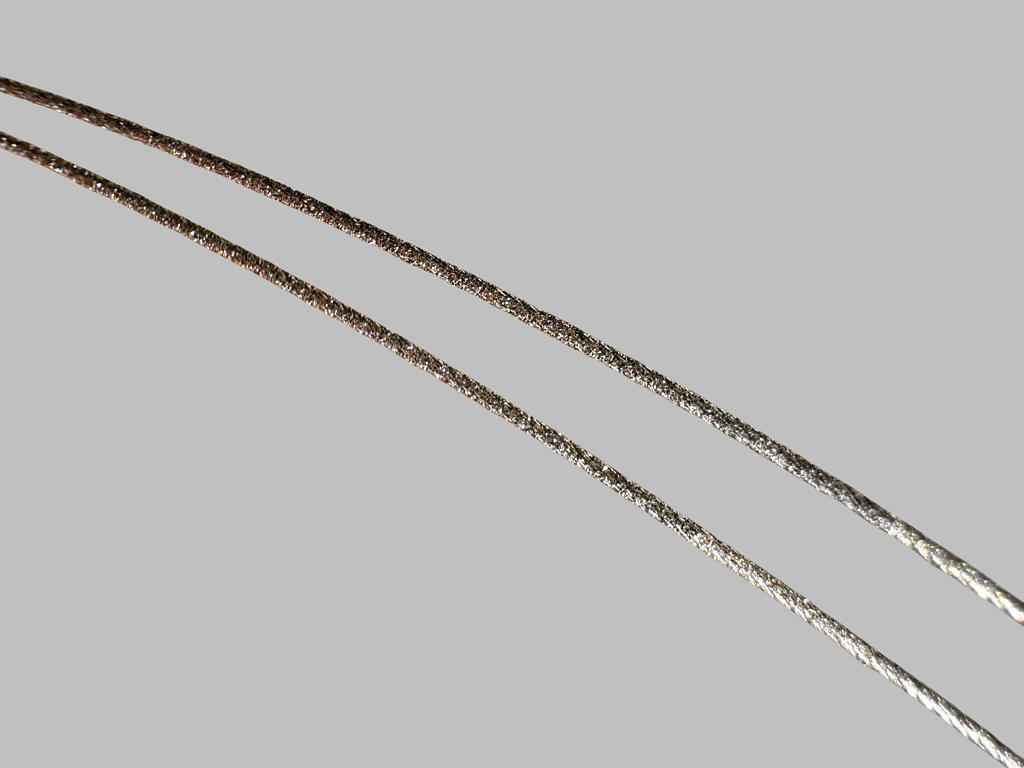
This guide covers what we’ve learned cutting SmCo on our endless diamond wire saws, how the process differs from NdFeB and ferrite cutting, and the specific parameter adjustments that make the difference between usable parts and expensive scrap.
SmCo Material Properties That Affect Cutting
SmCo comes in two families, and they behave differently under a diamond wire.
SmCo5 (1:5 series) — one part samarium, five parts cobalt. Simpler crystal structure, energy product of 16–22 MGOe, maximum operating temperature around 250 °C. This grade, first developed in the 1960s, is somewhat easier to machine because its microstructure is more homogeneous.
Sm₂Co₁₇ (2:17 series) — two parts samarium, seventeen parts cobalt, plus iron, copper, and zirconium. More complex precipitation-hardened microstructure, energy product of 24–32 MGOe, operating temperature up to 350 °C. This is the grade used in aerospace and defense applications, and it’s also the more difficult one to cut cleanly.
Both grades share several properties that shape the cutting strategy:
Hardness comparable to NdFeB. SmCo has a Vickers hardness around HV 500–600. That’s in the same range as sintered NdFeB, so the same diamond wire grits and wire diameters work for both materials. You don’t need different wire specifications when switching between SmCo and NdFeB.
Lower fracture toughness than NdFeB. This is the critical difference. SmCo’s grain boundary phase is less compliant than the Nd-rich phase in NdFeB. When a diamond grit creates a micro-crack at a grain boundary during cutting, that crack has less resistance to propagation. In practice, this means SmCo chipping tends to be more severe than NdFeB chipping under the same cutting conditions — the chips are larger and the cracks go deeper.
Excellent corrosion resistance. SmCo doesn’t need protective coating in most environments. Unlike NdFeB where you have 30 minutes between cutting and oxidation protection, SmCo cut surfaces remain stable indefinitely in normal atmospheric conditions. This eliminates the post-cut rush to apply oil or move parts to coating, which simplifies the entire production workflow significantly.
High material cost. Samarium and cobalt are both expensive elements, and the sintering process for Sm₂Co₁₇ involves complex heat treatment cycles (aging at 350–900 °C with controlled cooling). Finished SmCo blanks typically cost $150–400/kg depending on grade and quantity — roughly 3–5× the price of equivalent NdFeB. This makes kerf loss a first-order economic concern, not just a nice-to-have optimization.
Conductive. SmCo is electrically conductive, so EDM wire cutting is technically possible as an alternative. However, EDM creates a heat-affected zone and recast layer that damages the precipitated microstructure of Sm₂Co₁₇, degrading the magnetic properties that make SmCo worth its premium price. For most precision applications, the thermal damage from EDM defeats the purpose of using SmCo in the first place.
Why SmCo Demands More Conservative Cutting Parameters
If you’re coming from NdFeB cutting and switching to SmCo on the same machine, the natural instinct is to use the same parameters. That usually works for the first few cuts — and then the chipping starts.
The underlying issue is the grain boundary mechanics. In NdFeB, the Nd-rich grain boundary phase acts as a thin ductile buffer between hard Nd₂Fe₁₄B grains. When cutting forces exceed the fracture threshold, the crack has to work through this ductile layer before it can jump to the next grain. That energy absorption limits crack propagation.
SmCo doesn’t have that buffer. The grain boundaries in Sm₂Co₁₇ are defined by precipitation of a cellular/lamellar microstructure during aging heat treatment. These boundaries are metallurgically sharp, and cracks propagate across them with minimal energy absorption. What this means practically is that SmCo has a narrower “safe zone” of cutting parameters — the window between “cutting efficiently” and “initiating subsurface damage” is smaller than for NdFeB.
We’ve found the adjustment that matters most is feed rate. Reducing feed rate by 20–30% from NdFeB baseline parameters typically brings SmCo cutting into the safe zone. Wire speed and tension can remain similar.
Recommended Process Parameters for SmCo Cutting
On our SG20-R machines, these are the parameters we use for SmCo:
| Parameter | SmCo Range | NdFeB Reference | Notes |
|---|---|---|---|
| Wire diameter | 0.35–0.50 mm | Same | Thinner wire preferred to minimize kerf on expensive material |
| Wire speed | 30–60 m/s | Same | Higher speed improves surface finish |
| Wire tension | 80–120 N | 100–150 N | Lower than NdFeB — reduces crack initiation risk |
| Feed rate | 1.0–2.0 mm/min | 1.5–3.0 mm/min | 20–30% slower than NdFeB for comparable cross-sections |
| Coolant | Water-based or oil | Oil required for NdFeB | SmCo is corrosion-resistant; water-based works fine |
| Surface roughness (Ra) | 0.3–0.6 μm | 0.3–0.5 μm | Slightly higher variance due to grain structure differences |
A few important notes on these numbers:
Wire tension is deliberately lower than NdFeB. We run SmCo at 80–120 N versus 100–150 N for NdFeB. The reasoning is the same as for ferrite — lower fracture toughness means each diamond grit contact point needs to apply less force to stay below the crack initiation threshold. If you’re getting clean cuts at 100 N, don’t increase tension to speed things up. The time you save cutting will be lost to reject parts.
Feed rate at 1.0–2.0 mm/min may feel slow. It is slow. For a 30 × 30 mm cross-section, a single cut takes 15–30 minutes. But consider the economics: a SmCo blank that size might cost $40–80, and a single cracked piece negates the productivity gain from faster feed rates across an entire batch. Conservative feed rates are cheaper than scrap.
Coolant flexibility is a genuine advantage. Because SmCo doesn’t corrode in water, you can use water-based coolant and get better heat dissipation than oil. For shops that process both SmCo and NdFeB, this means you can run SmCo with water-based coolant and switch to oil for NdFeB — but not the reverse (residual water on the machine will attack NdFeB cut surfaces). See our cooling and lubrication guide for coolant changeover procedures.
Wire life on SmCo is comparable to NdFeB. Despite SmCo’s reputation as a difficult material, diamond wire life isn’t significantly shorter than when cutting NdFeB. Both materials have similar hardness, and the lower feed rates used for SmCo actually reduce wire wear per unit time. Expect 4–6 days at 8 hours/day continuous operation with 0.35 mm electroplated diamond wire.
SmCo5 vs. Sm₂Co₁₇: Does the Grade Affect Cutting?
Yes, noticeably.
SmCo5 has a simpler, more homogeneous microstructure. The single-phase structure means crack propagation behavior is more predictable, and surface finish tends to be more uniform across the cut face. We can typically run SmCo5 at the upper end of the recommended feed rate range (closer to 2.0 mm/min) without quality issues.
Sm₂Co₁₇ has a precipitation-hardened cellular/lamellar structure that creates more complex fracture behavior. The cell boundaries act as preferential fracture sites, and the mixed-phase microstructure produces a cut surface with more variation — some areas smooth from micro-cutting, others rougher from grain pull-out along cell boundaries. For Sm₂Co₁₇, we recommend staying at the conservative end of the feed rate range (1.0–1.5 mm/min), especially for thicker cross-sections above 20 mm.
The difference shows up most clearly in edge chipping. SmCo5 edges chip cleanly in small, predictable fragments. Sm₂Co₁₇ edges can produce larger, irregular chips because the crack follows the cell boundary network rather than propagating along a simple straight path. For Sm₂Co₁₇ parts where edge quality is critical, reducing feed rate for the first and last 2 mm of the cut (the entry and exit zones) makes a measurable difference.
Why Kerf Loss Matters More for SmCo Than Any Other Magnet
Let’s do the math on kerf loss with real numbers.
A typical SmCo block for motor or sensor applications might be 50 × 40 × 25 mm, priced at roughly $200/kg. The block weighs about 0.042 kg (SmCo density is ~8.4 g/cm³), so the raw material cost is roughly $8.40 per block.
Slicing this block into 2 mm wafers:
With ID blade cutting (0.5 mm kerf): 50 mm ÷ (2.0 + 0.5) mm = 20 slices. Material utilization: (20 × 2.0) / 50 = 80%.
With diamond wire cutting (0.40 mm kerf): 50 mm ÷ (2.0 + 0.40) mm = 20.8 → 20 slices, but with 2 mm left over that can contribute to one additional partial slice. At thinner kerf, effective utilization is closer to 83%.
The 3% utilization improvement seems small per block, but across thousands of parts per month in a production environment, it adds up. And the real saving is often in the pieces themselves — fewer reject parts from chipping means higher effective yield, which matters more than kerf when the material is this expensive.
Using thinner wire (0.35 mm rather than 0.50 mm) pushes kerf down to 0.40 mm. The trade-off is shorter wire life and slightly more risk of wire breakage on larger cross-sections. For high-value SmCo work, the wire cost difference is negligible compared to material savings.
Surface Quality on Wire-Cut SmCo
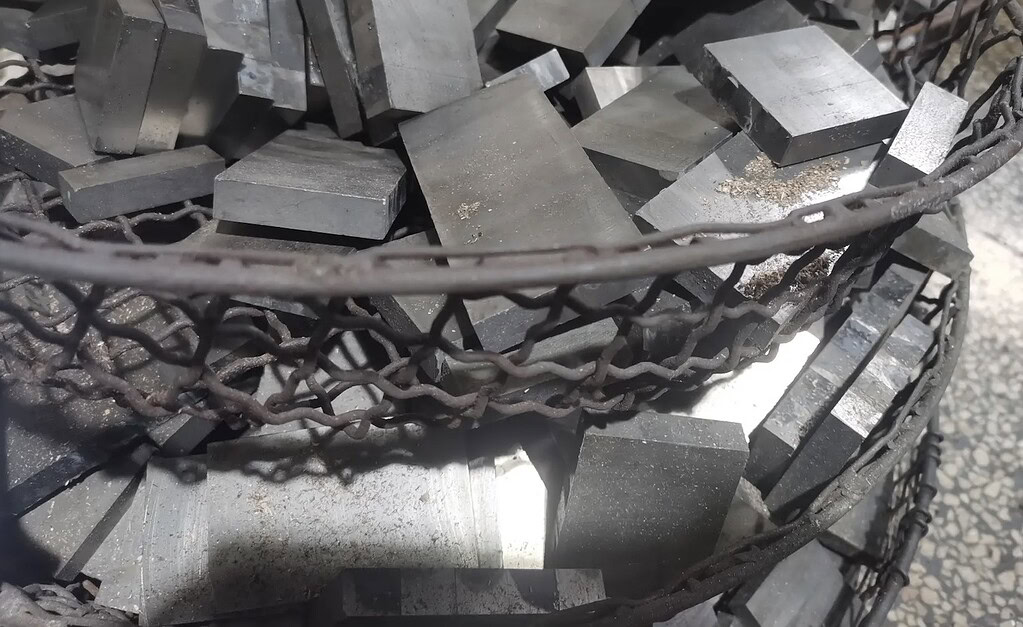
The cut surface on SmCo has characteristics that fall between NdFeB and ferrite.
Like NdFeB, SmCo has some metallic character at the grain level that allows limited ductile micro-cutting. But the grain boundary phase in SmCo is harder and less compliant than NdFeB’s Nd-rich phase, so the ductile-to-brittle transition happens at lower cutting forces. The result is a surface that has more fracture pit density than NdFeB but less than ferrite under comparable conditions.
Typical Ra values on wire-cut SmCo range from 0.3 to 0.6 μm. The lower end is achievable with fresh wire, low feed rates (1.0 mm/min), and high wire speed (50+ m/s). The higher end represents production-realistic conditions with moderate wire wear.
For most SmCo applications, this surface finish is adequate without additional grinding or polishing. SmCo magnets rarely receive electroplating (their corrosion resistance makes it unnecessary), so the stringent surface requirements that drive NdFeB chamfering and coating preparation don’t apply. If the magnet goes into a bonded assembly, the wire-cut surface provides excellent adhesive bonding area.
For the subset of applications that do require smoother surfaces — precision sensor magnets, certain medical device components — a light grinding pass removes 0.02–0.05 mm of stock and brings Ra below 0.2 μm. The key advantage of starting from a wire-cut surface versus a blade-cut surface is that less grinding stock means shorter grinding time and lower risk of grinding-induced thermal damage.
Typical SmCo Cutting Applications
Aerospace Actuator Magnets
Sm₂Co₁₇ magnets in aircraft actuators operate at sustained temperatures of 200–300 °C and must maintain stable flux over the aircraft’s service life. Dimensional tolerances are tight (±0.02 mm), and any microstructural damage from cutting can reduce high-temperature coercivity. The low-stress, cold-cutting nature of diamond wire is particularly valuable here — no heat-affected zone means the cutting process doesn’t compromise the thermal aging treatment that gives Sm₂Co₁₇ its high-temperature performance.
Satellite and Space Systems
SmCo magnets in satellite attitude control systems, traveling wave tubes, and sensor assemblies must function in vacuum at temperature extremes. The magnets are often small (under 10 mm) and extremely expensive per piece. Wire cutting’s precision and low kerf loss directly reduce per-part cost, and the minimal subsurface damage ensures reliable long-term performance.
High-Temperature Motor Magnets
Industrial motors, downhole drilling motors, and automotive under-hood applications where operating temperatures exceed NdFeB limits. These applications often use arc-segment SmCo magnets that require precise thickness control. Diamond wire cutting produces the initial blanks with thickness tolerance within ±0.03 mm, reducing or eliminating the grinding step before assembly.
Medical Device Components
SmCo magnets in implantable devices, surgical instruments, and diagnostic equipment where biocompatibility and dimensional precision are critical. The fact that SmCo doesn’t require coating simplifies the supply chain for medical device manufacturers dealing with stringent material qualification requirements.
Precision Sensors
Magnetic field sensors, Hall-effect sensors, and gyroscope components where flux stability over temperature is essential. Small SmCo pieces (often 5 × 3 × 1 mm or smaller) benefit from the low cutting force of diamond wire — at these dimensions, blade cutting produces unacceptable chipping rates. Our SG20 desktop model handles these small-part applications with fast setup times between different part sizes.
Common SmCo Cutting Problems and Solutions
Larger-than-expected edge chips: SmCo chips tend to be bigger than NdFeB chips because crack propagation meets less resistance at grain boundaries. Reduce feed rate by 20% and check wire tension — if you’re above 120 N, bring it down to 100 N. For Sm₂Co₁₇ specifically, verify that you’re reducing feed rate in the entry/exit zones.
Surface roughness inconsistency across the cut: If one area of the cut face is smooth and another is rough, the cause is usually directional — you’re cutting across the grain alignment axis in the rough zone and along it in the smooth zone. SmCo is anisotropic, and the preferred magnetic orientation direction also affects mechanical fracture behavior. This isn’t a defect; it’s inherent to the material. If uniformity is critical, a light grinding pass evens out the surface.
Wire deflection on thick cross-sections: SmCo blocks above 30 mm cross-section can cause measurable wire deflection at higher feed rates, leading to thickness variation across the slice. Reduce feed rate to 1.0 mm/min and verify guide wheel groove condition. Worn grooves amplify wire lateral movement.
Cost of wire breakage: Wire breakage on SmCo is expensive because it usually damages the workpiece. Track cumulative cutting meters and replace wire proactively before it reaches end-of-life. For SmCo, we recommend replacing wire at 70–80% of the life you’d use for NdFeB — the cost of a new wire loop is trivial compared to a ruined SmCo blank.
Workpiece cracking during fixturing: Same as ferrite — SmCo is brittle enough that excessive clamping force can initiate cracks. Use padded clamps or adhesive mounting. For details on fixturing brittle magnet materials, see our fixture design guide.
SmCo vs. NdFeB vs. Ferrite: Quick Cutting Comparison
| Factor | SmCo | NdFeB | Ferrite |
|---|---|---|---|
| Material cost | Very high ($150–400/kg) | Medium ($50–80/kg) | Low ($5–15/kg) |
| Kerf loss priority | Critical | Important | Moderate |
| Wire tension | 80–120 N (lowest) | 100–150 N | 100–130 N |
| Feed rate | 1.0–2.0 mm/min (slowest) | 1.5–3.0 mm/min | 1.0–2.5 mm/min |
| Coolant | Water or oil (flexible) | Oil (required) | Water (preferred) |
| Post-cut coating | Not needed | Required (NiCuNi) | Not needed |
| EDM alternative | Possible but damages microstructure | Possible | Not possible |
| Typical Ra | 0.3–0.6 μm | 0.3–0.5 μm | 0.4–0.8 μm |
| Crack sensitivity | High | Moderate | Very high |
The pattern is clear: SmCo cutting is essentially NdFeB cutting with lower force parameters, less post-processing, and higher consequences for error. If your machine and operators can handle NdFeB well, SmCo is a straightforward transition — just dial back the aggression and treat every workpiece as high-value.

Getting Started with SmCo Cutting
For shops already cutting NdFeB on our equipment, adding SmCo to the production mix requires no hardware changes. The same SG20-R machine, same wire specifications, same coolant system (assuming water-based for SmCo). The adjustments are all in the process parameters: lower tension, slower feed, and more conservative wire replacement schedule.
We offer free test cutting for SmCo samples — send us your material and we’ll cut it with documented parameters so you can evaluate the results directly.