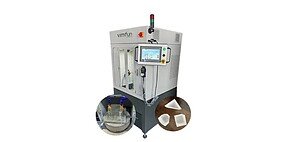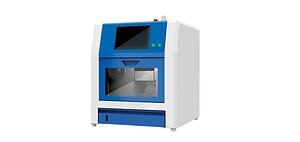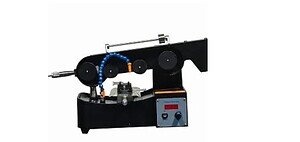
Why do certain diamond wire saws cut gems without harm while others damage them? More than 7 years of experience in precision cutting equipment and laboratory cutting machines. I’ve seen this issue eat up hours of lab work. This article will describe what size small diamond wire saw can take.
I will discuss wire diameter in mm and inches, length of cut, depth of cut, and table size. I will also demonstrate to you which size works for different materials. By the end, you will know precisely what to get for your lab.
What Is a Small Diamond Wire Saw and Why Does Size Matter?
The small diamond wire saw is a cutting instrument in the laboratory. It does virtually minimal harm to hard, brittle, or delicate materials. The wire is tiny — frequently sub 0.3 mm. It travels around pulleys. Cuts gradually and neatly. Unlike a blade saw, it takes relatively little material away.
This is important for cutting crystals, semiconductors, or ceramics. Equipment like this is utilized in geology, electronics, and medical research for precision cutting. The size of the wire, the length of the cut, and the size of the table all will effect your outcomes. Wrong size choice consumes time and destroys samples.
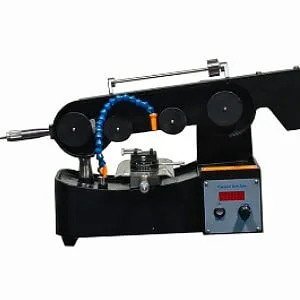
Small Diamond Wire Saw – Key Size Specifications at a Glance
| Specification | Typical Range | Common Unit | Notes |
| Wire Diameter | 0.10 – 0.40 mm | mm / inch | Thinner = less kerf loss |
| Cutting Length (usable) | 150 – 400 mm | mm / inch | Depends on machine model |
| Max Sample Width | 50 – 200 mm | mm | Varies by table size |
| Max Cutting Depth | 30 – 150 mm | mm | Controlled by arm travel |
| Wire Loop Length | 3,000 – 8,000 mm | mm | Endless diamond wire technology |
| Table Size (X × Y) | 100×100 – 200×200 mm | mm | Adjustable on most models |
What Wire Diameter Should You Choose for Precision Cutting?
The size selection of the sample preparation equipment is particularly crucial for the wire diameter. Less material lost with a thinner wire – this is termed kerf loss for rare or valuable samples, and this matters a lot. Most of the tiny diamond wire saws are in the range of 0.10 mm (0.004 inch) to 0.40 mm (0.016 inch).
Thinner wire cuts more smoothly but may break under extreme stress. Thicker wires are stronger and better for tougher samples. For most users of laboratory cutting machines, the optimal starting point is 0.20 – 0.30 mm.
How Wire Thickness Affects Cut Quality
Wire thickness controls three key things: kerf width, surface finish, and speed.
- A 0.10 mm wire gives the cleanest, finest cut – great for fragile material cutting like crystals or tissue
- A 0.20 mm wire is the most used in labs – it balances speed and cut quality well
- A 0.30 mm wire works better on hard ceramics and composites
- A 0.40 mm wire is for tough or large industrial samples
Wire Diameter Comparison
| Wire Diameter | Kerf Width | Best For | Fragile Use | Speed Rating |
| 0.10 mm | ~0.12 mm | Ultra-thin crystals, tissue | Excellent | Slow |
| 0.20 mm | ~0.22 mm | Semiconductors, soft ceramics | Very Good | Medium |
| 0.30 mm | ~0.33 mm | Hard ceramics, glass | Good | Medium-Fast |
| 0.40 mm | ~0.44 mm | Industrial composites | Moderate | Fast |
What Does Wire Diameter Look Like in Inches?
- 0.10 mm = 0.004 inch
- 0.20 mm = 0.008 inch
- 0.30 mm = 0.012 inch
- 0.40 mm = 0.016 inch
Key Buying Tip
Always match wire size to your sample value and material. For fragile or uncommon samples, use thinner. VIMFUN offers small diamond wire saws in a selection of wire diameters. You can replace wires without completely recalibrating. This saves a lot of time in a busy lab.
What Cutting Length and Depth Can a Small Diamond Wire Saw Handle?
Many purchasers ignore the importance of cut length and cut depth and live to regret it. Cutting length is the maximum cut the wire can make in one pass. Cutting depth: The thickness of material the arm can cut through. Most small diamond wire saws can take lengths from 150 mm to 400 mm and depths from 30 mm to 150 mm.
A length of 200 mm and a depth of 80 mm are suitable for most samples for a crystal cutting machine at a university lab. Check both specifications always. Your sample size must be suitable for the research laboratory equipment you use.
Cutting Length vs Cutting Depth – What Is the Difference?
- Cutting Length = how wide a sample the wire can cross (left to right)
- Cutting Depth = how deep the arm travels down through the sample (top to bottom)
Advantages and Disadvantages by Size Range
Short Cutting Length (150–200 mm)
- Small and small – fits on any tabletop
- Cheaper and more easy to maintain
- Can not cut huge chunks or rock cores
- Will only work for tiny samples in lab
Medium Cutting Length (200–300 mm)
- Size most preferred for laboratory cutting machine demands
- Works on semiconductors, pottery, fossils etc.
- Mid-range price
- Might require a table expansion for really big samples
Long Cutting Length (300–400 mm)
- Suitable for large industrial and geological specimens
- Great for Geology Labs and Archaeology Labs
- Larger size, more expense
- Too large for ordinary university laboratory usage
Cutting Size Comparison with Summary
| Machine Size Class | Cutting Length | Cutting Depth | Best Sector | Summary |
| Compact / Benchtop | 150–200 mm | 30–60 mm | University labs, medical | Great for small, precise samples in tight spaces |
| Standard Lab | 200–300 mm | 60–100 mm | Research, semiconductors | Most flexible – covers 90% of lab needs |
| Semi-Industrial | 300–400 mm | 100–150 mm | Geology, materials science | For large samples and high-volume cutting |
| Custom / Modular | Adjustable | Adjustable | Industrial, aerospace | Built for special or custom project needs |
The normal lab size (200-300 mm) is preferred by most users of precision cutting equipment in research and university laboratories all around the globe.
Which Industries Use Small Diamond Wire Saws – and What Sizes Do They Need?
Jobs come in various sizes. An arm for a geologist cutting rock cores is longer than an arm for a chip developer slicing a 2-inch wafer. Knowing your field makes it easier to determine the proper size. Endless diamond wire technology is employed in electronics, geology, health and even art studios.
Each field has sizes that are better suited. The perfect fit saves your time, preserves your samples and lowers waste. Getting the size incorrect may quickly damage a sample. Here are true examples of what sizes each business typically utilizes.
Case Study: Small Diamond Wire Saw Sizes Across Sectors
| Industry | Typical Sample | Wire Diameter | Cutting Length Needed | Result |
| Semiconductor | Silicon wafers (2–6 inch) | 0.10–0.20 mm | 150–200 mm | Smooth cuts, no chipping |
| Geology / Petrology | Rock cores (up to 100 mm) | 0.30–0.40 mm | 200–300 mm | Clean slices for lab analysis |
| Medical / Biomedical | Bone, tissue, implants | 0.10–0.20 mm | 100–200 mm | Minimal damage, sample intact |
| Materials Science | Ceramics, composites | 0.20–0.30 mm | 200–300 mm | Clean cuts for SEM analysis |
| Art Conservation | Fossils, ancient artifacts | 0.10–0.20 mm | 150–250 mm | Safe, low-damage cutting |
Additional Sector Insights
The Electronics and Semiconductor Labs. These laboratories require the smallest wires — roughly 0.10-0.15 mm. Most wafers will need a cutting length of 150mm. The surface polish has to be flawless. Any chip or break damages the sample.
- Best wire size 0.10 – 0.15 mm
- Optimal length of cut: 150 mm – 200 mm
- Low vibration and coolant control must be applied
Geology and Earth Sciences Rock and mineral samples are large and hard. The labs require bigger cables and longer arms. For fossils and rare rocks, fragile material cutting still important.
- Best wire gauge: 0.30-0.40 mm
- Best cutting length: 250-400 mm
- High wire tension and adjustable feed force are a must
What Extra Size Features Should You Check Before Buying?
It’s not only wire diameter and length of cut that count. Also, the table size, wire loop length and feed travel range are of great importance. Many purchasers of research laboratory equipment fail to examine the size of the table.
Then their sample does not fit – even if the arm is long enough. A suitable benchtop crystal cutting machine must have a table of at least 150 x 150 mm. It also requires adjustable wire tension and a minimum of 3,500 mm loop.
Key Extra Specs to Check
- Wire loop length: 3000-8000mm longer loops tend to wear less and cut longer before a replacement is needed
- Table size (X × Y): 100×100 mm is minimal; 200×200 mm is suitable for most laboratories
- Feed travel: 80 – 100 mm minimum vertical movement for deep cuts
- Wire speed range: 1-20 m/s – slower for delicate samples, quicker for tougher ones
- Cooling system: An integrated coolant nozzle must be included for heat sensitive samples
Why Wire Loop Length Matters
Endless diamond wire technology uses a wire that loops back on itself. Longer loop = longer time. This is why:
- Longer wire length guarantees longer lasting diamonds
- Less down time = Less wiring modifications
- Lower cost per cut over weeks and months of time.
- Better value for money for high-volume labs
FAQs
What is the most common wire diameter for a small diamond wire saw?
The most often utilized wire size is 0.20-0.25 mm. This works nicely for most lab samples. It will cut semiconductors, soft ceramics and crystals neatly. This is the size most conventional precision cutting equipment comes with And it’s also simple to get as a replacement.
- Best for: crystals, glass, semiconductors
- Blade width: approx. 0.22-0.28 mm
- As a spare, available from most providers
What wire size is best for fragile material cutting?
Use the thinnest wire you can find — 0.10 – 0.15 mm. The thin wire removes less material. It is less stressful on the sample. This is the option for bones, fossils, thin crystals or tissue.
- For the most fragile samples use 0.10 mm
- Keep wire speed modest – 1 to 5 m/s is optimum
- Always run coolant to avoid heat cracking sample
Does wire loop length affect cutting performance?
Yes, it does. The diamonds will wear out slower with a longer loop. As time goes on more wire touches the sample. The loop endless diamond wire technology is 5,000+ mm and lasts significantly longer than a 3,000 mm loop.
- Longer loop = lower cost per cut
- 3,000–5,000 mm: standard for small machines
- 5,000–8,000 mm: better for high-use or busy labs
What table size should I pick for a small diamond wire saw?
The minimum size of the table for flexible usage is 150 × 150 mm. If your samples are bigger then choose 200 x 200 mm. Not simply what the wire can get to. The size of the table restricts what you can clamp down.
- Minimum: 100 x 100 mm (small crystals only)
- Standard – 150 x 150 mm (most versatile)
- Size: 200 x 200 mm (geology; material science)
Conclusion
A small diamond wire saw cuts wire from 0.10 mm to 0.40 mm, lengths from 150 mm to 400 mm, and depths from 30 mm to 150 mm. The proper size depends on your material and your sample. Always match the wire, length, and table size to your actual lab demands.
Wrong size costs time and spoils samples. Get the greatest precision cutting tools with VIMFUN. They have all of the sizes, competent assistance and quick delivery. Visit VIMFUN now and obtain the right equipment for your lab.