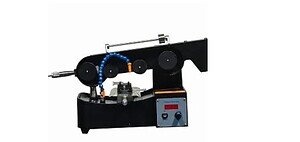
In traditional diamond wire cutting processes, operators have historically relied on years of experience, intuition, and manual observation to adjust cutting parameters. However, this “black box” operational model is rapidly becoming obsolete, especially as industries machining silicon carbide (SiC), sapphire, and quartz demand stricter micron-level tolerances. Modern manufacturing requires “white box” transparency—monitoring every critical parameter in real time, letting data speak, and using Artificial Intelligence (AI) to guide decision-making. Implementing process monitoring data control is becoming the critical foundation for high-efficiency, low-cost, and high-yield manufacturing.
By shifting from a reactive approach to a proactive, predictive model, data-driven decision-making can drastically enhance both efficiency and product yield. The integration of AI control and automated compensation is no longer a luxury but a necessity, standing in stark contrast to the outdated “rule of thumb” techniques that often lead to hidden material waste and equipment fatigue.

Why is Real-Time Monitoring Necessary?
The transition to Industry 4.0 means that running diamond wire cutting equipment is no longer just a mechanical task; it is a highly complex, continuous data exchange process. The limitations of traditional operations make real-time monitoring commercially vital.
The Cost of Traditional “Black Box” Operations
Operating without real-time data visibility comes with severe, often unquantified penalties for manufacturing facilities:
- Over-Reliance on Operator Experience: Without objective data, different operators will set wildly different parameters for the same material. This lack of standardization makes it nearly impossible to consistently replicate optimal cutting conditions across various shifts.
- Delayed Problem Detection: In a traditional setup, by the time an operator visually identifies degrading surface quality or Total Thickness Variation (TTV) issues, a significant amount of scrap has already been produced. Furthermore, wire breakage often occurs suddenly and without warning, leading to catastrophic tool failure. Equipment wear, such as guide wheel degradation, goes unnoticed until it causes a major defect.
- Hidden Cost Escalations: The consequences of the “black box” are high scrap rates (typically hovering between 3% and 8%), prolonged downtime due to trial-and-error troubleshooting, and unnecessarily frequent wire replacements. Operators often discard expensive endless diamond wire loops prematurely “just to be safe,” wasting valuable resources.
Three Core Values of Real-Time Monitoring
The implementation of a robust monitoring architecture provides three distinct commercial and operational values:
Value 1: Predictive Maintenance
Instead of waiting for a failure, sensors detect micro-anomalies. For example, a progressive drop in wire tension indicates imminent failure. By catching this early, operators can plan a 15-minute wire change instead of suffering a sudden break that requires 2 hours of emergency recovery. Economically, identifying this early saves thousands of dollars per incident in downtime alone. Achieving accurate line replacement cost optimization is only possible with this predictive capability.
Value 2: Adaptive Parameter Optimization
Sensors constantly gauge cutting load, temperature, and surface quality. When integrated with AI models, the system autonomously adjusts feed rates, linear wire speeds, and tension. The result is a Material Removal Rate (MRR) that automatically sustains its optimal peak without human intervention. Factories can expect a 15-25% boost in efficiency and a 40-60% reduction in scrap rates.
Value 3: Traceability and Continuous Improvement
Every single cutting batch generates a comprehensive data log. Process engineers can analyze these logs to identify exactly which parameter combinations yield the best results. This creates an empirical foundation for experimenting with new materials and builds a permanent, digitized “Process Knowledge Base” for the enterprise.
Key Sensors and Monitoring Metrics
To establish effective data control, the physical layer must be outfitted with highly responsive, industrial-grade sensors.
Key Sensor Checklist
Below is a breakdown of the essential sensors required to transform standard diamond wire cutting equipment into an intelligent machining center.
Table 1: Key Sensor Checklist – [Alt Text: Key sensors for process monitoring data control including tension, temperature, and load sensors with pricing and accuracy]
| Sensor Type | Monitoring Metric | Function / Purpose | Accuracy Requirement | Typical Price Range (USD) |
|---|---|---|---|---|
| Tension Sensor | Wire Tension (N) | Detects wire wear, tension drift, and provides wire break warnings. | ±5 N | $500 – $1,000 |
| Temperature Sensor | Wire Exit Temp (℃) | Evaluates cooling efficiency and prevents thermal damage to the wire/material. | ±2 ℃ | $200 – $500 |
| Vibration Accelerometer | Mechanical Vibration Spectrum | Detects guide wheel wear, spindle imbalance, and bearing degradation. | ±10% | $1,000 – $2,000 |
| Load Cell | Cutting Load (kN) | Diagnoses feed stability and the sharpness/state of the diamond wire. | ±2% | $800 – $1,500 |
| Online Roughness Meter | Surface Roughness Ra (μm) | Real-time quality monitoring and abrasive particle status evaluation. | ±0.1 μm | $5,000 – $8,000 |
| Flow Meter | Coolant Flow (L/min) | Detects system clogs, evaluates lubrication efficiency. | ±3% | $300 – $600 |
Key Monitoring Metrics and Their Meanings
Gathering data is useless without defining what normal looks like. Here are the 6 critical metrics tracked in real-time:
Table 2: Six Core Monitoring Metrics – [Alt Text: Six crucial metrics for process monitoring data control in cutting including tension stability and MRR consistency]
| Metric | Definition | Target / Ideal Range | Diagnostic Signal |
|---|---|---|---|
| Wire Tension Stability | The standard deviation of tension fluctuations. | <10 N (at a 200 N baseline). | Fluctuations >20 N indicate guide wheel wear or servo motor faults. |
| Temperature at Wire Exit | Temperature of the wire as it leaves the cutting zone. | <50℃ (coolant in), <45℃ (coolant out). | Temp >55℃ indicates insufficient cooling; wire life will rapidly decrease. |
| Cutting Load Trend | Rate of load change per unit of time. | Stable load within ±10%. | A gradually increasing load means the wire is dulling or abrasives are shedding. |
| Real-time Surface Roughness | Average Ra of every 10 samples measured. | Ra < 0.8 μm (for silicon wafers). | Gradually increasing Ra signals accelerated abrasive wear; wire replacement needed. |
| Equipment Uptime | (Total Time – Downtime) / Total Time. | >95%. | Used to track the frequency, duration, and root cause of machine stoppages. |
| MRR Consistency | Coefficient of variation for intraday MRR. | <5%. | Indicates process stability and highly predictable product yields. |
Sensor Integration Architecture
The flow of data from the physical cut to the automated response follows a strict hierarchy. Achieving true parameter optimization automation relies on this low-latency pipeline, while thermal anomalies rely on precise temperature monitoring and thermal management routing:
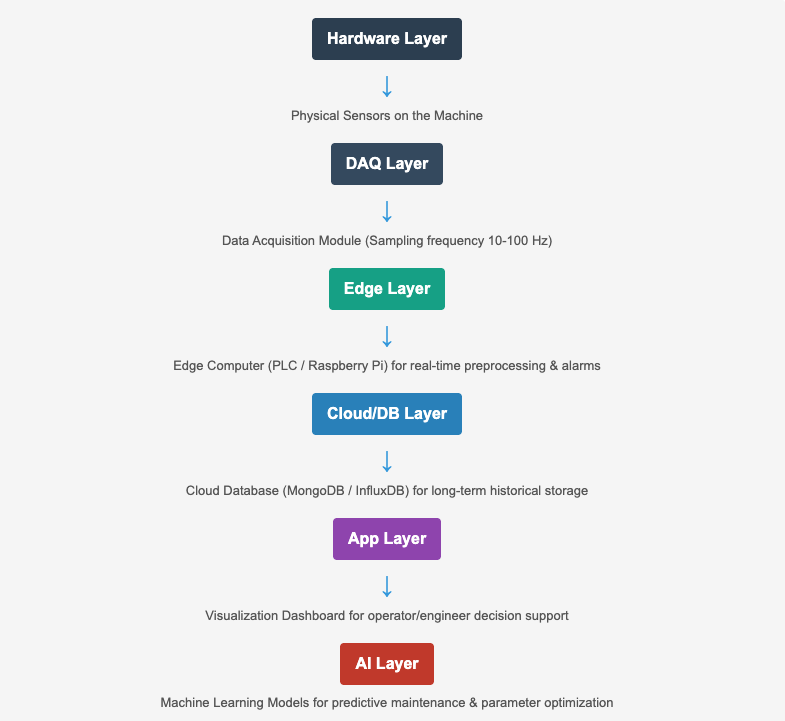
Data-Driven Automatic Parameter Control
The ultimate goal of extracting data is to close the loop—allowing the machine to correct itself before a defect occurs.
Principles of the Closed-Loop Control System
In a traditional open-loop system, an operator sets parameters, executes the cut, manually observes the outcome, and makes adjustments. This cycle takes hours. In a modern closed-loop system powered by process monitoring data control, sensors feed real-time data to an AI decision engine, which automatically executes micro-adjustments in milliseconds.
Three Typical Automated Control Scenarios
Scenario 1: Adaptive Tension Control
- Monitoring Flow: The system detects wire tension dropping 10N below the setpoint.
- Action: The PLC immediately commands the servo motor to increase tension. The system remeasures within 5 seconds. If the target isn’t met, it increases tension again or triggers a diagnostic alert for guide wear.
- Benefit: Traditional manual adjustment requires 30 minutes of reaction time. Automated control takes 30 seconds with zero human intervention. Tension fluctuations drop from ±20N to ±5N, extending endless wire life by 15-20%.
Scenario 2: Temperature-Feedback Feed Adjustment
- Monitoring Flow: Wire exit temperature exceeds 50℃.
- Action: The AI algorithm diagnoses the root cause. Is coolant flow low? It increases pump output. Is the feed rate too aggressive? It automatically reduces the feed rate by 5%.
- Benefit: Prevents the diamond wire from overheating and softening. It avoids sub-surface damage (SSD) deepening, thereby improving yield.
Scenario 3: Predictive Wire Replacement Alerts
- Monitoring Flow: A linear regression model tracks the daily downward trend of wire tension holding capacity.
- Action: The trendline predicts the wire has 72 hours of viable life left. When the system schedule shows 48 hours of work remaining, it triggers a pre-warning.
- Benefit: Operators plan the replacement during a scheduled batch gap, achieving zero unplanned downtime. Sudden breaks drop from 2-3 times a month to nearly zero.
AI Model Training and Optimization
Implementing AI isn’t instantaneous. It requires a phased approach:
- Initial (Months 1-3): Collect baseline data across 100+ complete cutting cycles, covering different materials (e.g., SiC, quartz), thicknesses, and wire speeds.
- Mid-Term (Months 3-6): Train decision trees or neural networks using historical data to predict optimal next-step adjustments based on current sensor inputs.
- Long-Term (>6 Months): Continuous learning allows the model to adapt to process drift, such as changing wire suppliers.
Table 3: Improvement Comparison (Traditional vs. AI Control) – [Alt Text: Traditional vs AI control improvements using process monitoring data control for cutting metrics]
| Metric | Traditional Method | AI Controlled | Improvement |
|---|---|---|---|
| Operator Intervention | 4-6 times / day | 0-1 times / week | ↓ 95% |
| Unplanned Downtime | 2-4 hours / week | 0.5 hours / week | ↓ 80% |
| Wire Replacement Freq. | 5-7 loops / month | 3-4 loops / month | ↓ 40% |
| MRR Stability | ±15% | ±3% | ↑ 80% |
| Overall Yield | 94-96% | 98-99% | ↑ 3-5% |
By leveraging real-time MRR optimization and strictly enforcing real-time quality monitoring, factories can drastically increase their throughput without expanding their footprint.
Data Analysis and Continuous Improvement
Data is only as valuable as the insights extracted from it. Process engineers must utilize historical data to refine their manufacturing philosophy continually.
Four Levels of Data Analysis
- L1 – Dashboards and Reporting (Daily): Tracking today’s average MRR, tension trends, and downtime counts. Used by floor operators and shift leaders via tools like Grafana.
- L2 – Key Metric Analysis (Weekly): Comparing week-over-week yield and correlating wire life with specific parameter combinations. Used for performance evaluations.
- L3 – Deep Data Mining (Monthly): Developing optimal parameter curves for different materials (silicon vs. sapphire) and benchmarking new wire suppliers against legacy ones. Used for process improvement and maintenance scheduling.
- L4 – Machine Learning Prediction (Strategic): Predicting next quarter’s wire consumable demand or forecasting spindle/guide wheel failure. Used for executive procurement and CAPEX decisions.
Case Study: Silicon Wafer Plant Parameter Optimization
- Baseline: Linear wire speed at 75 m/s (based on machine specs), feed rate at 1.0 mm/min. Yield was stagnant at 94.5%.
- Data Analysis (200+ batches over 3 months): Data revealed an inverse relationship between MRR and wire life in the 70-80 m/s range. However, quality was most stable when the feed rate was dynamically kept between 0.8-1.2 mm/min.
- Optimal Combination Discovered: 72 m/s wire speed + 1.1 mm/min feed rate.
- Results: MRR increased by 18%, wire life increased by 8%, and yield jumped to 97.8%. The net annual economic benefit was over ¥380,000 simply by tweaking software parameters.
Building an Enterprise Process Knowledge Base
The ultimate goal is translating raw data into standardized fundamental cutting process knowledge. By building decision trees (e.g., IF Material = Silicon AND Thickness = 300mm THEN Set Wire Speed = 75 m/s), companies can onboard new engineers in days rather than months. Furthermore, combining this with rigorous cooling system optimization ensures that knowledge remains institutionalized, protecting the company against employee turnover.
Implementation Roadmap and Return on Investment (ROI)
For decision-makers, implementing this technology requires a structured, financially sound roadmap.
Phased Implementation Plan
Table 4: Phased Implementation and Costs – [Alt Text: Phased implementation roadmap for process monitoring data control system including costs and ROI]
| Phase | Core Actions | Estimated Cost (USD) | Expected Benefits | Payback Period |
|---|---|---|---|---|
| Phase 1: Basic Monitoring (Months 1-2) | Install 4-6 key sensors, basic DAQ/PLC, simple alarm logic, database setup. | $12,000 – $18,000 | 15% drop in wire cost, 40% drop in downtime via alarms. | 3-4 Months |
| Phase 2: Vis & Alarms (Months 3-4) | Deploy Grafana dashboards, SMS/Email alerts, operator training. | $6,000 – $9,000 | Increased operator efficiency, second-level issue response. | 5-6 Months |
| Phase 3: Closed-Loop AI (Months 5-12) | Servo/hydraulic upgrades, AI model training, deep PLC integration. | $30,000 – $45,000 | 3-5% yield boost, 20% capacity increase, 25% cost drop. | 8-12 Months |
ROI Calculation Example (2000kg/day Silicon Cutting Plant)
Table 5: ROI Calculation Example – [Alt Text: ROI calculation for process monitoring data control investment showing rapid payback]
- Initial 3-Year Investment: $60,000 (Hardware, Software, Integration, Training)
- Annual Savings – Wire Cost: Previous cost was $150,000/yr. Saving 25% yields $37,500/yr.
- Annual Gains – Yield Improvement: Boosting yield from 94% to 98% yields an extra 20,000 kg/year. At $15/kg profit, this equals $45,000/yr.
- Annual Gains – Uptime: Reducing downtime by 80% equals $27,000/yr in extra capacity utilization.
- Total Annual Benefit: ~$109,500.
- Year 1 ROI: ($109.5k – $60k) / $60k = 82.5%
- 3-Year Cumulative ROI: 447%
Implementation Risks and Mitigation
Table 7: Common Risks and Mitigation – [Alt Text: Risk management in process monitoring data control deployment]
| Risk Factor | Probability | Mitigation Strategy |
|---|---|---|
| Poor Data Quality | High | Strict sensor selection; implement a rigorous calibration schedule. |
| Operator Resistance | Medium | Emphasize system as an “assistive tool” not a “replacement.” |
| System Reliability | Medium | Design redundant systems; keep manual override backups available. |
| Integration Complexity | High | Choose proven commercial off-the-shelf solutions over purely in-house builds. |
Case Study: Data-Driven Transformation in a Sapphire Plant
Background: A facility producing 300 kg of sapphire daily utilizing 5 wire saws and 50 staff members was struggling. They faced high wire replacement frequencies (7 loops/machine/month), volatile yields (91-96%), and extensive downtime (12 hours/month).
Implementation Process (12 Months):
- M1-M2 (Planning): Installed tension, temp, and load sensors on two pilot machines.
- M3-M4 (Alarms): Activated basic threshold alarms. Wire breakage immediately dropped by 60%.
- M5-M8 (Analysis): Gathered 1,000+ cutting cycles. Discovered optimal parameters were vastly different from operator habits (68 m/s speed + 0.65 mm/min feed, compared to historical 75 m/s + 0.72 mm/min).
- M9-M12 (Rollout): Pushed AI control to all 5 machines.
Final Results (Compared to Baseline):
Table 6: Sapphire Plant Case Study Results – [Alt Text: Case study results of process monitoring data control in a sapphire plant]
| Metric | Baseline | Current Status | Improvement |
|---|---|---|---|
| Wire Cost / Month | $5,000 | $3,100 | ↓ 37% |
| Product Yield | 93.2% | 98.1% | ↑ 4.9% |
| Downtime / Month | 12 Hours | 2 Hours | ↓ 83% |
| New Hire Training | 12 Weeks | 4 Weeks | ↓ 66% |
The key success factor was strong executive sponsorship and prioritizing high-fidelity data over sheer sensor volume.

Common Problems and Troubleshooting
Q1: Sensor data is too noisy to make decisions. What is the cause?
Root Cause: Sensors are mounted too close to electromagnetic interference or vibration sources, or the data sampling rate is too low to capture true waveforms.
Solution: Relocate sensors away from main spindles. Increase sampling rates to >100 Hz. Apply low-pass or moving-average software filters to smooth out the noise before feeding it to the AI.
Q2: The AI model’s recommended parameters contradict human experience.
Root Cause: The model may be overfitting to noisy data, or process conditions (like a new batch of abrasive slurry or a new wire vendor) have fundamentally changed the baseline.
Solution: Do not blindly trust the AI. Run test cuts on low-value batches. Keep manual override authority. Allow the AI to continually ingest new data to recalibrate itself over a 3-6 month period.
Q3: The system investment is too large, and the ROI cycle seems too long.
Root Cause: The factory is attempting a “Big Bang” implementation instead of a phased approach.
Solution: Start small. Implement Phase 1 (basic monitoring) on your 2 most critical bottleneck machines. Use the immediate savings from preventative wire replacements to fund the expansion into closed-loop control.
Q4: Employees are resisting the automation, fearing job loss.
Root Cause: Top-down implementation without clear communication regarding the system’s purpose.
Solution: Frame the system as a “co-pilot,” not an autopilot. Upskill operators to handle data interpretation and complex maintenance rather than manual knob-turning. Implement incentive programs tied to the yield improvements the system generates.
Future Trends and New Technologies
Process monitoring data control is evolving rapidly. Here is where the technology is heading:
Short-Term Trends (1-2 Years)
- Cloud Data Centers: Aggregating data across multiple facilities allows for cross-factory benchmarking. Small factories can leverage subscription-based cloud AI instead of building massive on-premise IT infrastructure.
- Edge AI Execution: Deploying lightweight models (TensorFlow Lite) directly on the machine’s edge controller guarantees ultra-low latency, ensuring cuts are adjusted in milliseconds without relying on internet connectivity.
- Multi-Source Data Fusion: Combining mechanical load data with acoustic emission and computer vision to detect micro-cracks in the wire 2-3 hours before a structural failure occurs.
Mid-Term Disruptions (2-5 Years)
- Digital Twin Technology: Creating a perfect virtual replica of the cutting machine. Engineers can simulate radical parameter changes safely in the digital realm before pushing the updated code to the physical machine, cutting R&D time from months to weeks.
- Reinforcement Learning: Machines will no longer rely solely on historical data. They will “learn” in real-time, autonomously experimenting within safe bounds to continuously optimize for shifting process variables.
Long-Term Vision (>5 Years)
- “Lights Out” Factories: Fully autonomous diamond wire cutting facilities combining AI control with robotic loading, wire changing, and self-diagnostics. Operating 24/7 with zero human intervention.
- Hyper-Personalized Manufacturing: AI automatically micro-adjusting parameters for individual wafers based on specific client requests (e.g., requesting Ra < 0.3 μm), cutting order verification cycles from one month to one week.
Frequently Asked Questions
Q1: Will a real-time monitoring system significantly increase my overhead costs?
While there is an initial CAPEX investment (ranging from $12,000 to $50,000 depending on scale), the system actively reduces operational overhead. By virtually eliminating sudden wire breaks and slashing scrap rates, annual ROI typically falls between 30% and 50%. Most factories recover their investment within 12 to 18 months, after which it generates pure profit.
Q2: How should I handle situations where the AI recommendations don’t match my floor supervisor’s intuition?
AI should be treated as a highly capable advisor, not an absolute commander, especially during the first 6 months. When conflicts arise, test the AI’s parameters on a small, low-risk batch. As the system ingests more operational data, its recommendations will objectively outperform human intuition. The final decision, however, should always remain in human hands.
Q3: Can small factories benefit from this, or is it only for massive semiconductor plants?
Small factories actually benefit tremendously because they often have more room for improvement. A small operation can start with a basic sensor package on their primary bottleneck machine. Their agile nature allows them to implement changes and see financial returns much faster than heavily bureaucratic larger corporations.
Q4: Which sensors are the most critical? Should I install as many as possible?
More is not always better; “fewer but precise” is the golden rule. Prioritize wire tension, cutting load, and exit temperature sensors—these three provide the highest signal-to-noise ratio regarding the wire’s health. Installing unnecessary sensors generates data noise that can confuse both the operators and the diagnostic algorithms.
Conclusion
The strategic significance of process monitoring data control extends far beyond simple equipment upgrades; it represents a fundamental shift in manufacturing philosophy. It moves facilities away from “experience-driven” guesswork and reactive firefighting toward “data-driven” precision and proactive forecasting. In the highly competitive realms of hard and brittle material machining, relying on diamond wire cutting fundamentals augmented by real-time AI control has transitioned from a competitive advantage to a baseline requirement. Regardless of the facility’s size, adopting intelligent, transparent operations ensures that manufacturing becomes predictable, highly profitable, and sustainably scalable into the future.