Choosing between a glass wire saw and a circular diamond blade saw requires the actual material, thickness, geometry and final specification. For diamond wire saws, the machine and diamond wire loop must be matched to the job. Neither method is universally better. Compare complete cycles, accepted-part yield, edge and subsurface condition and remaining finishing under equivalent trial conditions.
1. Kinematic Principles & Cutting Mechanics Comparison
The fundamental operational difference between a circular blade saw and an endless diamond wire saw lies in tool geometry, contact mechanics, and normal cutting forces:
- Circular Diamond Blade Saws: Blade construction, grit, bond, speed, feed, support and cooling affect the cut. Evaluate load, temperature and damage for the particular setup rather than assigning every blade a high thrust or temperature. Thin dicing and thick-stock sawing are different operations.
- Endless Diamond Wire Saws: A flexible abrasive loop travels continuously through the cut. Guidance, tension, feed, abrasive and support affect the result. Thin wire and fluid flushing alone do not establish a particular force, ductile removal regime, contact temperature or freedom from thermal damage.
2. Kerf Loss & Material Yield: Economics on Expensive Technical Glasses
Material loss matters for valuable glass, glass-ceramics and crystals. Distinguish fused silica, borosilicate, ZERODUR glass-ceramic, chalcogenide glass and sapphire crystal and compare actual accepted parts rather than one universal kerf for each process:
- Blade Kerf: Select a blade suited to the thickness and task and measure the resulting kerf and runout effects. Blade body thickness is not the actual kerf, and not all diamond blades require a thick steel core.
- Wire Kerf: Measure the actual slot with the selected coated wire, guides, tension and feed. Core diameter alone is insufficient; wire bow, abrasive and tracking also matter. No universal kerf width or guide-runout limit is specified.
Yield Comparison Method: Use a defined usable stock length, target part thickness, measured kerf, end allowances, finishing stock and rejects for both processes. The earlier numerical example has incomplete inputs and is not used to calculate a production yield.
- Blade Trial: Record the actual stock, qualified part thickness, measured kerf and finishing requirement. Count accepted parts after the agreed inspection, not only the number of nominal cuts.
- Wire Trial: Use the same material and final acceptance criteria and include wire setup, handling and rejects. Calculate a yield difference only when both sets of inputs and the inspection results are complete.
Assess material savings together with capital cost, consumables, setup, handling, inspection and downstream finishing. Payback depends on the actual workload and qualified output; no fixed return within a few months is established here.
3. Edge Chipping & Subsurface Damage (SSD): Impact on Post-Processing
Glass is inherently notch-sensitive; surface cracks and edge flaws severely degrade the mechanical strength and optical wavefront fidelity of finished glass components:
- Blade Edge and Subsurface Condition: Measure breakout and damage for the specific blade, material, feed, cooling and support. Assess roughness and subsurface damage separately rather than treating all blade cuts as one damage depth.
- Wire Edge and Subsurface Condition: Inspect the actual part using the agreed methods, including support and exit effects. A backing plate does not guarantee a fixed chip size or SSD depth. For setup factors, see how to set up a glass cutting saw for precise cuts; that guide is not a performance guarantee.
- Post-Processing: Decide grinding, lapping, polishing, cleaning and stock allowances from the final specification and measured cut condition. Wire sawing does not universally eliminate rough grinding, reduce finishing by a fixed percentage or require CMP for every optical component. An as-cut surface is not necessarily a finished optical surface.
4. Depth of Cut & Workpiece Thickness Scalability
Thickness capacity is a major physical differentiator between rotating circular blades and linear diamond wire loops:
- Blade Access and Depth: Check the permitted blade diameter, flange clearance, guarding, spindle, workholding and actual machine depth limit. Review cooling and stability in the proposed cut. A generic formula or oversized-blade example is not a safe equipment selection rule.
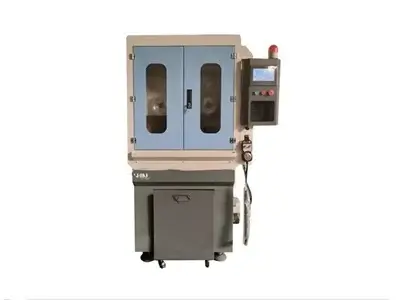
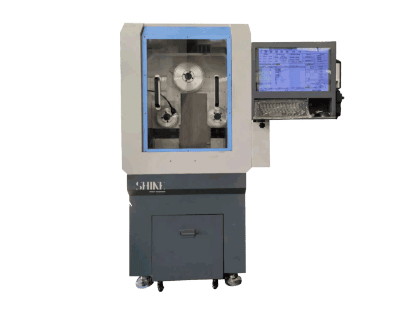
- Wire Cutting Capacity: For the SG 20 glass cutting wire saw, confirm the actual usable workpiece, travel, support and cut path. A wire system has different access constraints from a circular blade, but no flange obstruction does not mean unlimited depth, uniform cutting force or zero pinching risk.
5. Geometric Versatility: 2D Contouring vs. Straight Planar Slicing
Workshops frequently require non-planar glass geometries, such as circular blanks, curved optical elements, and multi-facet prisms:
- Circular Blade Geometry: Confirm available straight, angled, indexed or other supported cuts on the actual machine. Do not reduce all blade machines to a single linear motion or assume every alternative contour process necessarily causes unacceptable damage.
- Wire Profile and Prism Options: Review the actual axes, path, entry and fixtures for the CNC contour cutting machine SGI 20. For angular blanks, evaluate the SG40-R prism cutting wire saw reference, currently presented as SGR40. Document supported angles, indexing and inspection rather than assuming arbitrary contours or a universal angular precision.
6. Technical Comparison Matrix: Glass Wire Saw vs. Diamond Blade Saw
Use the following checklist to compare candidate setups for the same part. It contains evaluation criteria, not generic performance ratings:
| Decision Factor | Diamond Wire Trial | Diamond Blade Trial | Comparison Basis |
|---|---|---|---|
| Motion and access | Confirm wire layout, axes, threading and guidance | Confirm blade, flange, axes and permitted depth | Actual stock, geometry and safe machine envelope |
| Material loss | Measure kerf, allowances and accepted slices | Measure kerf, allowances and accepted slices | Same material and finished-part criteria |
| Edge and surface | Inspect chipping, roughness and relevant subsurface damage | Inspect chipping, roughness and relevant subsurface damage | Same methods and finishing requirement |
| Production cycle | Include wire setup, cutting, handling and inspection | Include blade setup, cutting, handling and inspection | Time and cost per accepted part |
| Operating needs | Verify power, fluids or extraction, consumables and servicing | Verify power, fluids or extraction, consumables and servicing | Delivered configuration and site assessment |
7. Objective Decision Framework: When to Choose Wire Saw vs. Blade Saw
Choose from representative trials and the complete workflow. The following are reasons to evaluate a method, not automatic selection thresholds:
- When to Choose a Diamond Blade Saw:
- Repeated straight cuts where the selected blade and machine meet the thickness, edge, dimensional and throughput requirements;
- Rough sizing where measured kerf and finishing allowances are acceptable;
- Jobs where the proposed blade system offers the required workflow at an acceptable total cost, without assuming that every blade machine is manual or cheaper.
- When to Choose a Glass Wire Saw:
- Valuable, high-purity, or hard-to-source optical glass (synthetic fused silica, BK7, Zerodur, chalcogenides, laser crystals, optical filter glass);
- Blocks, ingots or boules for which the proposed wire configuration offers suitable access, support and qualified cut quality;
- Parts for which a trial demonstrates acceptable edge and subsurface condition and a practical finishing allowance;
- 2D curved profiling, circular optical blanks, and multi-angle prism facet slicing.
8. Vimfun (Shine) Glass Wire Saw Machinery & Test Cutting Validation
Vimfun (Zhengzhou Shine Smart Equipment Co., Ltd.) designs and manufactures precision industrial diamond wire saws engineered specifically for glass and optical crystal fabrication:
- SG 20 CNC Glass Cutting Wire Saw: Evaluate compatible slicing and stock preparation. Confirm the actual axes, feedback, guarding and cooling; optical scales and a particular flood system are not assumed supplied.
- SG40-R Rotary Prism Cutting Wire Saw: Confirm the current model, rotary mechanism, fixture, supported angles and cycle. Indexing alone does not establish a no-reclamping process for every prism.
- SGI 20 CNC Contour Cutting Machine: Verify supported paths, stock, wire access and trial geometry; coordinated motion alone does not prove closed internal-feature capability.
- SH60-R Model Reference: Confirm the current model, usable stock, rotary arrangement, fixtures and process documentation before proposing it for a quartz ingot. A model label does not establish a particular load or production result.
Use the free diamond wire test cutting service to agree a representative sample, candidate configuration, inspection method and available report. Confirm which kerf, edge, roughness, damage or cycle measurements are included; a full microscopy and production-cost study is not assumed for every trial.