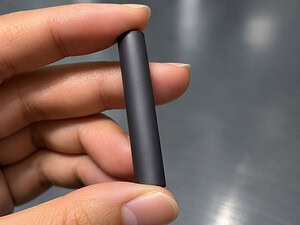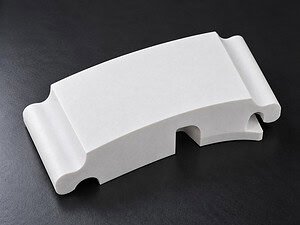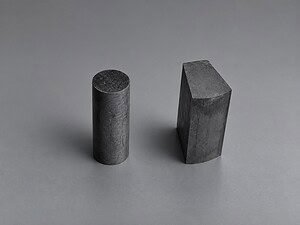
When preparing fragile specimens for Transmission Electron Microscopy (TEM), Scanning Electron Microscopy (SEM), or optical metrology, material scientists frequently ask: can a laboratory wire saw cut through glass and ceramics? The short answer is an emphatic yes. In fact, a precision laboratory diamond wire saw is widely regarded across academic, metallographic, and failure analysis (FA) laboratories as the premier cutting tool for sectioning hard, brittle, and stress-sensitive non-metallic materials without inducing micro-cracks, thermal shock, or edge breakout.
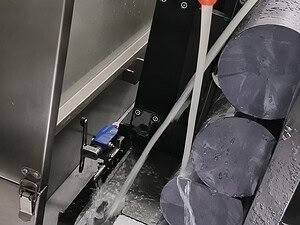
Traditional abrasive cut-off wheels and circular dicing saws generate severe radial clamping loads (> 20–50 N) and intense localized frictional heat (> 300°C) that readily shatter fragile optical glass, delaminate piezoelectric ceramics, and induce phase changes. In contrast, an endless diamond wire saw utilizes an ultra-thin diamond wire loop running at linear speeds of 10 to 40 m/s with continuous fluid flushing. By operating in the low-force brittle-to-ductile micro-grinding regime, laboratory wire saws achieve clean, sub-micron surface finishes (Ra < 0.2 μm) while conserving rare or expensive research substrates.
For an overarching examination of industrial glass cutting advantages, consult our engineering guide on Was macht Glasseilsägen ideal für das Schneiden von Glas. Below, our technical team breaks down the micro-mechanics, material compatibilities, specimen fixturing techniques, and machine configurations for laboratory glass and ceramic sectioning.
1. The Micro-Mechanics: Why Wire Saws Prevent Fractures in Glass and Ceramics
Glass and technical ceramics are characterized by high Vickers hardness (typically 500 to 2500 HV) and low fracture toughness (KIC < 1.0–4.0 MPa·m1/2). Sectioning these materials without breakage requires overcoming three physical failure mechanisms:
- Low Normal Cutting Forces (< 0.5–1.5 N): Brittle fracture initiates when the normal tensile stress under an abrasive grain exceeds Griffith crack propagation limits. Because a diamond wire loop (∅0.20 mm to ∅0.35 mm) presents a microscopic linear contact line, individual electroplated diamond grains remove material via ductile-regime micro-chipping. Normal contact loads remain below 0.5–1.5 N, completely avoiding catastrophic bulk fractures.
- Minimal Kerf Loss (0.25–0.40 mm): Laboratory research specimens—such as isotopic ceramic pellets, laser gain crystals (Nd:YAG), and single-crystal quartz—are often costly or available only in small quantities. A circular blade wastes 1.5 to 3.0 mm of material per cut. A laboratory wire saw limits kerf loss to 0.25–0.40 mm, yielding 2x to 3x more usable analytical slices from a single specimen ingot.
- Null Wärmeeinflusszone (Zero-HAZ): Dry sawing or high-speed abrasive grinding generates extreme frictional heat that causes thermal shock cracking in quartz and induces unwanted phase transitions in zirconia (tetragonal-to-monoclinic transformation). Laboratory diamond wire saws operate with continuous fluid flood cooling (deionized water or water-soluble lubricant), keeping cutting interface temperatures below 40°C and preserving the true crystalline microstructure.
2. Supported Glass and Technical Ceramic Materials
Laboratory wire saws effortlessly process the entire hardness spectrum of non-metallic research materials:
| Material Class | Specific Substrates | Hardness / KIC | Primary Laboratory Application |
|---|---|---|---|
| Optical & Laser Glass | N-BK7, Fused Silica, Zerodur, Nd:YAG | 550 – 750 HV / 0.7–1.2 MPa·m1/2 | Optical prism blanks, laser crystal rods, interferometry test flats |
| Oxide Ceramics | Aluminiumoxid (Al2O3), Zirconia (YSZ, PSZ) | 1400 – 1800 HV / 3.0–5.0 MPa·m1/2 | Bioceramic implants, thermal barrier coatings, wear components |
| Non-Oxide Ceramics | Silicon Nitride (Si3N4), Silicon Carbide (SiC) | 1800 – 2600 HV / 2.5–4.5 MPa·m1/2 | High-temperature turbine components, ceramic armor, wide-bandgap boules |
| Electronic & Piezo Ceramics | PZT, Barium Titanate, AlN | 400 – 1100 HV / 0.8–1.5 MPa·m1/2 | Ultrasonic transducer dice, thermal substrates, MEMS sensors |
| Porous & Layered Ceramics | SOFC electrolytes, ceramic aerogels | Variable porous structure | Energy storage characterization without pore crushing or smear |
3. Specimen Fixturing, Wax Mounting & Edge Protection Protocols
Achieving clean, chip-free cross-sections in a laboratory environment requires disciplined specimen mounting:
- Thermo-Reversible Wax Bonding: Fragile ceramic bars, glass tubes, or wafer chips must never be clamped with steel vise jaws. Researchers should bond specimens to flat aluminum or ceramic mounting plates using thermo-reversible adhesive waxes (such as Crystalbond 509) heated to ~120°C on a laboratory hotplate. Once cooled, the wax provides 100% conformal, stress-free support.
- Sacrificial Exit Backing: When the diamond wire exits the back surface of a glass or ceramic specimen, unconstrained tensile forces cause corner breakout (edge chipping). Placing a sacrificial glass slide or phenolic backing block directly behind the specimen absorbs the exit stress wave, restricting chipping to < 30–50 μm.
- Coolant Compatibility: Use deionized (DI) water with 2% synthetic water-soluble grinding lubricant. The integrated closed-loop fluid pump washes away microscopic glass and ceramic swarf into a settling sump, preventing abrasive recirculation from scratching specimen surfaces.
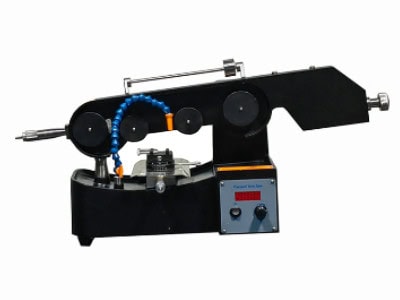
4. Selecting the Right Laboratory Wire Saw Architecture
Vimfun engineers distinct laboratory-scale Diamantdrahtsägen tailored for research facilities, university labs, and industrial failure analysis departments:
A. Gravity-Feed Benchtop Wire Saw (SGD 52)
The SGD 52 utilizes an adjustable counterweight gravity feed mechanism. By adjusting balancing weights, researchers apply extremely light, constant contact forces (as low as 0.1 N) that automatically modulate cutting progress depending on local material density. For detailed mechanical comparisons and ROI considerations, review our guide on premium quality table top wire saws.
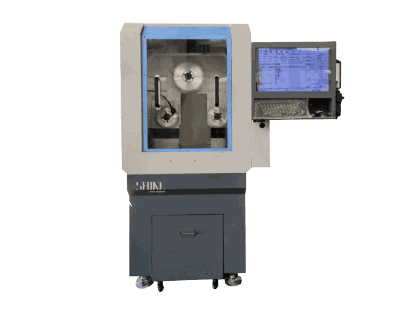
B. CNC Precision Laboratory Slicing Saw (SG 20)
When automated repeatability and exact slice thickness indexing (±0.005 mm) are essential, the SG 20 CNC-Glasdrahtsäge provides closed-loop dual-axis servo feed within an enclosed stainless-steel wet chamber. With programmable wire speeds up to 50 m/s and automated index feeding, the SG 20 produces uniform serial slices for metallographic and crystal characterization.
C. CNC 2D Contour Profiling Saw (SGI 20)
To cut complex internal notches, tensile dogbone specimens, or custom geometric profiles out of ceramic and glass plates, the Kompakte 2D-Profilschneidemaschine executes 2-axis CNC toolpaths with tight internal corner radii impossible to achieve with conventional core drills or milling bits.
Validate Your Laboratory Cutting Parameters
Choosing the ideal diamond wire diameter (∅0.20 mm to ∅0.35 mm), abrasive diamond grit size, and linear cutting velocity depends on your specific substrate hardness and brittleness. Take advantage of Vimfun’s complimentary kostenloser Diamantdraht-Testschneidservice. Submit your research glass or ceramic samples to receive comprehensive cross-sectional roughness (Ra), kerf loss, and subsurface damage reports before choosing your laboratory cutting system.