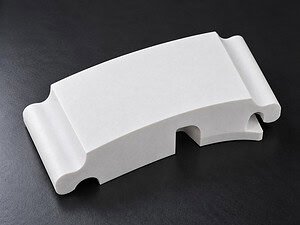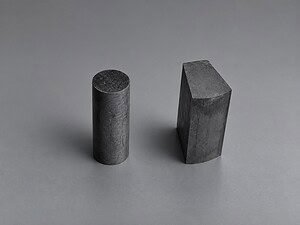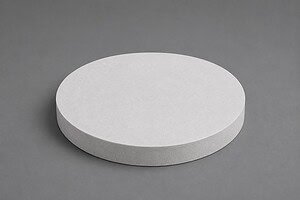
As stringent building energy codes (such as Passive House, LEED Platinum, and Net-Zero Energy standards) become the global benchmark for commercial and industrial construction, PU insulation cutting has transitioned from a routine rough-fabrication step into a precision manufacturing process directly dictating building envelope thermal integrity. Whether fabricating rigid polyurethane (PUR) blocks, polyisocyanurate (PIR) roof boards, or modular cold-storage sandwich panels, dimensional inaccuracies and edge damage compromise thermal resistance and lead to costly installation rejects.

For a detailed technical evaluation comparing thermal hot-wires, mechanical blade saws, and continuous wire saws, refer to our comprehensive insulation cutting machine selection guide. This article examines the application-specific challenges of precision cutting in green building envelopes and how endless diamond wire technology preserves insulation performance.
Why Cutting Precision Dictates Thermal Performance in Green Buildings
In high-performance building envelopes, thermal continuity must remain uninterrupted across thousands of square meters of wall and roof assemblies. Low-tolerance cutting introduces critical failure modes:
- Thermal Bridging at Panel Interlocks: A dimensional deviation of merely 1–2 mm along panel edges prevents tight interlocking in tongue-and-groove joints, creating linear thermal bridges that degrade overall assembly U-values.
- Air and Vapor Infiltration: Ragged or concave cut surfaces create hidden air channels within wall assemblies, allowing warm, moisture-laden air to penetrate the insulation layer, resulting in interstitial condensation, mold formation, and structural degradation.
- Compromised Adhesive Lamination: When producing metal-faced or foil-faced sandwich panels, rough or charred foam faces reduce effective contact area, severely weakening adhesive peel strength and risking facade delamination under wind loads.
Physical Mechanisms: Preserving Closed-Cell Structure and Lambda Value
The superior thermal performance of rigid PUR and PIR foams (λ ≤ 0.022–0.028 W/m·K) relies upon microscopic closed cells containing blowing agent gases. The cutting method directly influences the integrity of these cell walls along the kerf face:
| Cutting Methodology | Physical Removal Mechanism | Impact on Cut Edge & Cell Integrity |
|---|---|---|
| Hot-Wire Thermal Cutters | Thermal melting & pyrolytic decomposition | Creates dense, melted plastic skin or charred voids; releases hazardous isocyanate fumes; alters cell geometry |
| Toothed Blade / Band Saws | High-impact macroscopic mechanical tearing | Crushes microscopic cell struts along the cut line; tears fibrous facings; produces heavy airborne static dust |
| Endless Diamond Wire Saws | Continuous abrasive micro-grinding at 20–40 m/s | Cleanly shears micro-cell struts without crushing cell walls; zero melt skin; preserves design thermal resistance right to the edge |
Precision Cutting Demonstration: Vimfun Diamond Wire Saw in Action
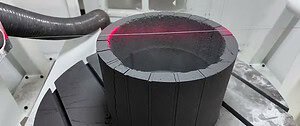
The following video demonstrates industrial endless diamond wire sawing applied to dense PU thermal bricks, showcasing clean cold abrasive cutting, edge retention, and absence of thermal degradation:

Unlike blade saws that deflect across dense blocks or generate rough surfaces, the continuous diamond wire loop slices through both rigid foam cores and protective facing layers (aluminum foil, fiberglass mesh, or cementitious skins) in a single unified motion without facing delamination.
Engineering Quality Acceptance Framework for PU Panel Lines
Rather than relying on unverified generic claims (such as fixed percentage reject reductions), professional panel manufacturers evaluate diamond wire cutting through verifiable engineering metrics:
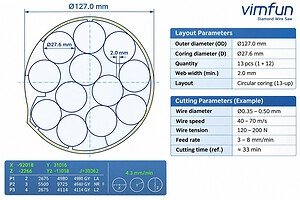
- Dimensional Repeatability (±0.2 mm): Utilizing rigid CNC servo drives and calibrated pneumatic wire tensioning on Vimfun diamond wire saws ensures consistent panel thickness and edge squareness across long production runs.
- 2D Contouring for Complex Architectural Shapes: For curved pipe insulation shells, HVAC acoustic duct elbows, and architectural molding, CNC profile cut wire saws execute complex 2-axis paths directly from CAD drawings without expensive dedicated tooling.
- Dust Control and Workplace Environment: Abrasive micro-grinding generates heavier, granular swarf rather than fine static dust clouds, enabling high-efficiency capture via localized negative-pressure vacuum hoods.
- Facing Integrity & Adhesion Testing: Sliced surfaces exhibit clean, uncrushed cellular texture, facilitating optimal adhesive penetration and peel strength during subsequent lamination.
Validate Your Insulation Profiles with Engineering Test Cutting
Every insulation formulation—varying by density, blowing agent, and facing composition—behaves uniquely during cutting. Before specifying equipment for your green building panel line, take advantage of the Vimfun (Zhengzhou Shine Smart Equipment Co., Ltd.) free diamond wire test cutting service.
Submit your PU/PIR samples, target tolerances, and production drawings for a comprehensive engineering evaluation, including dimensional inspection reports, edge roughness data, and recommended wire specifications.