Introduction: The Evolution of Precision Slicing
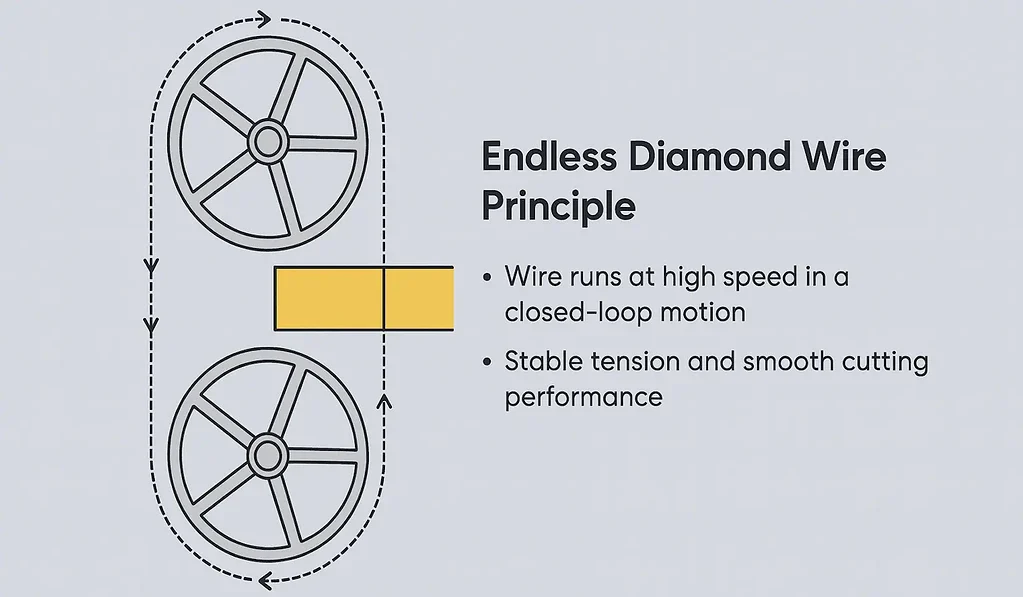
In the rapidly advancing landscape of high-tech manufacturing, the choice of slicing technology has become a cornerstone of operational success. For decades, traditional methods such as Inner Diameter (ID) sawing, reciprocating multi-wire saws, and Electrical Discharge Machining (EDM) were the industry standards. However, the emergence of endless diamond wire sawing has fundamentally redefined the diamond wire cutting principles for processing high-value materials like NdFeB magnets, SiC, and sapphire.
Mastering the transition to this technology is not just about adopting a new tool; it is about implementing a comprehensive OEE enhancement strategy that addresses material recovery, surface integrity, and long-term profitability.
1. Endless Wire vs. Reciprocating Multi-Wire Sawing
While reciprocating multi-wire saws are widely used in the silicon ingot industry, they face significant physical limitations when applied to the precision slicing of brittle or extremely hard materials.
1.1 Kinematic Differences and Wire Speed
- Continuous Velocity: Endless wire saws operate as a closed loop, allowing for a constant, high-speed linear velocity of up to 80 m/s.
- Deceleration Issues: In contrast, reciprocating saws must come to a complete stop and reverse direction at the end of every stroke, leading to inconsistent material removal rates (MRR) and increased mechanical wear.
- Impact on Throughput: The ability to maintain a steady speed directly translates to higher throughput, often reducing cycle times by 30% to 50% compared to reciprocating systems.
1.2 Thermal Management and Surface Quality
- Effective Heat Dissipation: The unidirectional motion of the endless wire ensures that cooling and lubrication are applied consistently to the cutting zone, preventing the “heat spikes” associated with the reversal phase of reciprocating saws.
- Reduced Subsurface Damage: By eliminating the mechanical shock of direction changes, endless wire sawing utilizes a more stable micro-fracture mechanism, resulting in a superior surface finish (Ra) and significantly less subsurface damage.
2. Diamond Wire vs. EDM (Electrical Discharge Machining)
For conductive materials like NdFeB, EDM has historically been a popular choice. However, as raw material costs rise, the inefficiencies of EDM have become more apparent.
2.1 Material Recovery and Kerf Loss
- The 0.4 mm Standard: Endless diamond wire sawing typically achieves a narrow 0.4 mm kerf, maximizing the number of slices per ingot.
- EDM Waste: EDM relies on spark erosion, which inherently creates a wider kerf and a “recast layer” on the material surface that often requires extensive post-processing.
- Yield Impact: In the rare-earth industry, the transition from EDM to diamond wire can increase the total material recovery rate by up to 20%.
2.2 Preservation of Magnetic and Structural Integrity
- Cold Cutting Advantage: Diamond wire is a mechanical cold cutting technology, ensuring that the workpiece temperature stays well below the Curie point for magnets.
- EDM Heat Risk: The localized heat generated by EDM sparks can cause permanent loss of magnetic flux in NdFeB or induce thermal cracking in sapphire.
3. Technical Performance Metrics Comparison
To assist equipment engineers in their evaluation, the following table summarizes the performance benchmarks across the three primary technologies:
| Performance Metric | Endless Diamond Wire | Reciprocating Wire | EDM (Electrical) |
| Linear Wire Speed | Up to 80 m/s | 10–20 m/s (Avg) | N/A |
| Typical Kerf Loss | ~0.4 mm | 0.25–0.5 mm | 0.5–1.2 mm |
| TTV Control | Excellent (<10 μm) | Moderate | Good |
| Surface Finish (Ra) | 0.2–0.8 μm | 0.5–1.5 μm | >1.5 μm (Recast) |
| Thermal Risk | Negligible | Low-Moderate | High |
4. Engineering Decision: When to Upgrade to Endless Wire?
Utilizing the Economic Assessment gear from our process optimization model, facilities should prioritize endless wire technology under the following conditions:
4.1 Processing High-Value, Brittle Materials
If your production involves NdFeB, Silicon Carbide (SiC), or Sapphire, the cost of raw material waste outweighs the initial capital expenditure of upgrading. A stable 0.4 mm kerf combined with high-speed throughput provides a rapid Return on Investment (ROI).
4.2 Scaling for High Volume OEE
When OEE enhancement targets are hindered by frequent wire breakages or the slow speed of EDM, the endless wire saw offers the necessary reliability. Its ability to run 24/7 with a predictable maintenance and feedback loop ensures consistent output.
4.3 Meeting Stringent Geometric Specifications
For applications in electronics and optics where Total Thickness Variation (TTV) and Warp must be kept to a minimum, the unidirectional stability of the endless wire is unmatched.
5. Maintenance and Long-Term Reliability
Transitioning to endless wire sawing requires a shift in maintenance philosophy. Unlike traditional saws, the performance of an endless wire saw is highly dependent on the Engineering Troubleshooting Branch and real-time monitoring.
- Tensioning Systems: Maintaining a tension between 150 N and 250 N is critical to prevent wire bowing, a common issue in both reciprocating and older diamond wire systems.
- Filtration Requirements: Because the wire moves at such high speeds, the filtration of abrasive swarf must be more aggressive to prevent secondary surface damage.

6. Engineering FAQ: Slicing Comparison
Q: Does endless wire sawing require a different type of diamond wire than reciprocating saws?
A: While the core technology is similar, endless wire saws often utilize high-tensile steel cores optimized for the high centrifugal forces of 80 m/s operation.
Q: How does the “micro-fracture mechanism” differ between these technologies?
A: In endless wire sawing, the unidirectional motion ensures that lateral cracks propagate more predictably, whereas the reversal of reciprocating saws can cause erratic crack patterns and increased edge chipping.
Q: Can I cut non-conductive ceramics with an endless wire saw?
A: Yes. Unlike EDM, which is restricted to conductive materials, the mechanical action of the diamond wire makes it the superior choice for sapphire, glass, and technical ceramics.
7. Conclusion: The New Standard in Precision Slicing
The technical superiority of endless diamond wire sawing over traditional EDM and reciprocating methods is clear when evaluating speed, yield, and quality. By integrating proper maintenance with a deep understanding of cutting principles, manufacturers can achieve unprecedented levels of efficiency in the modern factory.
Related Diamond Wire Loop Resource
For loop-specific design details, see our diamond wire loops main page.