Оглавление
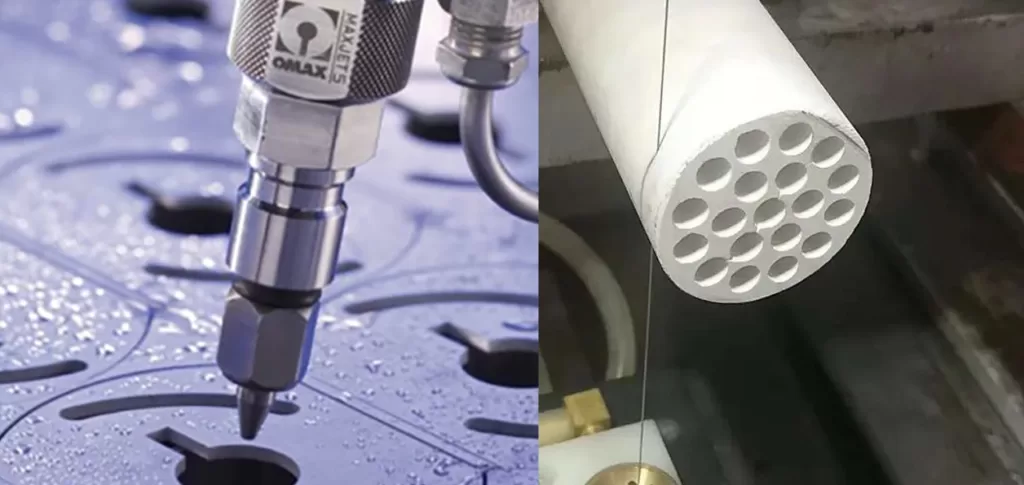
Введение
В современном производстве и машиностроении эффективная технология резки материалов имеет решающее значение для выпуска высококачественной продукции. Водно-абразивная резка под высоким давлением (ASWJ) - это все более популярная технология прецизионной резки, которая демонстрирует превосходство в различных областях. В этой статье рассматриваются принципы работы, преимущества и сравнительный анализ ASWJ с другими технологиями резки.
Принципы работы водоабразивной резки под высоким давлением
High-pressure water-abrasive cutting removes material through the impact of a water jet carrying abrasive particles. ASWJ means abrasive suspension waterjet: water and abrasive are premixed before passing through the cutting nozzle. This differs from an abrasive injection waterjet, where abrasive is entrained into an already formed water jet. Hydrogen is not a required ingredient. Both conductive and non-conductive materials can be processed; material grade, thickness and quality requirements determine suitability.
Преимущества водоабразивной резки под высоким давлением
ASWJ обладает рядом заметных преимуществ, в том числе:
- Прецизионная резка: Achievable accuracy depends on the machine, nozzle condition, material, thickness and traverse speed. Verify taper, jet lag and cut-surface quality on representative parts rather than assuming micron-level accuracy.
- Универсальность материала: Abrasive waterjets can process selected metals, stone, glass and ceramics. Some soft materials can be cut with pure water alone; added abrasive is not necessary for every application.
- Холодная резка: В отличие от традиционных методов горячей резки, ASWJ - это процесс холодной резки, снижающий риск деформации материала из-за теплового напряжения.
- Управление отходами: The process produces wastewater, spent abrasive and workpiece debris. Collection, separation and disposal requirements depend on the material being cut; the absence of a thermal cutting process does not make the waste harmless.
- Высокая скорость и эффективность: Высокоскоростная струя в сочетании с абразивным материалом делает ASWJ более эффективным в определенных сценариях по сравнению с другими методами резки.
Недостатки водоабразивной резки под высоким давлением (ASWJ)
Несмотря на свои преимущества, ASWJ не лишен недостатков, в том числе:
- Комплексная установка: Внедрение технологии ASWJ может быть сложным, требующим специального оборудования и хорошо контролируемой среды. Такая сложность может затруднить организацию небольших операций.
- Расход абразива: В процессе резки ASWJ использует абразивные материалы. Эти абразивные материалы со временем изнашиваются, что приводит к необходимости их частого пополнения, увеличивая эксплуатационные расходы.
- Обслуживание: Насосы высокого давления и форсунки, используемые в системах ASWJ, требуют регулярного обслуживания для обеспечения оптимальной производительности. Такое обслуживание может быть дорогостоящим и отнимать много времени.
- Опасения по поводу безопасности: ASWJ предполагает работу с жидкостями под высоким давлением, которые могут быть опасны при неправильном обращении. Операторы должны пройти обучение, чтобы обеспечить безопасную и эффективную работу.
- Water and Contamination Limits: Electrical conductivity is not required, unlike wire EDM. Instead, assess water absorption, corrosion, trapped abrasive and cleaning requirements, particularly for porous or contamination-sensitive workpieces.
- Потенциальная эрозия: Со временем высокоскоростная струя может вызвать износ режущего оборудования, что приведет к его эрозии и снижению точности.
Производителям и предприятиям необходимо учитывать эти недостатки наряду с преимуществами ASWJ, чтобы определить его пригодность для конкретных применений и проектов.
Сравнительный анализ: ASWJ по сравнению с другими технологиями резки
ASWJ carries loose abrasive in water, while closed-loop diamond wire cutting uses diamond abrasive attached to a moving wire. These are different material-removal methods, not interchangeable machine specifications. Compare them against the same drawing and acceptance criteria:
- Адаптация материалов: Как и ASWJ, закрытая алмазная резка может резать различные материалы, в том числе непроводящие.
- Precision and Support: Diamond wire results depend on wire deflection, tension, guide alignment and fixture support. Thin or fragile parts require sample validation; neither method guarantees the required finish without further processing.
- Скорость: Neither process is always faster. Compare setup, cutting, cleaning and finishing time for the same material, section size and accepted surface quality.
- Material Yield: Wire diameter and deflection affect the wire-cut kerf; nozzle configuration, thickness and traverse conditions affect the waterjet kerf. Measure both material loss and finishing allowance rather than assuming one method always wastes less material.
| Требование | ASWJ / abrasive waterjet | Closed-loop diamond wire |
|---|---|---|
| Water restrictions | Water exposure is inherent to the process; assess absorption, corrosion and drying. | Wet or dry operation depends on the material, wire and machine. Dry cutting requires appropriate debris extraction. |
| Contamination | Loose abrasive and cutting debris require collection and cleaning. | Workpiece debris and wire wear still require control; the process is not contamination-free. |
| Cut geometry | The jet requires a suitable entry point and an unobstructed exit into the catcher. | The wire and guides need clearance. An internal contour requires a viable threading or entry method; a closed loop cannot simply enter an enclosed hole. |
| Thick or fragile sections | Check taper, jet lag, piercing damage and exit-edge condition through the full thickness. | Check wire bow, fixture loads, fragile features and support as the offcut separates. |
| Heat and surface quality | A non-thermal cutting process avoids the conventional heat-affected zone, but cut texture and edge quality still need inspection. | Abrasive contact generates frictional heat. Validate cooling or dry-process controls and any finishing allowance. |
| Cost comparison | Include abrasive, water treatment, nozzle wear, setup and finishing. | Include wire wear, fixtures, debris handling, setup and finishing. Compare cost per accepted part. |
For a broader process comparison, see waterjet versus diamond wire cutting. Before a trial, provide the material grade, workpiece dimensions, drawing, water restrictions and required edge and surface quality.
Области применения водоабразивной резки под высоким давлением
Abrasive waterjet processes are used or evaluated across the following fields. An application of injection-type waterjet equipment is not automatically evidence of ASWJ suitability; confirm the actual jet system and qualification requirements:
- Аэрокосмическая промышленность: Резка компонентов самолетов и деталей двигателей.
- Медицинский сектор: Selected component-cutting applications require validation of edge quality, cleaning and contamination controls; this does not establish suitability for every medical device.
- Автомобильное производство: Резка и обработка автомобильных деталей, включая детали кузова и двигателя.
- Строительство: Резка строительных материалов, таких как камень, стальные конструкции и бетон.
- Производство электроники: Evaluate water and abrasive exposure carefully for electronic materials. Suitability for a particular substrate does not establish suitability for semiconductor wafer production.
- Искусство и творчество: Позволяет заниматься творчеством в области искусства, скульптуры и декоративного искусства.
Применение для сложных материалов
For hard ceramics, glass and other brittle materials, evaluate entry damage, edge chipping, cracking and the condition of the exit face. Waterjet piercing and support beneath the cut need particular attention. With diamond wire, evaluate clamping loads, wire access, deflection and support at final separation. Porous materials also need a cleaning and drying assessment. No fixed pressure, wire tension or feed setting is prescribed here without a representative trial.
Заключение
High-pressure water-abrasive cutting can be useful where a water-and-abrasive process meets the material and geometry requirements. Closed-loop diamond wire is another option for compatible workpieces, but it has its own access, support and debris-control constraints. Select a method using measured cut quality, accepted yield and total processing cost. For diamond wire feasibility, provide a drawing and material details through our sample-cutting service.