Diamond wire cutting high value brittle materials requires a fundamentally different approach from cutting structural metals or standard optical glass. When you are cutting a block of germanium worth several thousand dollars, the cost of a single bad cut is not a process inefficiency — it is a financial event. The material cannot be re-melted and recast into a usable form. The kerf dust cannot be recovered to optical grade. The cracked wafer cannot be salvaged. One wrong parameter setting and the entire piece is lost.
This is the operating reality for manufacturers processing germanium, zinc selenide, gallium arsenide, cadmium zinc telluride, and other high-purity functional crystals used in infrared optics, semiconductor substrates, laser systems, and radiation detection. The workpieces are often small. The tolerances are tight. And the material cost makes every cut consequential.
This guide covers what makes each material demanding for diamond wire cutting, and what process controls matter most for protecting yield.
Why Diamond Wire Cutting High Value Brittle Materials Requires Customized Parameters
Most cutting operations establish one parameter set and apply it across material families. For steel or aluminum, this works. For high-value brittle crystals, it fails for a straightforward reason: the same cutting force that removes material cleanly from one crystal structure initiates fracture propagation in another.
Germanium has a diamond cubic structure with strong {111} cleavage planes. Apply the wrong lateral force — from wire deflection, vibration, or uneven tension — and the crack does not follow the kerf path. It follows the crystal plane, producing an irregular fracture that destroys the workpiece geometry and the surface beneath it.
Zinc selenide is softer and less prone to cleavage fracture, but its surface is acutely sensitive to scratching and contamination. Abrasive particles recirculating in the coolant become cutting points that score the polished surface — and ZnSe surfaces cannot be re-polished to laser grade without removing significant material depth.
Gallium arsenide and cadmium zinc telluride add a further constraint: crystal orientation must be preserved through the cut. A GaAs wafer cut 2° off the specified crystallographic axis may look identical but will perform differently in every epitaxial process downstream.
These are not edge cases. They are the daily operating conditions for manufacturers working with functional crystals.
Diamond Wire Cutting High Value Brittle Materials: Germanium
Germanium sits at the intersection of high material cost and extreme cutting sensitivity. At current market prices for optical-grade germanium, the material value of a single 150 mm diameter ingot section exceeds the cost of a day’s machine operation. Kerf loss is not a process metric — it is a direct line item on the BOM.
Three cutting parameters determine outcome quality for germanium:
Wire tension consistency. Germanium’s cleavage tendency means that any lateral force deviation during the cut transfers directly to the crystal. Servo-controlled wire tension that holds within ±5 N throughout the cut prevents the wire deflection that initiates cleavage fracture at the cut exit face. Fixed-weight tension systems cannot match this stability during long cuts where thermal expansion changes effective tension.
Feed rate profile. Constant feed rate through a germanium ingot is rarely optimal. Entry into the material should be slower — 20–30% below the sustained cutting rate — to prevent the initial contact shock that chips the entry edge. Exit from the material should also slow as the wire approaches breakthrough, where the remaining unsupported crystal is most vulnerable to fracture.
Coolant selection and delivery. Germanium’s thermal sensitivity (absorption increases with temperature) requires coolant that maintains the cut zone near ambient temperature. White mineral oil is the standard choice — it provides adequate lubrication without the corrosion risk that water-based fluids present on germanium’s surface. Coolant delivery at both the wire entry and exit points of the cut, at sufficient flow rate to flush germanium swarf, prevents abrasive particle recirculation that scores the cut surface.
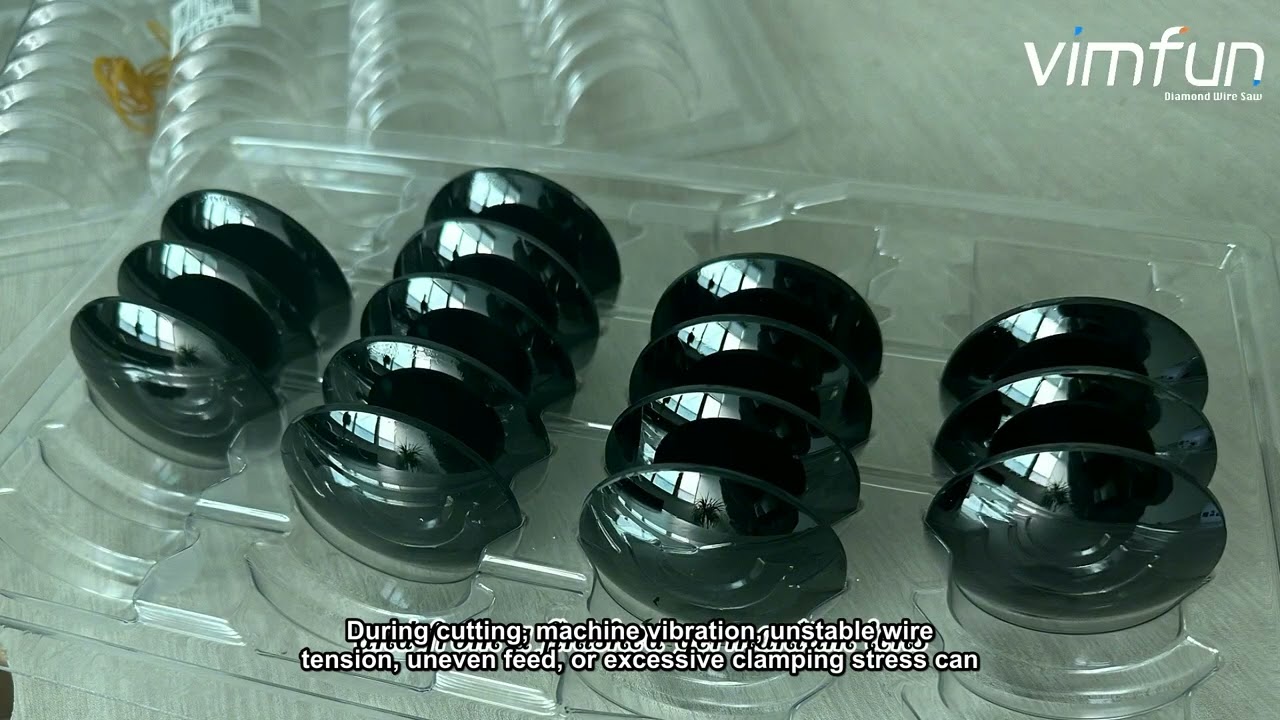
The SG20 and SGI-20 platforms are used for germanium slicing and contour cutting respectively, with wire diameter selection from 0.25–0.50 mm depending on kerf loss requirements and the geometry being cut.
Diamond Wire Cutting High Value Brittle Materials: Zinc Selenide
ZnSe presents a different challenge profile from germanium. It is softer (Knoop hardness ~120 versus ~780 for germanium), making it easier to cut but also more susceptible to surface damage from abrasive contamination during the cutting process.
The critical control point for ZnSe is the cleanliness of the cutting environment. ZnSe is used in CO₂ laser optics where the finished surface must achieve Ra < 5 nm after polishing. Any surface scratch introduced during wire cutting that extends below the polishing stock depth becomes a defect that no downstream process can remove. This means:
- Coolant filtration to remove ZnSe swarf particles that would re-cut the material surface
- Enclosed cutting chamber design to prevent airborne contamination from settling on cut surfaces
- Dedicated coolant systems not shared with other materials — cross-contamination from abrasive particles used in harder material cutting is a common source of surface damage on ZnSe
Feed rate for ZnSe should be conservative: typically 30–50% lower than the rate used for optical glass of similar diameter. The combination of ZnSe’s low hardness and low fracture toughness means that aggressive feed generates deep subsurface damage that increases the required grinding allowance and reduces final lens yield. The goal is a cut face that enters the grinding and polishing sequence with Ra below 1.5 μm and subsurface damage depth below 20 μm.
The surface quality optimization parameters for ZnSe cutting differ from those for glass or germanium on every variable — wire speed, tension, feed, and coolant type all require material-specific adjustment.
Gallium Arsenide and Compound Semiconductor Crystals
GaAs, InP, and related compound semiconductor crystals introduce constraints that purely optical materials do not impose: crystal orientation, wafer-to-wafer thickness uniformity (TTV), and surface damage depth that limits how much material subsequent processes can remove while maintaining specified layer depths.
For GaAs wafer cutting, the dominant requirement is TTV control across the full wafer batch. Epitaxial process tools specify TTV ≤ 5 μm for 100 mm wafers — a tolerance that requires lapping and polishing, but that cannot be met at all if the as-cut TTV exceeds 15–20 μm. The wire saw must deliver consistent thickness across the wafer and across the batch.
Achieving this requires process monitoring at the cutting stage: measuring TTV on first-article wafers at the start of each ingot section, then adjusting feed rate or tension if the batch trend shows drift. Reactive quality control — inspecting after the full batch is cut — catches rejects but cannot prevent them. In-process monitoring catches the drift while there is still material left to cut at corrected parameters.
Crystal orientation preservation requires fixture design that aligns the crystal axis relative to the wire travel direction. A GaAs ingot mounted 2° off-axis produces wafers that are 2° off-axis throughout the batch. The fixturing decision, made before the first cut, determines orientation compliance for the entire ingot section.
Cadmium Zinc Telluride: The Most Demanding Case
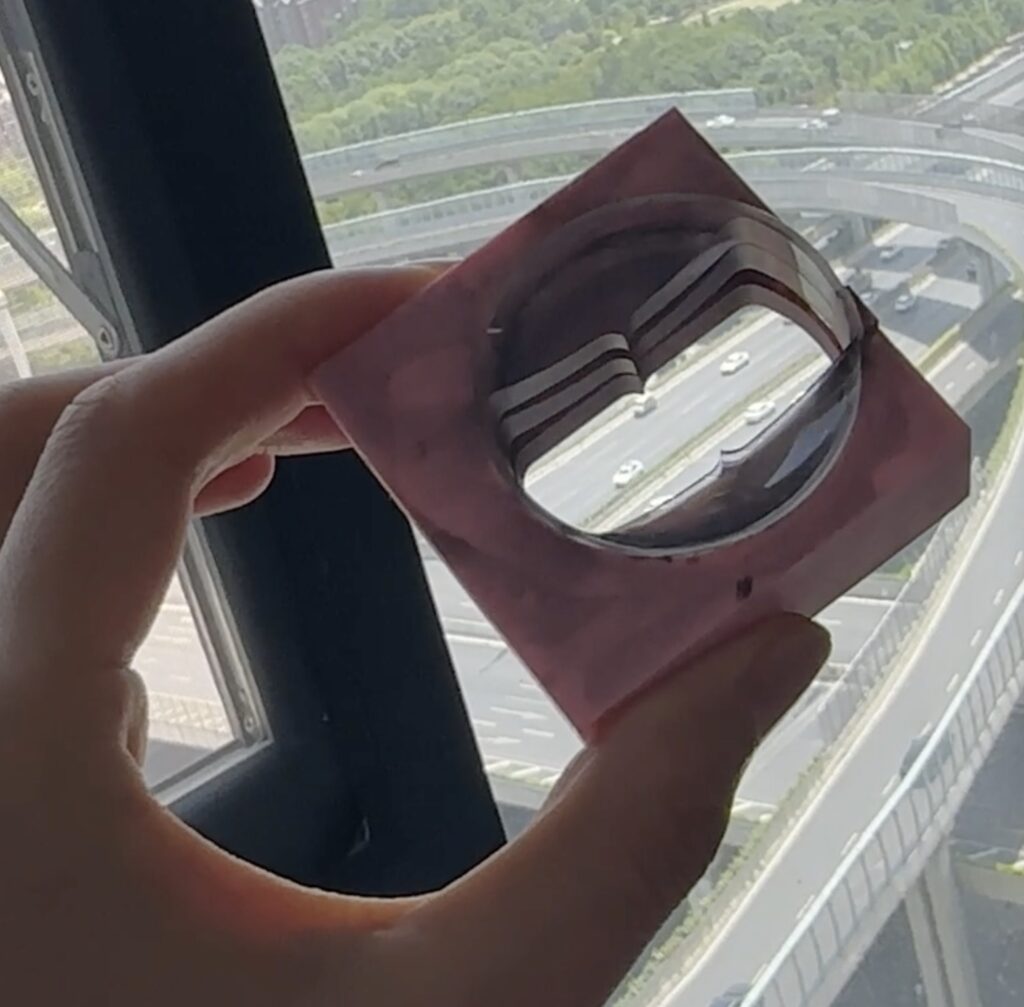
CdZnTe (cadmium zinc telluride) is used in radiation detection applications — gamma ray detectors, X-ray imaging systems, and medical PET scanners. The material is expensive (often exceeding germanium on a per-gram basis), brittle, and extremely sensitive to both mechanical and thermal shock during cutting.
CdZnTe has a zinc blende crystal structure with pronounced cleavage along {110} planes. The cutting challenge is not just avoiding fracture along the intended cut plane — it is avoiding fracture along the cleavage planes that intersect the cut geometry at angle. A crack that initiates at any point in the cut and propagates to a cleavage intersection can split the workpiece in an entirely unexpected direction.
The combination of wire speed control (lower speed than germanium, typically 20–30 m/s) and minimal vibration isolation is critical for CdZnTe. Machine frame rigidity, guide wheel balance, and wire tracking precision all contribute to the vibration environment at the cut interface. For CdZnTe, the tolerance for vibration before fracture initiates is narrower than any other material category we work with.
Customized Solutions, Not Universal Parameters
The consistent theme across all high-value rare materials is that there is no universal parameter set that works well across the category. Germanium needs one tension profile; ZnSe needs a different coolant system; GaAs prioritizes TTV uniformity; CdZnTe requires maximum vibration isolation.
What these materials share is that the consequences of parameter errors are immediate and irreversible. You do not get a second chance on a $5,000 germanium ingot section. You cannot re-cut a batch of GaAs wafers that came out 10 μm off specification.
The diamond wire cutting technology that works for these materials is the same fundamental process used in silicon and sapphire production — but the configuration, process development, and process control requirements are categorically different. The machines must provide stable tension, controlled vibration, accurate feed, and material-appropriate cooling. The process must be developed on representative material before production cuts begin.
For manufacturers moving from blade or ID saw cutting to diamond wire for germanium or ZnSe, the yield improvement comes not from the switch in technology alone — it comes from the combination of lower kerf loss, shallower subsurface damage, and the ability to maintain consistent parameters through the cut that diamond wire enables when properly configured for the material.
According to Crystran’s optical materials reference data, germanium, ZnSe, GaAs, and CdZnTe each have distinct mechanical and optical properties that directly govern cutting process design — hardness, fracture toughness, cleavage plane orientation, and thermal conductivity all affect how the wire interacts with the material. The SPIE Digital Library documents cutting-induced subsurface damage in infrared crystals across numerous peer-reviewed studies, confirming that wire-based cutting methods consistently produce shallower damage layers than blade or ID saw alternatives on brittle IR materials.