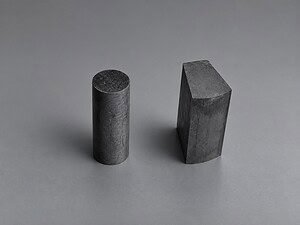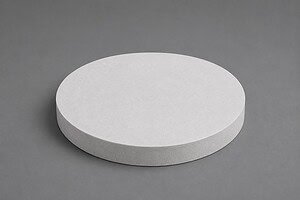
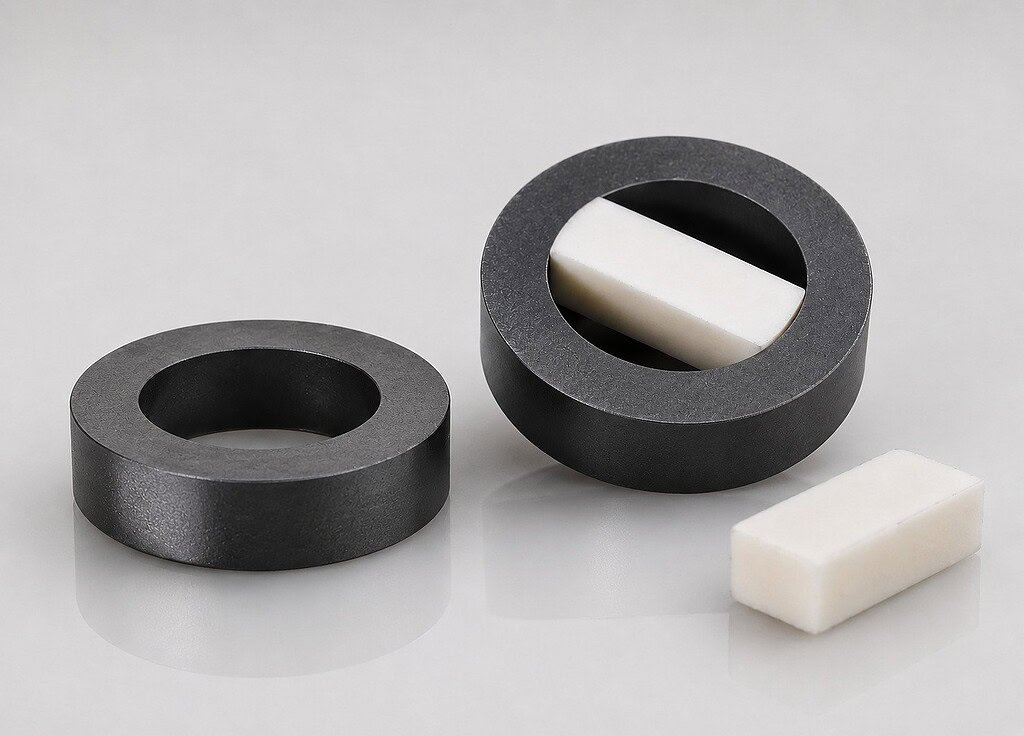
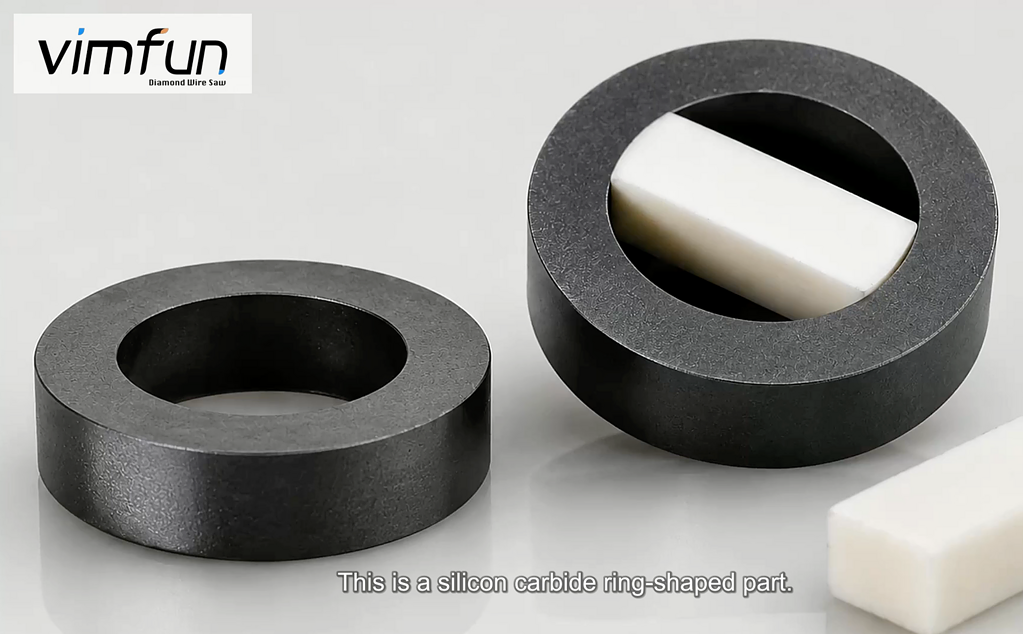
Silicon carbide seal rings end up inside pump housings, automotive water pumps, and chemical process equipment — applications where one ring failure shuts down whatever the assembly is sealing. The ring in this case measures 60 mm outer diameter, 10 mm inner bore, 10 mm thick. Small enough to look unremarkable. Hard enough that conventional grinding consistently leaves it with chipped edges and microcrack networks the customer has to either scrap or rework.
The properties that make silicon carbide valuable in service — wear resistance, chemical inertness, thermal stability under load — are the same properties that make it difficult to cut without damaging the finished part. Abrasive wheel cutting produces edge chipping at the outer profile and inner bore, plus a subsurface damage layer that compromises the sealing face. On a ring this small, with both diameters held to tight tolerance, there is no easy fix downstream — the cut surface is what gets shipped. This case walks through how Vimfun cut the part using diamond wire technology, with reference back to our corte de cerámica overview for the broader material context.
The Application: Why SiC Rings Are Hard to Source
Silicon carbide rings in this size range are typically used in mechanical seals — pump seals, chemical process seals, automotive water-pump seals — where the combination of chemical inertness, wear resistance, and thermal stability outperforms metal or polymer alternatives. The end customer specifies a ring with tight tolerances on:
- Diámetro exterior — sets the seal housing fit
- Inner bore diameter — sets the shaft clearance
- Parallel faces — sets the contact-face flatness against the mating ring
- Edge condition — chipped edges concentrate stress and cause premature failure
For this category of part, the ring is not the expensive piece — the failure of a finished assembly downstream is. A pump seal that fails in service can take down a production line. So the cutting tolerance specification is tight even though the part itself is small.
The Challenge: SiC + Small Ring Geometry
Dos problemas se multiplican en este caso:
| Restricción | Por qué es importante |
|---|---|
| Dureza del carburo de silicio | Knoop ~2800 kg/mm² — entre los materiales industriales no diamantados más duros |
| Fragilidad | Baja tenacidad a la fractura; las microfisuras se inician fácilmente bajo la fuerza de corte |
| Resistencia al desgaste | La misma propiedad que hace valioso al SiC en servicio hace que el desgaste de la herramienta de corte sea severo |
| Pequeño diámetro exterior (~60 mm) | Masa limitada de la pieza de trabajo para absorber las fuerzas de corte — la vibración se transmite directamente al corte |
| Pequeño diámetro interior (~10 mm) | Espesor de pared ~25 mm — el estrés se concentra en el borde interior |
| Control estricto del espesor (~10 mm) | Ambas caras deben permanecer paralelas después del corte |
La combinación es más dura que la suma. El SiC por sí solo es cortable. Un anillo de 60 mm por sí solo es cortable. SiC más una geometría de anillo pequeño más clean inner and outer edges — that combination is where most general-purpose ceramic cutting setups fail.
Why Conventional Methods Struggle
Two common approaches show predictable failure modes on this geometry:
Resin-bond abrasive cutting
Standard abrasive wheel cutting was the historical default for SiC. The problems on a small ring:
- Edge chipping at both the outer cut entry and exit, and at the inner bore
- Microcrack network propagating from the cut surface into the bulk material
- Surface damage layer typically 10–30 µm deep, requiring additional lapping to remove
- Dimensional drift as the abrasive wheel wears unevenly across the cut
Internal grinding for the bore
The 10 mm inner hole is sometimes machined separately by internal grinding rather than cut in the same operation. This introduces:
- A two-step process where outer and inner geometries are produced on different setups
- Concentricity error between outer profile and inner bore (the two operations have separate datum surfaces)
- Manejo adicional y reajuste, cada paso aumenta el riesgo de astillado
Para aplicaciones de sellado de alta gama, ninguna de las rutas ofrece la consistencia geométrica que el cliente necesita al volumen que necesita.
El Enfoque: Corte de Precisión con Hilo de Diamante
Vimfun cortó este anillo de SiC utilizando un proceso de hilo de diamante de corte estrecho y baja fuerza diseñado para cerámicas duras y quebradizas. Tres propiedades del corte con hilo de diamante son importantes para esta pieza:
- Fuerza de corte distribuida a lo largo del contacto del hilo, en lugar de concentrarse en una pequeña huella de grano abrasivo. Una menor fuerza por unidad de área significa una menor tasa de iniciación de microfisuras en SiC quebradizo.
- Corte estrecho — típicamente 0,55–0,7 mm con los diámetros de hilo fino utilizados para anillos de SiC pequeños — minimiza la pérdida de material y reduce el estrés en los puntos de entrada/salida del corte.
- Trayectoria continua del hilo — el hilo de circuito cerrado utilizado por las plataformas de corte Vimfun (ver Estructura de la sierra de hilo de diamante y lazo de hilo de diamante galvanizado) traza las geometrías exterior e interior en movimiento coordinado, manteniendo una concentricidad que el rectificado en dos pasos no puede igualar.
Para obtener información general sobre el corte con hilo de diamante en materiales cerámicos en general, consulte nuestra corte de cerámica página de resumen.
Parámetros del proceso
| Parámetro | Valor |
|---|---|
| Pieza de Trabajo | Anillo de carburo de silicio, ~60 mm OD × ~10 mm ID × ~10 mm de espesor |
| Diámetro del hilo de diamante | 0,5–0,6 mm |
| Tipo de cable | Lazo de hilo de diamante galvanizado |
| Tensión del cable | 150–200 N |
| Velocidad del cable | 30–60 m/s |
| Velocidad de avance | 1–2 mm/min |
| Refrigerante | A base de agua, recirculado con filtración |
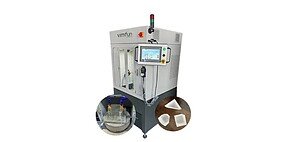
| Plataforma de máquina | SH-series horizontal rotary con control de avance fino |
Los valores mostrados reflejan el envolvente de proceso de VIMFUN para anillos de sellado de SiC de esta clase de tamaño, validados contra alúmina, zirconia y otras cerámicas duras y frágiles. El rango de avance de 1–2 mm/min es deliberadamente conservador: la fragilidad del SiC recompensa los cortes más lentos con bordes fracturados limpios en lugar de material desgarrado. Ver velocidad del alambre, tensión y velocidad de alimentación para ver cómo interactúan estos parámetros, y refrigeración y lubricación para el manejo de lodos en cerámicas duras.
El Resultado: Geometría Estable en Ambas Caras
El enfoque de hilo de diamante entregó las tres propiedades que esta aplicación de sellado necesita al mismo tiempo:
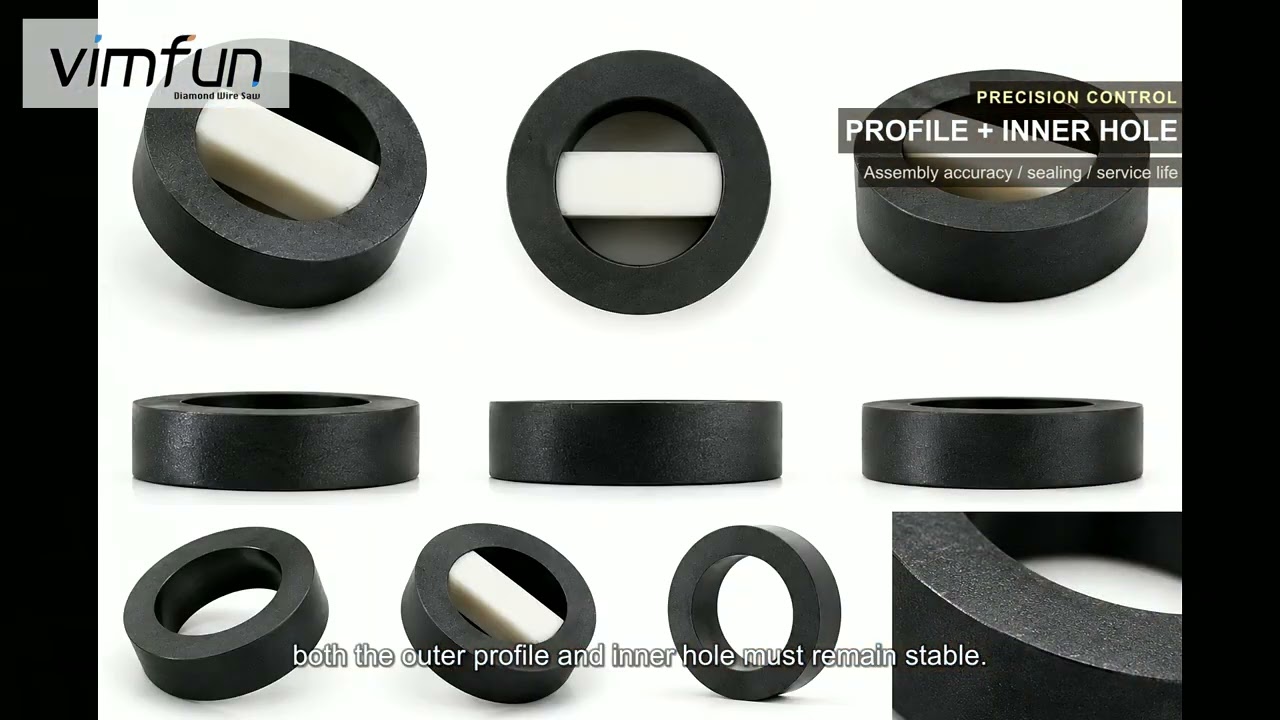
- Bordes más limpios tanto en el perfil exterior como en el taladro interior — astillado reducido dentro del umbral de inspección, sin superarlo
- Daños en el subsuelo inferior — profundidad de daño medida comparable a superficies pulidas finamente, reduciendo o eliminando la operación de pulido posterior
- Geometría consistente — diámetro exterior, taladro interior y espesor mantenidos dentro de la tolerancia del cliente sin retrabajo por pieza
Para la fabricación de sellos, el resultado significativo es posterior: menor desperdicio en la etapa de ensamblaje del sello, menos reclamaciones de garantía en campo y la capacidad de enviar piezas con una garantía de calidad más estricta de lo que el cliente podría obtener de blancos de SiC cortados convencionalmente.
Por qué la Fuerza Distribuida Importa en Cerámicas Duras y Frágiles
Todo se reduce a cómo la fuerza de corte interactúa con la mecánica de fractura frágil. El rectificado abrasivo concentra la carga en el punto de contacto de cada grano abrasivo. En un material frágil, la huella de cada grano es un sitio potencial de iniciación de microfisuras. Multiplique por el número de granos en contacto en cualquier momento y el daño acumulado se suma rápidamente.
Diamond wire spreads the cutting load along the wire contact arc inside the kerf. Per-unit-area force drops. For SiC and similar hard ceramics, that drop is what separates a clean cut from a chipped one. Three additional factors finish the job:
- Estabilidad de la tensión del alambre — uniform tension across the cut path keeps the wire from walking and creating asymmetric edge damage. See calibración de la tensión del cable for the calibration protocol.
- Velocidad de avance controlada — low feed on a thick SiC cross-section trades cycle time for cleanly fractured material at the cut zone, rather than torn material.
- Adequate cooling — water-based slurry at sufficient volume keeps the cut zone temperature stable, preventing thermal microcracking that would compound the mechanical damage.
This approach extends to other hard brittle materials in the same class — alumina, zirconia, silicon nitride, aluminum nitride, quartz, sapphire. The parameter envelope shifts material by material; the underlying mechanics stay the same. For related cases in this material family, see our estudio de caso de corte de anillos de cerámica de alúmina y hexagonal bore quartz tube cutting case study.
Industrias y aplicaciones
Diamond wire cutting of small SiC rings serves manufacturers in:
- Mechanical seal production — pump seals, automotive water pumps, chemical process seals
- Semiconductor equipment — wafer carrier rings, chamber components
- High-temperature industrial systems — burner nozzles, kiln furniture, heat exchanger inserts
- Specialty wear components — boquillas abrasivas, revestimientos de bombas de lodo, cerámicas balísticas
Si tiene un anillo pequeño, un disco o una pieza de forma precisa en cualquier material duro y quebradizo — SiC, alúmina, zirconia, nitruro de silicio, cuarzo, zafiro o vidrio fundido — y el rectificado convencional deja problemas de astillado o microfisuras que fallan en la inspección posterior, el mismo enfoque de alambre de diamante se aplica típicamente. El conjunto de parámetros se ajusta; la lógica del proceso no.
¿Podemos cortar esto para su aplicación?
Si alguna de estas situaciones coincide con la suya, envíenos el dibujo de su pieza:
- Materiales duros y quebradizos (SiC, alúmina, zirconia, nitruro de silicio) en forma de anillo, disco o baldosa
- Geometría pequeña (características sub-100 mm) donde el astillado es inaceptable
- Requisito estricto de concentricidad interior a exterior
- Uso final de componentes de sellado, semiconductores o de desgaste especial donde el costo de falla posterior es alto
- Volumen de producción desde tiradas de muestra hasta varios miles de piezas por mes
Incluya el grado del material, la geometría de la pieza con tolerancias y los requisitos de calidad posteriores. Le devolveremos una evaluación de viabilidad del proceso en un plazo de 3 días hábiles, incluyendo parámetros representativos y proyecciones de rendimiento. Cuando la geometría esté dentro de nuestro alcance, normalmente cortaremos una pieza de muestra para su verificación antes de comprometernos con las herramientas de producción. Vea nuestro más amplio resumen de corte con sierra de hilo para la plataforma de equipos detrás de este enfoque.