
Faraday rotator garnet cutting to 1 arc-minute on a 5-axis diamond wire saw
We ran a trial cut on a customer's magneto-optic garnet boule. The slices came back from their own lab at 1 arc-minute azimuthal deviation and 2 arc-minutes perpendicularity, with thickness held inside 0.02 mm — the kind of accuracy Faraday rotator garnet cutting actually demands.
See the magneto-optic garnet cut on the SGRTS 20
Finished part off the saw: a mirror-smooth cut face, no edge chipping, 0.01 mm thickness variation, and a 0.03 mm feeler-gauge check that won't enter the edge — followed by the customer's lab result of 2′ perpendicularity / 1′ azimuth.
Why Faraday rotator garnet cutting is unforgiving
The crystal here is a magneto-optic garnet — the family used to build a Faraday rotator. Two compositions dominate: terbium gallium garnet (TGG, Tb₃Ga₅O₁₂) for high-power and free-space isolators, and bismuth-substituted iron garnet (Bi:RIG) for 1550 nm telecom. Both are cubic garnets, both are grown slowly as boules or layers, and both have to be cut along a defined crystallographic axis. Get the axis wrong and the Verdet performance, extinction ratio, and beam quality all drift — the part may pass a dimensional check and still fail as an optical isolator.
That is the real constraint behind Faraday rotator garnet cutting: it is an orientation job first and a dimensional job second. The cut plane has to track the crystal direction to within a couple of arc-minutes, not a couple of tenths of a degree. On top of that, garnet sits around Mohs 8 and is brittle, so the tool has to remove material without loading the edge.
The demand picture is what makes the tolerance matter commercially. A Faraday isolator is the part that lets light pass one way and blocks the reflection coming back, and every high-speed optical module needs one. As 800G and 1.6T links scale for AI optical communication and data-center interconnect, the pull on magneto-optic crystal volume has gone vertical — and rotator-grade boules are expensive and slow to grow, with capacity booked out years ahead.
The gotcha: there is no scrap budget on these crystals. A 0.1° orientation error or a chipped edge isn't a reject you shrug off — it is weeks of crystal growth gone. That is why we treat orientation setup, not raw cut speed, as the thing to get right.
Setting the crystal orientation with five axes
Defining a crystal plane in 3-D space needs three angular handles: one rotation about the vertical axis (azimuth) and two tilts about perpendicular horizontal axes. The SGRTS 20 carries exactly that on top of the Y/Z slicing stage — five axes in total.
In our trial, the boule was first dialed onto its target crystal direction using the rotary axis plus both tilt axes. The wire never moves while orientation is being set. Only once the plane is locked does the Y/Z stage feed the part into the diamond wire loop. Because alignment and cutting share one rigid setup, the orientation you dial in is the orientation you cut — no transfer to a second fixture, no re-clamping error.
The rotary and tilt axes each carry a positioning accuracy of ≤1 arc-minute (0.1° / 6′ resolution). The 1–2′ field result tracks that spec closely; the extra arc-minute on perpendicularity is exactly where you'd expect it — wire deflection during the cut, fixturing, and the customer's own measurement all stack into that number.
Measured results on the customer's crystal boule
The customer indexed the finished parts against the target crystal plane in their own metrology lab and recorded two deviation components: the in-plane (azimuthal) error and the cut-face perpendicularity. For reference, demanding oriented-crystal optical work is commonly specified within ±5′ (≈ ±0.08°).
Azimutabweichung 1′ liegt innerhalb der Spezifikation für die Maschinenpositionierung; die Senkrechtstellung 2′ bleibt gut innerhalb des ±5′-Bandes, das typisch für präzisionsorientierte Kristallteile ist. Skala: 0–5 Bogenminuten.
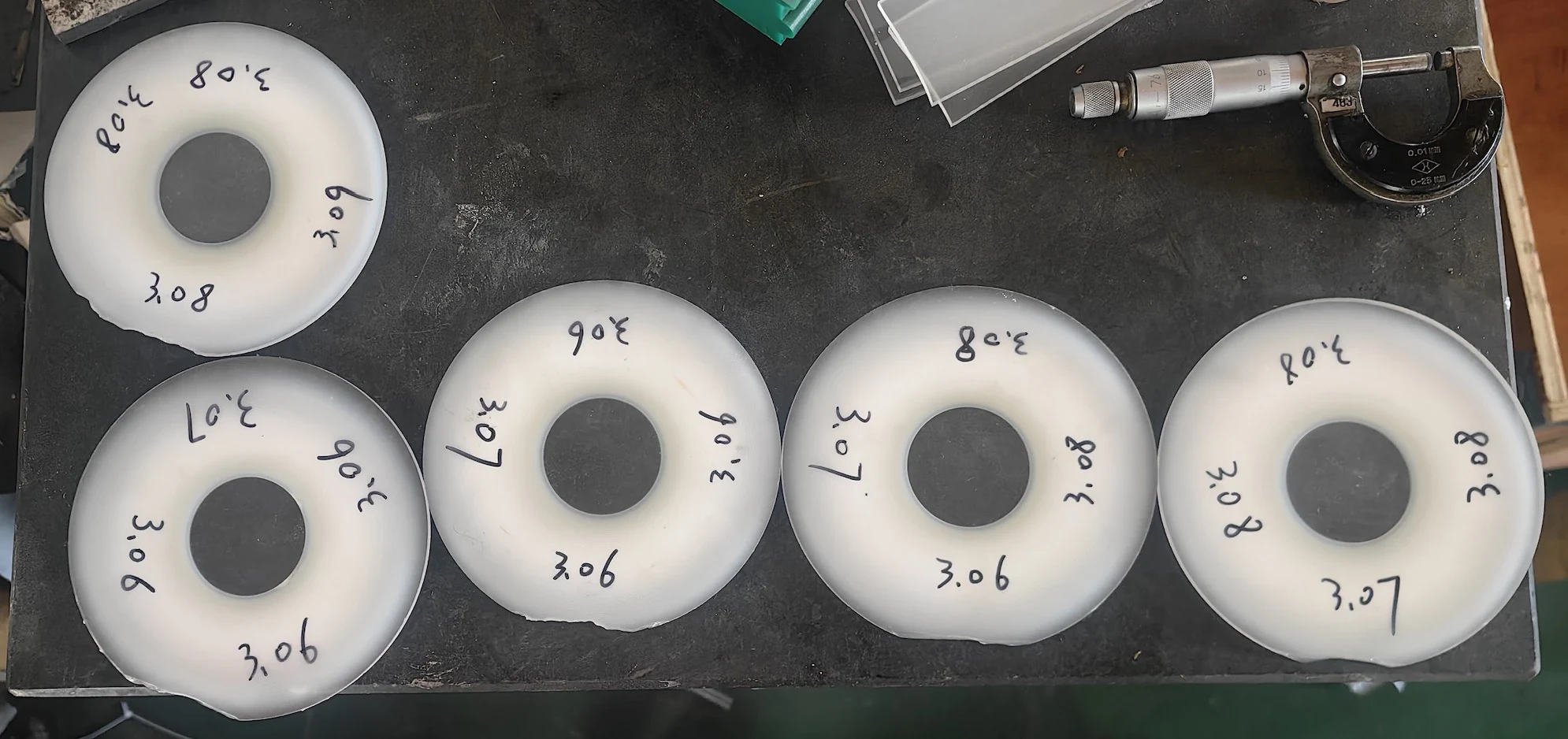
Dicke: fünf Teile, Vierpunkt-Mikrometerprüfung
Jedes fertige Teil wurde an vier Punkten auf seiner Oberfläche mit einem Außenmikrometer von 0,01 mm gemessen. Die Messwerte lagen über alle fünf Teile hinweg innerhalb eines Fensters von 0,03 mm, und kein einzelnes Teil variierte um mehr als 0,02 mm.
| Part | Min (mm) | Max (mm) | Variation (mm) | Status |
|---|---|---|---|---|
| P1 | 3.08 | 3.09 | 0.01 | BESTANDEN |
| P2 | 3.06 | 3.07 | 0.01 | BESTANDEN |
| P3 | 3.06 | 3.07 | 0.01 | BESTANDEN |
| P4 | 3.06 | 3.08 | 0.02 | BESTANDEN |
| P5 | 3.07 | 3.08 | 0.01 | BESTANDEN |
Gemessener Bereich über alle Teile: 3,06–3,09 mm · Instrument: Außenmikrometer, 0,01 mm Auflösung · 4 Punkte pro Teil.
Was aus den fertigen Kristallen wird
Geschnitten und poliert, diese magneto-optischen Granat-Wafer werden in die Rotatorstufe eines optischen Isolators oder optischen Zirkulators. Ein Terbiumgalliumgranat Rotator dreht die Polarisation in einem Magnetfeld um einen festen Winkel; kombiniert mit Polarisatoren lässt das Gerät Licht in Vorwärtsrichtung passieren und blockiert die Rückreflexion, die ansonsten eine Laserquelle destabilisieren würde.
Diese einzelne Funktion findet sich in mehreren Märkten wieder. In AI optical communication und Rechenzentrumsverbindungen benötigt jeder 800G/1.6T-Transceiver und jeder Faserverstärker eine Isolation, um reflektiertes Licht vom Laser fernzuhalten. In Industrie- und Faserlasern schützen Isolatoren die Seed- und Pumpstufen. In Lidar und medizinischer Photonik hält derselbe magneto-optische Kristall das Signal sauber. Unterschiedliche Wellenlängen erfordern unterschiedliche Zusammensetzungen – Bi:RIG um 1550 nm Telekommunikation, TGG für höhere Leistung und Freiraum – aber das Schneideproblem ist dasselbe: die Kristallachse halten, die Schnitte flach und parallel halten.
SGRTS 20 – fünfachsige Endlos-Diamantdrahtsäge
Der obige Schnitt wurde auf unserer Endlos-Diamantseilsäge Plattform konfiguriert mit fünf Achsen für das Schneiden von Faraday-Rotator-Granat. Die Endlosschleife ist hier wichtig: Ein kontinuierlicher Diamantdraht sorgt für eine dünne, gleichmäßige Schnittfuge und geringe Kantenbelastung, was verhindert, dass spröder Granat beim Ein- und Austritt absplittert.
Häufig gestellte Fragen zum Schneiden von magneto-optischen Granaten
Kann ein Diamantdrahtsäge TGG und magnetooptische Granate ohne Absplitterungen schneiden?
Ja. Eine endlose Diamantdrahtschleife schneidet TGG und andere magneto-optische Granate mit einer dünnen Schnittfuge und geringer Kantenbelastung, wodurch Absplitterungen unter Kontrolle gehalten werden, sobald Vorschubgeschwindigkeit, Drahtspannung und Kühlmittel auf das Material abgestimmt sind. Die spröde, aber nicht unmögliche Natur von Granat ist genau das Fenster, für das das Drahtsägen gut geeignet ist.
Wie halten Sie die Kristallorientierung während des Schnitts?
Der Kristall wird vor dem Schneiden mit einer Drehachse und zwei senkrechten Kippachsen auf seine Zielachse ausgerichtet, dann führt die Y/Z-Achse ihn in den Draht. Eine starre Einrichtung für Ausrichtung und Schnitt bedeutet, dass die eingestellte Ausrichtung die geschnittene Ausrichtung ist.
What thickness tolerance is achievable on garnet wafers?
Im obigen Versuch maßen fünf Teile 3,06–3,09 mm mit einer Variation innerhalb des Teils von 0,02 mm oder weniger auf einem 0,01-mm-Mikrometer. Die endgültige Dicke und Parallelität werden normalerweise beim Läppen und Polieren erreicht; die Aufgabe der Säge ist es, flache, parallele, korrekt ausgerichtete Rohlinge mit minimal zu entfernendem Material zu liefern.
Wo hat dieser Ansatz Grenzen?
Das Drahtsägen hinterlässt eine gesägte Oberfläche, die noch geläppt und poliert werden muss, daher ist es der Anfang des Prozesses, nicht der gesamte Prozess. Für sehr dünne Wafer (weit unter 0,3 mm) oder sehr hohe Scheibenzahlen pro Kristall können Mehrdraht- oder Innendurchmesserverfahren hinsichtlich des Durchsatzes überlegen sein. Für ausgerichtete, niedrigvolumige, hochwertige Rohlinge, bei denen jeder Millimeter Kristall zählt, ist der Fünf-Achsen-Eindraht-Weg die sicherere Wahl.
Senden Sie eine Probe für einen Probeschnitt
Wenn Sie Faraday-Rotator-Granat, TGG oder einen anderen ausgerichteten magneto-optischen Kristall schneiden und eine Bogenminuten-Ausrichtung mit enger Dicke benötigen, senden Sie uns einen Kristall oder ein Teststück. Wir führen einen Probeschnitt auf der SGRTS 20 durch und senden Ihnen die Teile mit gemessener Orientierungs- und Dickendaten zurück – genauso wie wir es hier getan haben.
Probeschnitt anfordern →