
Faraday rotator garnet cutting to 1 arc-minute on a 5-axis diamond wire saw
We ran a trial cut on a customer's magneto-optic garnet boule. The slices came back from their own lab at 1 arc-minute azimuthal deviation and 2 arc-minutes perpendicularity, with thickness held inside 0.02 mm — the kind of accuracy Faraday rotator garnet cutting actually demands.
SGRTS 20 での磁気光学ガーネットのカットをご覧ください。
ソーオフされた完成品:鏡面のようなカット面、エッジの欠けなし、厚さのばらつき0.01 mm、エッジに入らない0.03 mmのシックネスゲージチェック — その後、顧客のラボ結果である直角度2′ / 方位角1′。.
ファラデーローテーターガーネットの切断が許容されない理由
ここにある結晶は 磁気光学ガーネット — ファラデーローテーターを構築するために使用されるファミリー ファラデーローテーター. 。2つの組成が支配的です。 テラビウムガリウムガーネット (TGG, Tb₃Ga₅O₁₂) 高出力・自由空間アイソレータ用、 ビスマス置換鉄ガーネット(Bi:RIG) 1550 nm通信用。どちらも立方晶ガーネットであり、どちらもブールまたは層としてゆっくりと成長させられ、どちらも定義された結晶軸に沿って切断する必要があります。軸を間違えると、ヴェルデット性能、消光比、ビーム品質すべてが低下します。部品は寸法チェックを通過しても、光アイソレータとしては失格となる可能性があります。.
それがファラデーローターガーネット切断の真の制約です。まず配向作業であり、次に寸法作業です。切断平面は、数十分の1度ではなく、数アークミニット以内で結晶方向を追跡する必要があります。さらに、ガーネットはモース硬度8程度で脆いため、工具はエッジに負荷をかけずに材料を除去する必要があります。.
需要の状況が、公差が商業的に重要になる理由です。 ファラデーアイソレータ は、光を一方向に通過させ、戻ってくる反射をブロックする部品であり、あらゆる高速光学モジュールに必要とされています。800Gおよび1.6Tリンクが AI光通信 およびデータセンター相互接続のためにスケールアップするにつれて、磁気光学結晶の需要は急増しています。ローターグレードのブールは高価で成長が遅く、容量は数年先まで予約されています。.
落とし穴: これらの結晶にはスクラップ予算がありません。0.1°の配向誤差やエッジの欠けは、あきらめるような不良品ではありません。それは、数週間の結晶成長が無駄になったことを意味します。だからこそ、私たちは生の切断速度ではなく、配向セットアップを正しく行うことを重視しています。.
5軸による結晶配向の設定
3次元空間で結晶平面を定義するには、3つの角度ハンドルが必要です。垂直軸周りの1つの回転(方位角)と、2つの垂直水平軸周りの傾斜です。SGRTS 20は、Y/Zスライスステージの上にまさにそれを備えています。合計5軸です。.
私たちの試行では、まず回転軸と両方の傾斜軸を使用して、ブールを目標結晶方向に合わせました。配向を設定している間、ワイヤーは動きません。平面がロックされたら、Y/Zステージが部品をダイヤモンドワイヤーループに送り込みます。アライメントと切断は1つの剛性セットアップを共有するため、設定した配向が切断される配向になります。2番目の治具への移動や再クランプのエラーはありません。.
回転軸と傾斜軸はそれぞれ≤1アークミニット(0.1° / 6′分解能)の位置決め精度を備えています。1〜2′のフィールド結果は、その仕様に密接に従っています。垂直性に関する追加のアークミニットは、まさに予想されるとおりです。切断中のワイヤーのたわみ、固定、および顧客自身の測定がすべてこの数値に積み重なります。.
お客様のクリスタルブールでの測定結果
お客様は、完成した部品を自社の計測ラボでターゲットクリスタル面に対してインデックス化し、面内(方位角)誤差とカット面の垂直性の2つの偏差成分を記録しました。参考として、要求の厳しい配向クリスタル光学加工は、一般的に±5′(≈ ±0.08°)以内で指定されます。.
方位角偏差1′は機械の測位仕様に準拠し、垂直度2′は精密指向性結晶部品に典型的な±5′の範囲内に収まっています。スケール:0~5分角。.
厚さ:5個の部品、4点マイクロメータ検査
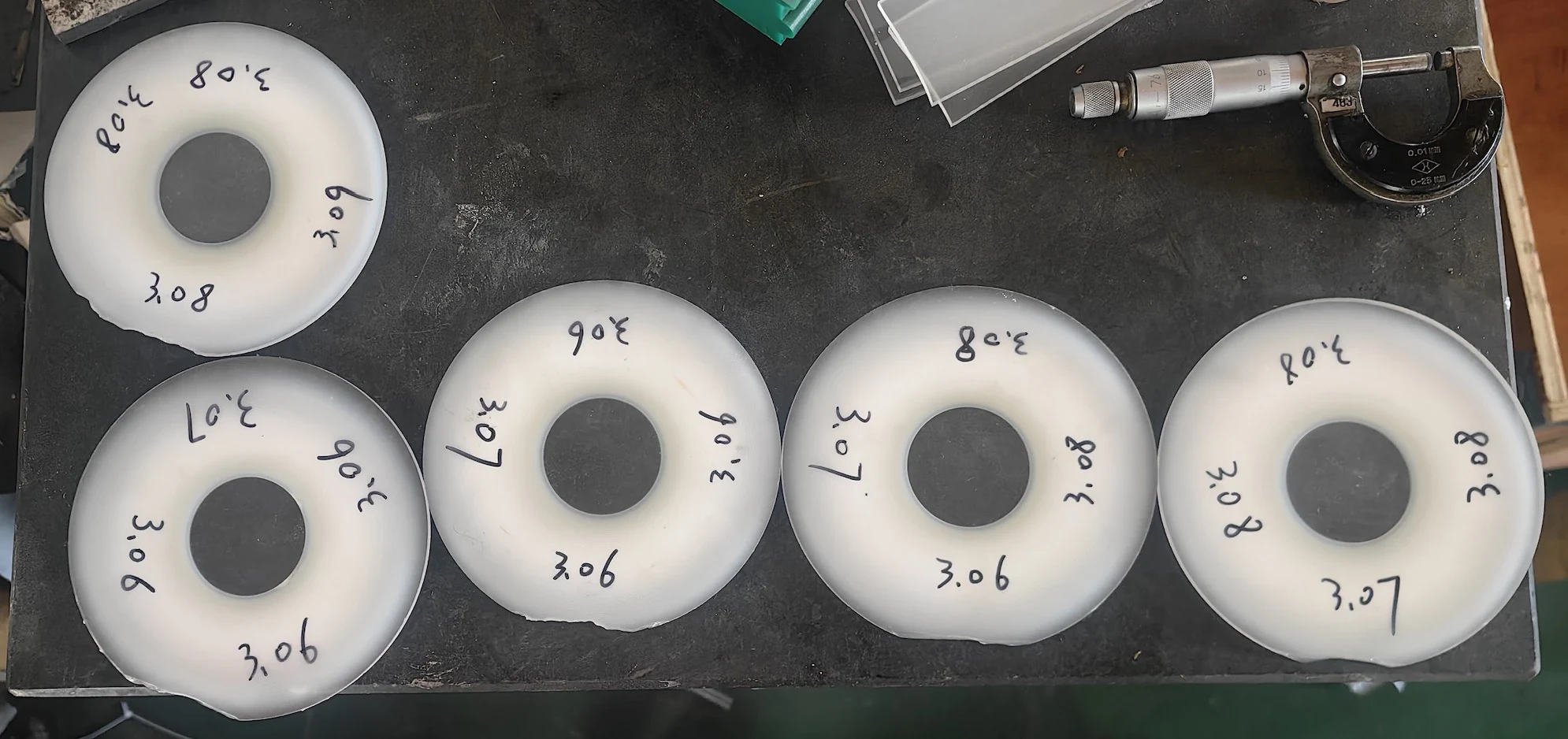
完成した各部品は、その表面の周りを4点で0.01 mmの外側マイクロメータで測定されました。5個全ての部品で読み取り値は0.03 mmの範囲内に収まり、単一の部品でも0.02 mmを超えるばらつきはありませんでした。.
| Part | 最小 (mm) | 最大 (mm) | ばらつき (mm) | ステータス |
|---|---|---|---|---|
| P1 | 3.08 | 3.09 | 0.01 | 合格 |
| P2 | 3.06 | 3.07 | 0.01 | 合格 |
| P3 | 3.06 | 3.07 | 0.01 | 合格 |
| P4 | 3.06 | 3.08 | 0.02 | 合格 |
| P5 | 3.07 | 3.08 | 0.01 | 合格 |
全部品での測定範囲:3.06–3.09 mm ・測定器:外側マイクロメータ、0.01 mm分解能 ・部品あたり4点。.
完成した結晶は何になるか
スライス・研磨されたこれらの磁気光学ガーネットウェーハは、のローターステージに使用されます。 光アイソレータ または 光サーキュレータ. 。 テルビウムガリウムガーネット ロータは磁場中で偏光を一定角度回転させます。偏光子と組み合わせると、デバイスは前方光を通過させ、そうでなければレーザー光源を不安定にする逆反射をブロックします。.
その単一の機能は、いくつかの市場にわたって現れます。 AI光通信 およびデータセンター相互接続では、すべての800G/1.6Tトランシーバーとすべてのファイバーアンプに、反射光がレーザーから離れるのを防ぐためのアイソレーションが必要です。産業用およびファイバーレーザーでは、アイソレータがシードおよびポンプステージを保護します。ライダーおよび医療用フォトニクスでは、同じ磁気光学結晶が信号をクリーンに保ちます。異なる波長は異なる組成を引き出します — 1550 nmの通信にはBi:RIG、高出力および自由空間にはTGG — しかし、切断の問題は同じです:結晶軸を保持し、スライスを平坦で平行に保つこと。.
SGRTS 20 — 5軸エンドレスダイヤモンドワイヤーソー
上記のカットは、当社の エンドレスダイヤモンドワイヤーソー platform configured with five axes for Faraday rotator garnet cutting. The endless loop matters here: a continuous diamond wire keeps a thin, steady kerf and low edge load, which is what keeps brittle garnet from chipping at entry and exit.
Common questions about magneto-optic garnet cutting
ダイヤモンドワイヤーソーは、TGGや磁気光学ガーネットを欠けさせずに切断できますか?
Yes. An endless diamond wire loop cuts TGG and other magneto-optic garnets with a thin kerf and low edge load, which keeps chipping under control once feed rate, wire tension, and coolant are tuned to the material. The brittle-but-not-impossible nature of garnet is exactly the window wire sawing is good at.
How do you hold crystal orientation during the cut?
The boule is aligned to its target axis with a rotary axis and two perpendicular tilt axes before cutting starts, then the Y/Z stage feeds it into the wire. One rigid setup for both alignment and cutting means the dialed-in orientation is the orientation that gets cut.
ガーネットウェーハで達成可能な厚さ公差はどのくらいですか?
In the trial above, five parts measured 3.06–3.09 mm with within-part variation of 0.02 mm or less on a 0.01 mm micrometer. Final thickness and parallelism are usually closed out in lapping and polishing; the saw's job is to deliver flat, parallel, correctly oriented blanks with minimal stock to remove.
Where does this approach have limits?
Wire sawing leaves a sawn surface that still needs lapping and polishing, so it is the front of the process, not the whole of it. For very thin wafers (well under 0.3 mm) or very high slice counts per boule, multi-wire or inner-diameter methods can win on throughput. For oriented, low-volume, high-value blanks where every millimeter of crystal counts, the five-axis single-wire route is the safer call.
Send a sample for a trial cut
If you are slicing Faraday rotator garnet, TGG, or any oriented magneto-optic crystal and need arc-minute orientation with tight thickness, send us a boule or test piece. We will run a trial cut on the SGRTS 20 and return the parts with measured orientation and thickness data — the same way we did here.
Request a trial cut →