Picture this familiar factory floor scenario: Why does the cutting quality suddenly drop on the exact same machine, with the exact same parameter settings, just after a routine batch change of the cutting fluid? It is a frustrating reality that many production managers and equipment engineers face. The culprit is rarely the hardware; it is almost always fluid management.
Proper cooling and lubrication in wire cutting is arguably the most underestimated, yet deeply impactful, hidden variable in the entire machining ecosystem. While operators obsess over wire speed and feed rates, the cutting fluid quietly performs three indispensable duties: temperature reduction, interfacial lubrication, and swarf removal. Neglecting this triad guarantees compromised precision, escalated consumable costs, and unpredictable downtime. This guide breaks down the science, the economics, and the practical troubleshooting of cutting fluid management to help you stabilize your production line.
Why Cooling and Lubrication Are Non-Negotiable in Diamond Wire Cutting
Although often categorized as a “cold cutting” process—especially when compared to laser or plasma cutting—the microscopic reality of diamond wire sawing is anything but cold. As thousands of microscopic diamond grits plow through hard and brittle materials like silicon, sapphire, or silicon carbide, the severe localized friction generates substantial thermal energy.
Operating without an optimized fluid system initiates a rapid, cascading failure of the cutting process. First, consider the thermal impact. Without adequate coolant, the high-tensile steel core wire undergoes sudden thermal expansion. This expansion causes immediate loss of tension control; the wire begins to bow and vibrate, leading to a severe degradation in geometric accuracy (such as Total Thickness Variation, or TTV) and eventually resulting in wire breakage.
Secondly, the absence of proper lubrication causes the friction coefficient between the diamond grits and the workpiece to skyrocket. When grits face sheer mechanical resistance without a protective fluid boundary, they experience premature micro-fracturing or are forcefully pulled out of their bonding matrix (nickel or resin). Consequently, the operational lifespan of the wire plummets, driving up tooling costs.
Finally, we must consider the mechanical necessity of clearing the kerf. Without the active flushing power of a fluid, microscopic chips (swarf) accumulate rapidly. This swarf loading clogs the cutting channel and embeds the remaining diamond grits in a paste of debris. The cutting force spikes exponentially as the wire stops cutting and starts grinding blindly against trapped waste. For a deeper understanding of how grit interaction dictates these forces, you can review the fundamental principles of diamond wire cutting process.
The Three Core Functions of Cutting Fluid
To master cooling and lubrication in wire cutting, engineers must understand that the cutting fluid is not a monolithic tool, but a multi-functional medium. It operates across three distinct physical mechanisms, each requiring specific flow and chemical properties.
Thermal Management (Cooling)
In high-speed slicing operations, the cutting fluid acts primarily as a high-capacity thermal sink. Through forced convection, the liquid rushes into the narrow kerf, absorbs the sensible heat generated by abrasive friction, and carries it away from the cutting zone.
The effectiveness of this thermal management relies heavily on two critical metrics: volumetric flow rate (measured in L/min) and the temperature delta (the difference between the inlet fluid temperature and the return fluid temperature). If thermal management is insufficient, the warning signs are immediate and visible. You will often observe heat tint (discoloration) on the cut surface of metals or a sudden, unexplainable deterioration in the surface roughness (Ra) values of semiconductor wafers, indicating localized thermal damage.
Lubrication (Friction Reduction)
Beyond removing heat, the fluid must physically separate the steel core of the wire from the abrasive sidewalls of the kerf. It does this by forming an extraordinarily thin, resilient lubricant film (often operating in the boundary lubrication regime) between the wire, the diamond abrasive, and the workpiece.
This microscopic barrier dramatically lowers the friction coefficient. By reducing parasitic drag, the cutting force is directed entirely toward material removal rather than overcoming friction. This efficiency directly extends wire life. The stability of this lubricant film is highly dependent on the fluid’s kinematic viscosity and its proprietary additive package (such as extreme pressure or anti-wear additives).
Swarf Removal (Flushing)
The physical act of cutting generates billions of microscopic chips. The flow dynamics of the cutting fluid serve to forcefully wash this swarf out of the ultra-narrow kerf.
If these particles are not evacuated instantly, they remain in the cutting path, leading to a destructive phenomenon known as “re-cutting.” In re-cutting, the diamond grits waste kinetic energy grinding existing chips into finer powder, which severely degrades the surface quality of the workpiece and dulls the tool. Efficient swarf removal is a function of fluid flow rate, flow velocity, and the precise targeting angles of the application nozzles.
Engineer’s Note: An ideal cutting fluid balances these three functions. High viscosity offers excellent lubrication but poor cooling and swarf removal; pure water offers exceptional cooling but terrible lubrication. The key is finding the exact formulated compromise for your specific material.
Types of Cutting Fluids — How to Choose
Selecting the right medium for cooling and lubrication in wire cutting dictates your environmental compliance, consumable budget, and baseline surface finish. Here are the primary categories utilized in industrial environments today:
- Water-based coolants: By far the most common choice, especially for silicon, technical ceramics, and glass. Water has exceptional specific heat capacity, making it highly efficient at cooling. It is also highly cost-effective and easy to dispose of. Drawbacks: Water has inherently poor lubricity and high corrosivity, requiring careful dosing of rust inhibitors and lubricity additives.
- Oil-based coolants: Utilizing mineral or synthetic base oils, these fluids offer unparalleled lubrication. They are frequently the preferred choice for cutting tough metals and specific alloys where boundary film strength is paramount. Drawbacks: Oil retains heat longer (inferior cooling efficiency), poses fire risks at high speeds, and carries significantly higher procurement and waste disposal costs.
- Semi-synthetic / Synthetic fluids: These chemically engineered fluids represent the modern standard for high-end CNC and wire cutting equipment. They contain no mineral oil (or very little) but use complex chemical polymers to provide excellent lubrication while maintaining the superior cooling properties of water.
- Dry cutting: In highly specialized, niche applications—such as cutting porous graphite, certain carbon composites, or materials highly reactive to moisture—cutting is performed dry, often utilizing high-velocity air or vacuum extraction to manage swarf.
Cutting Fluid Comparison Matrix
| Fluid Type | Cooling Efficiency | Lubrication Quality | Cost Impact | Primary Target Materials |
| Water-based | Excellent | Low to Moderate | Low | Silicon, Ceramics, Glass |
| Oil-based | Poor | Excellent | High | Metals, Tough Alloys |
| Semi/Synthetic | Very Good | Very Good | Moderate to High | Sapphire, SiC, Precision Parts |
| Dry / Air | Minimal | None | Very Low | Graphite, Carbon-Carbon |
Critical Parameters for Coolant Flow Optimization
A premium cutting fluid is useless if it is not delivered correctly. Equipment engineers must rigorously monitor and optimize the mechanical delivery systems to ensure process stability.
1. Flow Rate and Velocity
Flow rate is a delicate balancing act. Insufficient flow starves the kerf, resulting in poor swarf evacuation and rapid temperature spikes. Conversely, an excessive flow rate is not only wasteful but can create a hydraulic wedge effect—the high-pressure liquid can physically push against the wire, inducing high-frequency vibrations that destroy surface accuracy.
2. Nozzle Position and Angle
Precision is paramount. The nozzles must be precisely targeted at the exact entry point of the cutting zone. If the nozzles are misaligned by even a few millimeters, the fluid will bounce off the surface of the workpiece rather than penetrating deep into the kerf. Adjusting the angle to match the feed direction ensures maximum fluid entrainment.
3. Coolant Temperature Control
Thermal shock is detrimental to brittle materials. The inlet fluid temperature should typically be controlled via a chiller unit, ideally maintained steadily between 20°C and 25°C. Massive temperature fluctuations between the inlet and the workpiece lead to thermal expansion inconsistencies, directly impacting dimensional tolerances. For an in-depth look at managing these thermal variables, explore our thermal analysis in cold cutting process.
4. Filtration Systems
Filtration is the lifeblood of coolant longevity. As fluid recirculates, it carries abrasive swarf. If the filtration system (often utilizing bag filters, centrifuges, or magnetic separators) fails to trap micrometer-scale particles, the contaminated fluid returns to the cutting zone. Pumping swarf-laden fluid into the kerf guarantees deep, irreparable surface scratches.
5. Concentration Management
For water-miscible fluids, the concentration of the chemical additive package must be tightly controlled. Engineers should use a refractometer daily to measure the Brix value. If the concentration drops due to water evaporation or top-offs, lubricity plummets and machine rust begins. If the concentration is too high, it leads to foaming issues, sticky residue on the machine, and wasted chemical costs. Properly balancing these physical delivery parameters is just as crucial as feed rate and wire speed optimization for achieving a stable cut.
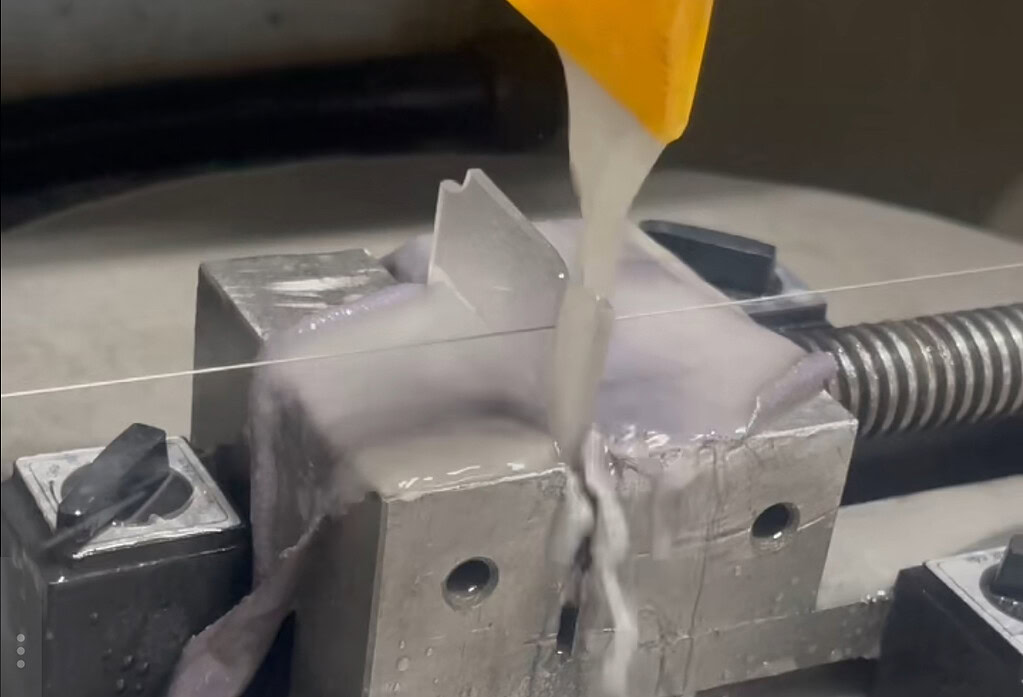
How Coolant Affects Surface Quality and Tool Life
The ultimate ROI of mastering cooling and lubrication in wire cutting is realized in the final inspection room and the purchasing department. Fluid management directly dictates both product yield and consumable spend.
When the lubricant film is insufficient, the diamond abrasive and the steel core experience severe dry friction against the workpiece. This unmitigated mechanical trauma generates deep micro-cracks beneath the surface of the material, which later propagate during polishing, causing wafers to shatter. Furthermore, poor swarf removal embeds hard chips into the side of the cut, creating distinctive, unpolishable re-cutting scratches that ruin the surface roughness (Ra).
Cooling deficiencies have an equally measurable cost: material waste. When the steel core wire overheats due to inadequate coolant flow, its diameter microscopically expands. This expansion forces the kerf width to grow. In high-value material processing like silicon carbide or aerospace alloys, a wider kerf translates directly to fewer slices per ingot—a massive financial loss.
Conversely, maintaining optimal fluid delivery, pristine filtration, and strict concentration limits yields remarkable benefits. Industry data consistently shows that highly optimized cooling and lubrication can extend diamond wire operational life by 30% to 50%, while minimizing kerf loss. To see how these variables tie into final product geometry, read our guide on surface quality and kerf loss optimization. For an economic breakdown of how extended tool life impacts bottom-line profitability, see our analysis on cutting efficiency and tool life.
Common Coolant Problems and Troubleshooting
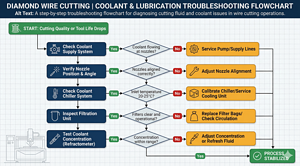
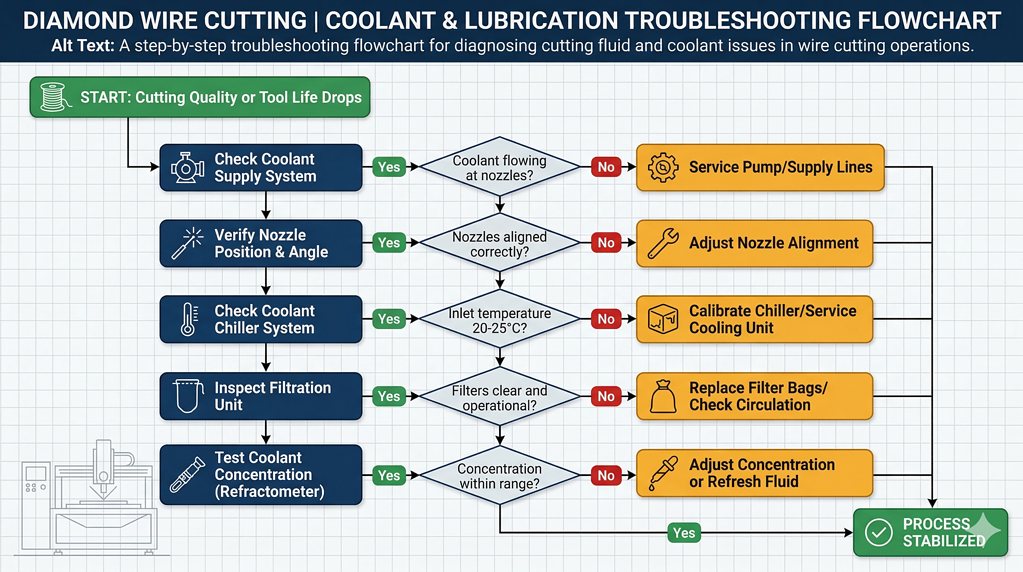
Even with robust systems in place, parameters drift. When surface quality suddenly drops, production managers should consult the fluid systems before adjusting mechanical machine parameters. Below is a practical troubleshooting matrix for common fluid-related faults.
| Phenomenon / Symptom | Potential Root Cause | Recommended Solution |
| Heat tint or burn marks on cut surface | Insufficient flow rate; nozzle misalignment; chiller failure. | Verify flow meter readings; recalibrate nozzle targeting using a laser pointer tool; check chiller setpoint. |
| Regular, deep scratches on workpiece | Filtration failure; clogged filter bags allowing swarf recirculation. | Replace filter bags immediately; inspect return lines for sludge buildup; upgrade to finer micron rating. |
| Severe foaming in the coolant tank | Coolant concentration too high; introduction of tramp oil or foreign contaminants. | Use a refractometer to check concentration; add pure water to dilute; skim tramp oil from tank surface. |
| Sudden, drastic drop in wire lifespan | Lubricity additive depletion (fluid aging or bacterial degradation). | Drain and thoroughly clean the system; replace with fresh batch; monitor pH levels going forward. |
| Rust or oxidation spots on machine/workpiece | Anti-rust inhibitor concentration too low; incorrect pH balance. | Boost fluid concentration; add specific anti-corrosion additives; switch to a more robust chemical formula. |
Proactive maintenance prevents these reactive troubleshooting sessions. Modern facilities integrate flow meters, temperature sensors, and inline refractometers into their PLCs. If you want to move from reactive to predictive maintenance, it is essential to implement real-time monitoring and data control.
Frequently Asked Questions
Q1: What is the best coolant for cutting silicon with diamond wire?
Water-based synthetic or semi-synthetic coolants are the undisputed mainstream choice for silicon cutting. Silicon generates fine, powdery swarf and requires rapid heat dissipation to prevent thermal stress fractures. Water-based solutions offer the highest cooling capacity at a controllable cost. We highly recommend using specialized formulations that include specific surfactants; these reduce surface tension, allowing the fluid to penetrate deeper into the ultra-thin kerf and dramatically improving swarf evacuation.
Q2: How often should I replace the cutting fluid?
Fluid lifespan entirely depends on your production volume, material type, and how rigorously you maintain the system. As a baseline rule for continuous operation, you should be checking fluid concentration (Brix) and pH levels at least twice a week. When the pH drops below 8.5 (indicating bacterial growth or degradation) or the concentration deviates by more than ±1% from the manufacturer’s recommendation despite top-offs, it is time for a change. Under heavy, continuous load, a full flush and replacement every 2 to 4 weeks is standard industry practice.
Q3: Can I use water instead of specialized coolant?
While pure or deionized water can act as a thermal sink and wash away swarf, it is strongly discouraged for standard operations. Water has zero lubricity and is highly oxidative. Running pure water will cause the friction coefficient inside the kerf to skyrocket, accelerating diamond grit pull-out and halving your wire life. Furthermore, it will rapidly rust the expensive steel components of your CNC machine. The only exception is extremely rare niche applications like dry-cutting graphite, where liquids are avoided entirely.
Q4: How does coolant flow rate affect cutting accuracy?
Flow rate is directly tied to Total Thickness Variation (TTV) and surface roughness. If the flow is too low, localized overheating causes wire expansion and tension loss, while trapped swarf pushes the wire off its intended path, ruining dimensional accuracy. Conversely, if the flow is aggressively high, the hydraulic pressure of the fluid itself can push the wire sideways or induce high-frequency vibrations. The optimal flow rate must be carefully calibrated based on your specific kerf width, feed rate, and the density of the material being cut.
Cooling and lubrication in wire cutting is frequently referred to by veterans as the “invisible fourth parameter”—standing equally alongside wire speed, feed rate, and wire tension. Assuming that fluid is “just water” is a costly operational mistake. Ignoring the physical chemistry and fluid dynamics inside the kerf is equivalent to surrendering control over your final surface quality, your tool longevity, and ultimately, your production costs.
By treating your fluid management systems with the same engineering rigor as your mechanical servos, you ensure stable, profitable, and repeatable slicing operations. To zoom out and see how fluid dynamics integrate into the complete machining ecosystem, return to our comprehensive overview of diamond wire cutting.