Introduction: The “Golden Triangle” of Slicing
Diamond wire saw cutting does not rely on a single setting or shortcut. Cutting stability and surface quality are determined by the balance of three interacting parameters: wire speed, wire tension, and feed rate.
These three variables form what engineers commonly describe as the “golden triangle” of diamond wire saw cutting parameters.
Changing wire speed alters the energy delivered by each diamond grit.
Changing wire tension alters the geometric stiffness of the wire and its resistance to bowing.
Changing feed rate alters chip load, cutting force, and productivity.
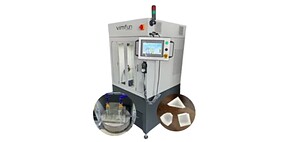
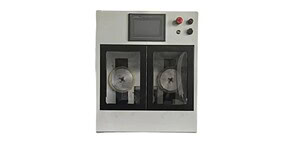
These cutting parameters are closely related to the internal structure of the diamond wire saw machine, including the drive system, tension system, and guide wheel layout.
1. Wire Speed: Controlling Material Removal Behavior
Wire speed defines how fast the diamond wire travels across the guide wheels and through the cutting zone. It is one of the primary drivers of material removal efficiency.
1.1 How Wire Speed Influences Cutting
Higher wire speed increases the number of diamond grit contacts per second. This raises the rate at which material is fractured and removed.
For hard and brittle materials such as silicon carbide, sapphire, and advanced ceramics, higher wire speed is essential. At elevated speed, diamond grits induce brittle fracture rather than ductile plowing, allowing material to be removed efficiently while reducing normal cutting force on the wire.
For softer or heat-sensitive materials such as silicon, optical glass, and graphite, moderate wire speed is preferred. Excessive speed increases frictional heat, which may lead to subsurface damage or thermal micro-cracking.
1.2 Practical Wire Speed Ranges
In practical applications, typical wire speed ranges are:
- Hard and brittle materials: approximately 40 to 60 meters per second
- Medium and softer materials: approximately 20 to 40 meters per second
Operating beyond these ranges is usually counterproductive. At extreme speed, coolant delivery becomes ineffective due to the air barrier around the wire, and vibration from guide wheel runout becomes more pronounced.
2. Wire Tension: Establishing Geometric Stiffness
A diamond wire has no inherent rigidity. Wire tension is what provides stiffness and allows the wire to maintain a straight cutting path.
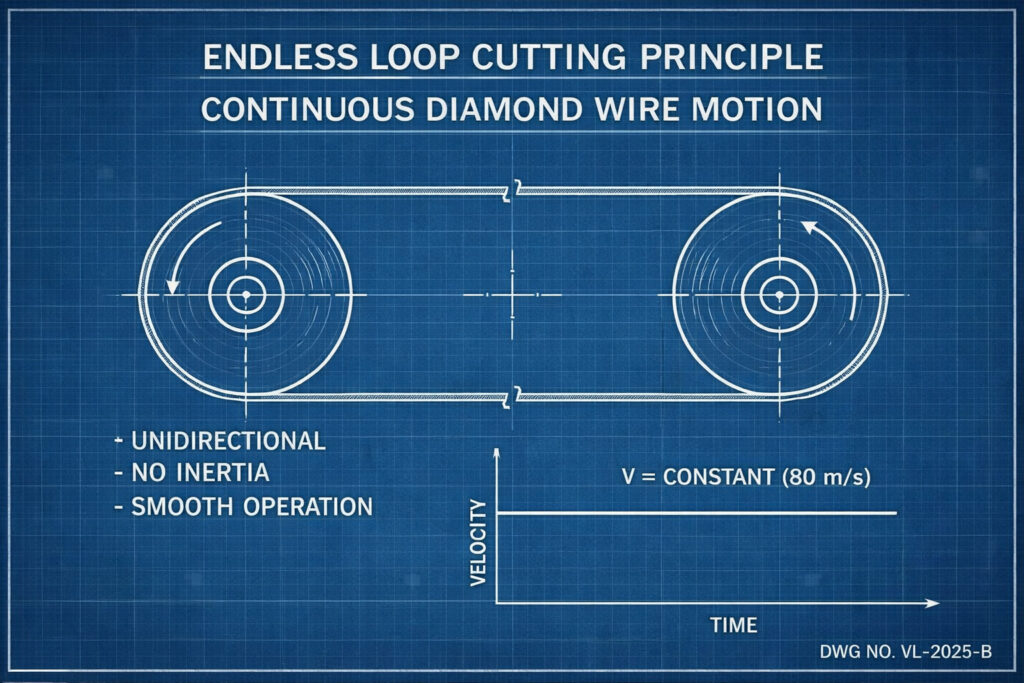
Endless diamond wire saw machines operate at much higher wire speeds than reciprocating wire saws. As a result, significantly higher tension is required to resist centrifugal forces and prevent lateral instability.
2.1 Why High Tension Is Required
The restoring force that keeps a wire straight is proportional to applied tension and inversely related to the unsupported span between guide wheels. If tension is too low, the wire behaves like a loose elastic band and bows easily under cutting load.
Excessive bowing leads directly to tapered cuts and thickness variation. In severe cases, cyclic bending accelerates fatigue and causes wire breakage.
2.2 Reference Tension Ranges for Endless Wire Loops
Typical reference values for endless diamond wire tension are:
- 0.3 mm wire diameter: approximately 120 to 135 newtons
- 0.4 mm wire diameter: approximately 140 to 160 newtons
- 0.5 mm wire diameter: approximately 150 to 170 newtons
- 0.6 mm wire diameter: approximately 160 to 180 newtons
These values apply specifically to closed-loop diamond wire systems. Actual working tension should remain well below the breaking strength of the wire, typically within 40 to 50 percent of the rated breaking load, to allow margin for shock loads during cutting.
Feed rate behavior is also influenced by the feed system and control logic, especially when adaptive load-based control is used.
3. Feed Rate: Balancing Productivity and Stability
Feed rate defines how fast the wire advances into the material. This parameter has the greatest influence on cycle time and the highest risk of failure if set incorrectly.
3.1 The Bowing Constraint
Feed rate cannot exceed the cutting capacity of the wire. When feed rate is too aggressive, cutting resistance forces the wire to bow backward.
Once wire bowing exceeds a small critical range, the wire no longer cuts vertically. Instead, it begins to drift sideways, leading to wedge-shaped cuts and rapidly increasing tensile stress. Continued feeding under these conditions almost always results in wire breakage.
3.2 Practical Feed Rate Ranges
Recommended starting feed rates vary by material:
- Silicon carbide and sapphire: approximately 0.2 to 0.8 millimeters per minute
- Glass and quartz: approximately 2.0 to 5.0 millimeters per minute
- High-density graphite and similar materials: approximately 10 to 30 millimeters per minute
Feed rate should always be increased gradually while monitoring spindle load and wire behavior.
3.3 Variable Feed Strategies
For square or large ingots, the effective contact length between wire and material changes during the cut. Advanced feed strategies account for this variation.
A reduced feed rate at entry minimizes impact shock. Feed rate may be increased through the middle of the cut where contact is longest and resistance is highest. Near exit, feed rate should again be reduced to prevent bottom-edge chipping or breakout.
4. Using the Golden Triangle for Troubleshooting
When cutting defects occur, one of the three primary parameters is usually responsible.
Wire breakage often indicates excessive feed rate or tension beyond safe limits.
Surface waviness typically results from insufficient tension or resonance between wire speed and machine structure.
Tapered cuts are most commonly caused by excessive feed rate leading to wire bowing.
Dull cutting or wire glazing may indicate wire speed that is too high relative to feed rate.
Effective troubleshooting always involves adjusting parameters as a system rather than in isolation.
5. Starting Parameter Recipes (Reference Only)
The following examples are intended as starting references only. Actual values must be verified based on wire specification and machine configuration.
Silicon Carbide
Wire diameter: 0.35 mm
Wire speed: approximately 50 meters per second
Wire tension: approximately 130 newtons
Feed rate: approximately 0.3 millimeters per minute
Coolant: high-pressure water-based coolant
Optical Glass
Wire diameter: 0.30 mm
Wire speed: approximately 35 meters per second
Wire tension: approximately 125 newtons
Feed rate: approximately 3.0 millimeters per minute
Coolant: water-based coolant
High-Density Graphite
Wire diameter: 0.50 mm
Wire speed: approximately 40 meters per second
Wire tension: approximately 160 newtons
Feed rate: approximately 15.0 millimeters per minute
Cooling method: dry cutting with dust extraction
Conclusion
Setting diamond wire saw cutting parameters is not guesswork. It is a controlled balance of physics.
Wire speed provides the cutting energy.
Wire tension provides geometric accuracy and stability.
Feed rate determines productivity and cutting load.
A skilled operator monitors spindle load continuously. When load increases, the wire is signaling excessive stress. Responding by reducing feed rate or adjusting wire speed preserves wire life and cutting accuracy.
These parameter-setting principles are applied throughout the complete diamond wire saw cutting process, from setup and fixturing to stable slicing.
FAQ
Q1: Why do endless diamond wire saws require such high tension?
Endless wire systems operate at very high linear speeds. Without sufficient tension, centrifugal forces cause the wire loop to expand and vibrate. High tension is essential to maintain a stable cutting path.
Q2: Does higher wire speed always increase cutting efficiency?
No. Excessive wire speed can cause diamond grits to rub instead of cut, leading to glazing. In some cases, reducing speed slightly improves material removal.
Q3: How can I tell if feed rate is too aggressive?
Common indicators include rising spindle load, visible wire bowing, surface step marks, and taper. Reducing feed rate immediately helps prevent wire failure.