Introduction
Modern manufacturing increasingly depends on high-precision cutting technologies to process advanced materials such as sapphire, silicon carbide, optical glass, quartz, ceramics, and graphite. Traditional cutting tools—including blades, band saws, and reciprocating wire systems—tend to generate excessive heat, wide kerf loss, micro-cracks, and inconsistent surface textures.
Modern wire cutting technology addresses these issues by providing:
- Extremely narrow kerf width
- Low thermal impact
- Smooth cutting surfaces with minimal post-polishing
- High compatibility with ultra-hard and brittle materials
- Reliable slicing for thin wafers and special geometries
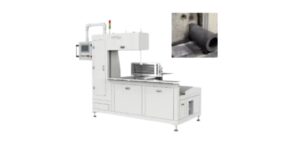
With the development of closed-loop diamond wire, servo tension control, and intelligent CNC feeding mechanisms, wire cutting has become a key technology across optics, semiconductors, research labs, and precision manufacturing. Learn more about our industrial wire saw systems.
The Physics Behind Abrasive Wire Cutting
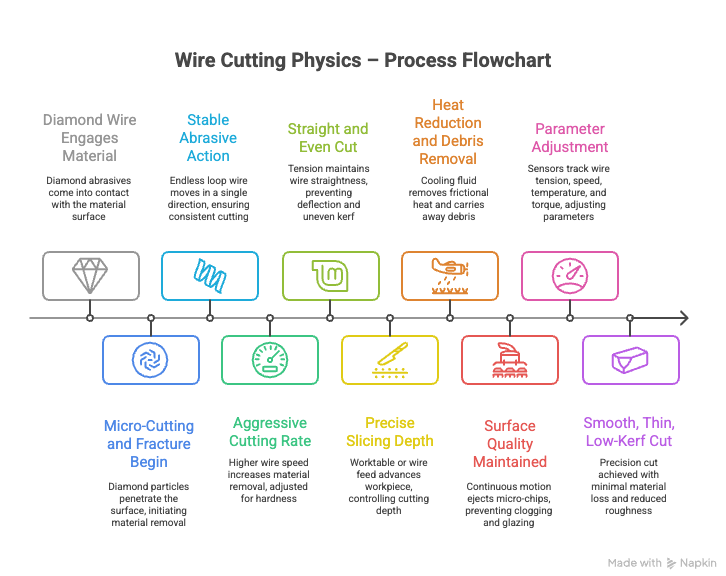
Modern wire cutting technology is built upon the mechanical interaction between diamond abrasives and the material surface. Three core mechanisms define this process:
Abrasive Interaction
Diamond particles remove material through micro-cutting and localized brittle fracture.
- Hard materials require sharper exposed diamonds and higher wire speeds.
- Brittle materials require stable tension and low vibration to prevent chipping.
- For a detailed overview of different brittle material cutting characteristics, see our cutting materials guide.
Continuous Wire Motion
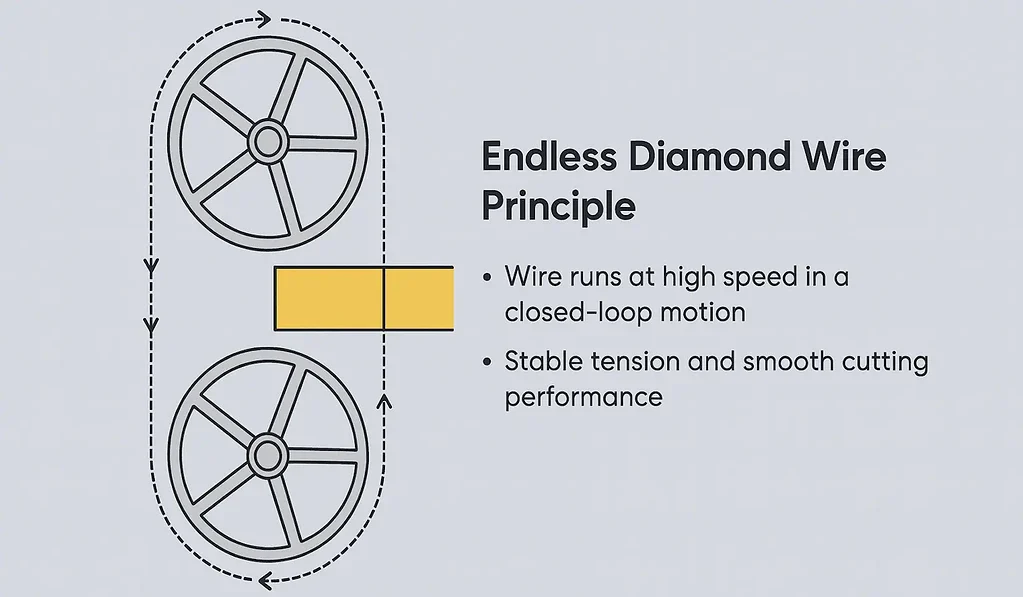
One of the biggest advancements is the use of endless loop diamond wire, which moves continuously in a single direction, unlike traditional spool wire that moves back and forth.
| Motion Type | Characteristics | Cutting Result |
|---|---|---|
| Continuous loop wire | One-direction motion | Up to 80 m/s, low vibration, smoother surface |
| Spool wire | Reciprocating motion | Reversal marks, lower efficiency |
ontinuous motion ensures consistent abrasive contact, uniform material removal, and improved stability.
Heat and Chip Management
High-speed motion improves chip evacuation, while cooling or lubrication reduces frictional heat.
This minimizes thermal damage, making it suitable for sensitive optical, semiconductor, and ceramic materials.
Key Parameters That Define Cutting Performance
Wire cutting depends on precise coordination of tension, linear speed, and feed rate.
Wire Tension
Tension determines straightness, stability, and surface uniformity.
| Parameter | Low Tension | High Tension |
|---|---|---|
| Suitable For | Brittle materials | Hard materials |
| Benefits | Reduced cracking | Faster cutting |
| Limitations | Slower | Higher risk of breakage |
Modern equipment uses servo or pneumatic tension systems to maintain stability during long cutting cycles.
Linear Wire Speed
Wire speed influences cutting efficiency and surface finish:
- General industrial range: 50–80 m/s
- Optical glass: Lower speed for fine surfaces
- SiC & sapphire: Higher speeds improve cutting rate
Feed Rate
Feed speed must be matched with material hardness and wire performance:
- Optical materials: ~10 mm/min
- Graphite: 15–30 mm/min
- Ceramics: moderate, stable feeding
Control Systems for Precision Slicing
Modern wire saws rely on CNC or PLC control systems to achieve consistent, high-precision slicing.
Automated Thickness Control
The machine automatically feeds by a preset slicing thickness, delivering:
- Stable repeatability
- Uniform slice dimensions
- Precision up to ±0.03 mm in advanced systems
Multi-Axis Cutting Capabilities
Advanced systems can include:
- Rotational axes
- Tilting axes
- Contour cutting paths
This allows for cutting of prisms, cylinders, irregular profiles, complex graphite structures, and specialized ceramics.
Real-Time Monitoring and Safety Functions
Typical advanced functions include:
- Wire break detection
- Real-time tension feedback
- Cooling or lubrication monitoring
- Speed and torque monitoring
- Emergency stop and auto shutdown

Application Scenarios and Comparison
Endless Wire Cutting vs. Spool-Type Wire Cutting
| Feature | Endless Diamond Wire | Spool-Type Wire |
|---|---|---|
| Motion | Continuous | Reciprocating |
| Max Speed | Up to 80 m/s | ~20 m/s |
| Vibration | Very low | Higher |
| Surface Finish | Very smooth | Reversal marks |
| Maintenance | Simple | Complex |
| Typical Use | Sapphire, SiC, optics, ceramics, graphite | General materials |
Precision in Thin Slicing
Modern systems deliver:
- ±0.03 mm thickness precision
- Minimal kerf loss
- Reduced need for secondary polishing
This is crucial for optical filters, sapphire wafers, semiconductor substrates, precision graphite components, and high-value brittle ceramic parts. You can explore more wire cutting applications in different industries here.
FAQ — Wire Cutting Technology & Applications
1. Why is endless loop diamond wire better than spool-type wire for cutting hard and brittle materials?
Endless loop wire moves in a single continuous direction at high speed (up to 80 m/s), which eliminates reversal marks and reduces vibration. This produces smoother surfaces, narrower kerf width, and more consistent cutting performance—especially important for sapphire, SiC, and optical glass.
2. How do tension and wire speed influence cutting quality?
Wire tension controls straightness and stability, while wire speed determines cutting aggressiveness and surface smoothness.
- High tension + high speed → efficient SiC and sapphire cutting
- Lower tension + controlled speed → better for optical glass and ceramics Correct parameter matching is critical for minimizing micro-cracks.
3. Can wire cutting achieve precision slicing for thin wafers?
Yes. Modern systems equipped with servo tension control and CNC feed mechanisms can achieve ±0.03 mm thickness precision with minimal kerf loss. This is ideal for sapphire wafers, optical filters, quartz plates, and semiconductor substrates.
4. Why does wire cutting produce less thermal damage compared with traditional blades?
Diamond abrasives remove material through micro-fracture rather than friction-based cutting.
Combined with continuous wire motion and efficient chip evacuation, this significantly reduces heat generation, protecting sensitive materials such as optics, semiconductors, and advanced ceramics.
5. What materials benefit most from modern wire cutting technology?
Wire cutting is particularly effective for:
- Sapphire
- Silicon carbide (SiC)
- Quartz and optical glass
- Technical ceramics
- Graphite and carbon composites Its ability to cut hard, brittle, and high-value materials with low damage makes it essential in semiconductor, optics, aerospace, and precision manufacturing industries.
Conclusion
Modern wire cutting technology combines:
- High-speed continuous loop diamond wire
- Intelligent tension control
- Precision CNC feeding
- Stable abrasive interaction with minimal heat
The result is a cutting process that offers:
- High accuracy
- Low material loss
- Excellent surface integrity
- Reliable performance for brittle and ultra-hard materials
For industries such as optics, semiconductors, aerospace, advanced ceramics, carbon composites, and high-purity graphite processing, wire cutting systems have become an essential tool for both research and production environments. To explore equipment tailored for your specific production needs, discover our complete range of industrial wire saw systems.