Diamond wire cutting is widely recognized and marketed as a “cold cutting” technology, an attractive premise for processing brittle and heat-sensitive materials. However, this terminology presents a fundamental engineering paradox. While the macroscopic bulk temperature of the workpiece remains relatively low, the microscopic reality at the abrasive-workpiece interface is drastically different. In fact, localized contact temperatures can easily surge to 600°C or higher during the high-frequency impact and friction of diamond abrasives.
This hidden thermal load is a critical, yet frequently overlooked, variable in modern manufacturing. The effective application of thermal analysis cold cutting principles is what separates average production lines from high-yield, precision operations. The distribution of these localized temperatures—and the resulting thermal stress—directly dictates final surface quality, material integrity, and equipment lifespan. By properly measuring, modeling, and controlling this thermal profile, process and quality engineers can reliably predict and prevent heat-related failure modes. Understanding this thermal reality is the ultimate key to minimizing hidden costs, extending wire life, and driving exceptional production yields.
1. The Thermal Reality of “Cold” Cutting
To master thermal management, engineers must first dismantle the misconception that “cold cutting” implies the absence of heat generation. This cognitive framework is essential for establishing robust process control parameters.
1.1 Clarifying the “Cold” Misconception
The term “cold cutting” is entirely relative. It does not mean the process is isothermal or devoid of heat generation. Instead, it indicates that compared to traditional abrasive grinding or conventional slicing methods, the heat source is tightly confined to a microscopic contact zone. In conventional grinding, contact temperatures regularly reach 1000–1200°C, causing bulk thermal damage. In diamond wire cutting, the peak localized temperatures typically hover between 400°C and 800°C. The “cold” designation refers to the rapid dissipation of this heat, ensuring it does not induce permanent microstructural alterations or phase changes across the bulk material.
1.2 Physical Sources of Heat Generation
Heat in the cutting zone is not arbitrary; it is the direct byproduct of mechanical work converted into thermal energy. The primary physical sources include:
- Abrasive Friction Heat: The intense rubbing of diamond particles against the workpiece. This can be modeled by the equation Qfriction=μ×N×v (where μ is the friction coefficient, N is the normal force, and v is the relative velocity).
- Plastic Deformation: The immense shear forces required to form micro-chips in brittle materials release significant thermal energy just before material fracture.
- Wire Core Losses: The dynamic bending and internal flexing of the metal wire core over guide pulleys generate internal heat through iron and copper losses (if applicable).
1.3 Why “Cold Cutting” Matters
Strictly maintaining the characteristics of cold cutting is vital for downstream quality. Uncontrolled heat generation leads to the surface hardening or phase transformation of the workpiece, permanently altering its original mechanical properties. For sensitive substrates like monocrystalline silicon or sapphire wafers, excessive heat localized at the kerf edge exacerbates thermal stress, initiating micro-cracks that penetrate deep into the material substrate. Proactive thermal management is fundamentally tied to subsurface damage reduction, preventing these micro-cracks from ruining the wafer’s structural integrity.
2. Temperature Distribution in the Cutting Zone
Understanding exactly where the heat resides is a prerequisite for optimizing your cooling strategy. The thermal profile in the cutting zone is highly stratified.
2.1 Three-Tier Contact Temperature Analysis
| Zone | Temperature Range | Characteristics | Impact |
|---|---|---|---|
| Abrasive Surface | 600–900°C | Highest thermal point, transient peak during impact. | Abrasive wear, particle dulling, graphitization. |
| Wire Core Surface | 200–400°C | Primary contact interface between the wire matrix and workpiece. | Wire tensile strength degradation, core thermal stress. |
| Workpiece Contact | 300–700°C | Dependent on the substrate’s specific thermal conductivity. | Surface thermal damage, generation of micro-cracks. |
2.2 Variables Influencing the Thermal Field
A rigorous thermal analysis cold cutting model must account for the primary kinematic parameters:
- Wire Speed: Higher wire speeds mean shorter individual abrasive contact times, leading to high peak transient temperatures but shorter durations. For example, increasing wire speed from 50 m/s to 100 m/s can elevate peak localized temperatures by 100–150°C.
- Feed Rate: Higher feed rates force a deeper depth of cut per abrasive grain, drastically increasing the volume of heat released per unit of time. Pushing the feed rate from 0.5 mm/min to 2 mm/min can raise the average workpiece boundary temperature by 80–120°C.
- Wire Tension: Insufficient tension causes wire deflection (bowing), increasing the effective contact area and friction time, which results in unnecessary frictional heat buildup.
- Cooling Efficiency: Inadequate coolant flow, poor nozzle targeting, or high initial fluid temperatures cause rapid heat accumulation. A mere 20% drop in cooling flow can spike local temperature peaks by 20–40%.
2.3 Steady-State vs. Transient Temperatures
Process engineers must balance two distinct thermal realities. Steady-state temperature is the equilibrium temperature reached by the general wire and workpiece area after continuous cutting; this metric is critical for maintaining overall throughput. Conversely, transient peak temperature is the sub-millisecond flash of heat generated the exact moment a diamond particle strikes the substrate. Both must be managed. For insights into how mechanical parameters directly alter these thermal states, engineers must carefully evaluate feed rate and wire speed optimization strategies.

3. Thermal Stress and Deformation
Heat generation does not just risk material burning; it introduces thermal stress and expansion, both of which are the primary enemies of geometric precision.
3.1 Thermal Expansion and Dimensional Fluctuation
The thermal expansion coefficient (α) for a high-carbon steel wire core is approximately 12×10−6/∘C. If the wire temperature rises from an ambient 20°C to 200°C (ΔT=180∘C), the diametric expansion can be calculated via Δd=d0×α×ΔT. For a 0.5 mm diameter wire, the expansion is: Δd≈0.0011 mm=1.1 \mum
While 1.1 μm seems negligible, this expansion occurs symmetrically, increasing the total kerf width by 2×Δd. Consequently, a nominal 0.35 mm kerf expands to 0.352 mm, deteriorating Total Thickness Variation (TTV). Conversely, the workpiece (e.g., Silicon, with α≈2.6×10⁻⁶/∘C) expands much less. A 100°C rise yields < 0.5 μm expansion. However, in ultra-precision optical applications, even a half-micron deviation can result in batch rejection.
3.2 Sources of Thermal Stress
- Gradient Stress: The workpiece surface experiences severe high temperatures while the internal substrate remains cool. This creates a state where the surface layer is under compression and the inner layer is under tension, aggressively deepening subsurface micro-cracks.
- Wire Core Stress: The wire continuously cycles through extreme heating in the cut and rapid cooling outside the cut. This severe thermal cycling alters the metallographic structure of the steel core, causing fatigue and unpredictable, sudden wire breakages.
3.3 Impact on Geometric Precision
- TTV Deterioration: Uneven thermal expansion across the wafer block directly causes slice thickness variations.
- Wire Bow: If one side of the wire heats faster than the other, asymmetric expansion forces the wire’s centerline to deviate, creating a bowed cut.
- Kerf Width Fluctuation: Thermal instability leads to kerf fluctuations of ±0.05 mm, well outside the acceptable ultra-precision tolerance of ±0.02 mm. Addressing these temperature gradients is central to strict kerf loss and TTV control.
4. Heat Dissipation Mechanisms and Cooling Strategy
Implementing an effective cooling strategy requires understanding exactly how heat escapes the cutting zone and how to manipulate those pathways.
4.1 The Three Pathways of Heat Dissipation
| Pathway | Proportion | Mechanism | Controllability |
|---|---|---|---|
| Chip Evacuation | 40–60% | Micro-chips carry away the abrasive heat upon ejection. | Medium (Depends on flushing efficiency). |
| Cooling Fluid | 30–50% | Fluid flows directly through the contact zone absorbing heat. | High (Adjustable flow, temp, concentration). |
| Radiation & Conduction | 5–15% | Natural heat transfer to surrounding air and machine parts. | Low (Passive mechanism). |
4.2 The Critical Role of Cooling Fluid
Cooling fluid is not merely for dropping temperatures; it is a complex thermal management tool. It regulates the baseline temperature distribution (inlet temperatures must stay between 15–25°C, and outlet temperatures strictly < 40°C). Furthermore, it creates a crucial lubrication film (10–50 μm thick) that drops the friction coefficient from a dry μ≈0.8–1.2 down to μ≈0.3–0.5, drastically cutting heat at the source. It also flushes chips. If chips are trapped, re-cutting occurs, generating secondary friction that adds 50–100°C to local peak temperatures.
4.3 Impact of Fluid Formulation
- Viscosity: A fluid that is too thick boasts high heat capacity but resists penetrating the tight kerf. A fluid too thin flows easily but evaporates or shears apart before extracting heat. The industry standard recommendation is ISO VG 32–46.
- Concentration: Emulsion concentrations of 5–10% are standard. Lower concentrations thin out the protective lubrication film, while higher concentrations choke fluid flow dynamics.
- Additives: Extreme Pressure (EP) additives are vital. Under high-heat conditions, they chemically bond to metal surfaces, stabilizing the boundary layer and suppressing friction spikes.
4.4 Cooling Nozzle Design
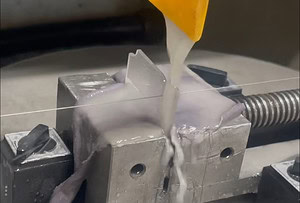
The delivery geometry is just as important as the fluid itself. Nozzle attack angles should be calibrated between 45–60° to ensure fluid actually penetrates the wire-workpiece interface. Flow rates should range from 40–80 L/min, ideally deployed via multi-point injection to ensure an even thermal gradient. For a comprehensive look at engineering fluid delivery, review these cooling and lubrication strategies in diamond wire cutting.
5. Measuring and Monitoring Temperature
Without data, thermal management is merely guesswork. Modern facilities must deploy robust monitoring architecture to transform thermal phenomena into actionable process parameters.
5.1 Comparison of Temperature Measurement Methods
| Method | Principle | Accuracy | Cost | Application Scenario |
|---|---|---|---|---|
| Infrared Thermal Imager | Infrared radiation tracking | ±2–5°C | Medium | Static inspection, wire thermal profiling. |
| Contact Thermometers | Thermocouple / RTD | ±1–2°C | Low | Offline offline workpiece surface checks. |
| Fiber Optic Sensors | Fluorescence decay | ±0.5–1°C | High | Embedded high-precision real-time internal temps. |
| CFD Simulation | Numerical modeling | ±5–10% | Software | Design phase, process optimization prediction. |
5.2 Practical Factory Monitoring Metrics
Since measuring the exact localized temperature beneath the wire is physically impossible during production, engineers rely on highly correlated proxy metrics:
- Wire Exit Temperature: Measured via infrared sensors immediately after the wire exits the kerf. An upward trend in this metric indicates climbing contact zone heat or a failing cooling supply.
- Workpiece Surface Temperature: Rapid scans of the cutting boundary. If surface temps exceed 100°C, the feed rate is likely outpacing the cooling capacity.
- Cooling Fluid Delta-T: The difference between outlet and inlet fluid temperatures (ΔT=Tout−Tin). If ΔT>15∘C, the system is retaining too much heat and fluid volume must be increased.
5.3 Diagnosing Anomalies via Temperature Data
- Continuous Wire Exit Temp Rise: Indicates the diamond abrasive has dulled and entered the failure phase. The wire should be scheduled for immediate replacement.
- Spikes on Specific Materials: If the temperature spikes unexpectedly, suspect a variation in the incoming material batch’s thermal conductivity or hardness.
- Erratic Temperature Fluctuations: Often points to cooling fluid concentration drifting out of spec, or unstable wire tension servos.
5.4 Data-Driven Process Adjustments
Advanced facilities map temperature data against Ra, TTV, and SSD to establish predictive quality models. Automated alarms trigger feed rate compensations the moment temperatures breach set thresholds. Mastering this allows for predictive maintenance, a cornerstone of real-time temperature monitoring and process control.
6. Thermal Damage Prevention and Material Integrity
The ultimate goal of performing a thermal analysis cold cutting assessment is preserving material integrity and protecting capital tooling.
6.1 Heat-Related Failure Modes
On the Workpiece:
- Heat-Affected Zone (HAZ): Surface micro-cracking and stress-induced phase changes occurring in the top 10–50 μm layer. In semiconductor manufacturing, this demands subsequent chemical mechanical planarization (CMP), adding significant overhead.
- SSD Deepening: When thermal stress compounds with mechanical shear stress, cracks propagate deeper. Controlling interface temperatures below 400°C keeps SSD depth within a manageable 5–10 μm. Spikes over 600°C drive SSD down to an unacceptable 50–100 μm.
On the Wire:
- Metallographic Shift: High-carbon steel cores subjected to relentless heating and cooling experience grain growth and stress relaxation, rendering the wire brittle and prone to catastrophic snapping.
- Abrasive Graphitization: Beyond 700°C, the carbon atoms in diamond abrasives begin to graphitize (soften). The wire dulls exponentially faster, slashing its lifespan.
6.2 The Economic Value of Thermal Control
Poor temperature control directly erodes profit margins. If SSD deepens from 10 μm to 50 μm, an additional 0.4 mm of material must be ground away, increasing processing costs by ¥5–10 per wafer and crashing overall yield. Furthermore, excessive heat can reduce wire cutting capacity from 500 kg down to 300 kg, driving consumable costs up by 50%. Upgrading cooling fluids and installing continuous temperature monitoring consistently yields a Return on Investment (ROI) of less than one year.
6.3 Best Practices Summary
- Establish strict, material-specific target temperature ranges before production.
- Mandate shift-based verification of cooling fluid viscosity, concentration, and flow.
- Deploy real-time infrared monitoring on wire exit zones.
- Implement closed-loop PLC logic to throttle feed rates when thermal alarms are triggered.
7. Case Study — Thermal Optimization in Silicon Wafer Cutting
Background: A leading photovoltaic silicon wafer manufacturer experienced a severe yield drop from an established 95% down to 88%. The primary cause was identified as excessive subsurface damage leading to wafer breakage during post-cut lapping processes.
Diagnosis: A comprehensive thermal analysis cold cutting audit revealed loose coolant management. The wire exit temperature was hovering between 60–80°C (well above the safe threshold of ≤ 50°C). Engineering models calculated that the internal contact zone was exceeding 700°C, initiating deep thermal micro-cracks.
Optimization Process:
- Standardized the coolant formulation, restoring the exact 8% emulsion concentration and strict viscosity controls.
- Installed inline infrared temperature monitoring at the wire exit, logging data directly to the central PLC.
- Optimized multi-point nozzle angles and increased total fluid flow from 50 L/min to 70 L/min.
- Established automated alarm thresholds: if the exit temperature exceeded 50°C, the machine automatically reduced the feed rate by 5%.
Results (After 3 Months):
- Wire exit temperatures stabilized tightly between 45–48°C.
- Calculated contact zone temperatures dropped below 550°C.
- Average SSD depth plunged from 40 μm down to a highly manageable 15 μm.
- Production yield rebounded from 88% to 97.5% (+9.5 percentage points).
- Post-grinding processing costs decreased by 18%, and wire lifespan extended by 20% (yielding 580 kg per spool instead of 480 kg). Total validated annual savings exceeded ¥500,000. For further insights on how these metrics align, explore cutting efficiency and tool life optimization.
8. Troubleshooting Temperature-Related Issues
For engineers on the factory floor, rapid identification and resolution of thermal spikes is critical to minimizing downtime.
Issue 1: Wire exit temperature continuously rising, but feed and speed remain unchanged.
- Root Cause Analysis: ① Coolant concentration has degraded. ② Coolant flow is mechanically restricted. ③ The wire has entered its terminal wear phase and is generating pure friction rather than cutting.
- Solution: Conduct a visual and refractometer check of the fluid. Verify line pressure. If fluid dynamics are nominal, the spool must be swapped for fresh wire.
Issue 2: Visible thermal burn marks on the workpiece surface.
- Root Cause Analysis: Feed rate is far too high for the current cooling capacity, or wire speed is too low, causing prolonged abrasive dwell times in a single spot.
- Solution: Immediately drop the feed rate by 20%. Ensure nozzles are physically clear of abrasive slurry buildup and aligned directly with the kerf.
Issue 3: TTV fluctuations are wild, but surface roughness (Ra) remains stable.
- Root Cause Analysis: This indicates asymmetric thermal expansion or severe wire bow rather than dull abrasives.
- Solution: Check the tensioning servo response times. Boost coolant flow to normalize the thermal gradient across the entire wafer block. Inspect the wire for structural defects.
Issue 4: Wire snapping frequently and without warning.
- Root Cause Analysis: High thermal cycling is causing core fatigue, or acidic coolant (low pH) is chemically attacking the heated metal matrix.
- Solution: Increase coolant volume to drastically drop contact temperatures. Measure coolant pH (must be maintained between 7.0–8.5). Consider servicing the machine’s tensioning dancer arms.
Frequently Asked Questions
Q1: What is the typical temperature in diamond wire cutting?
The temperatures are highly localized. At the absolute point of abrasive impact, transient temperatures spike between 500–800°C. The surface of the steel wire core generally stabilizes around 200–400°C. The immediate contact boundary on the workpiece typically sees 300–600°C. However, it is vital to remember these are localized micro-thermal events; just 100 μm beneath the cut surface, the bulk material temperature usually remains well under 100°C due to rapid heat dissipation.
Q2: Can I reduce kerf loss by increasing wire temperature?
Absolutely not. While it is true that elevated heat causes thermal expansion of the kerf, intentionally running a hotter process is highly destructive. Higher temperatures drastically accelerate wire dulling, push subsurface damage (SSD) deeper into your product, and exponentially increase the risk of the wire snapping. The correct engineering approach to minimizing kerf loss is using thinner wire diameters combined with optimized feed rates and aggressive cooling.
Q3: How does cooling fluid temperature affect cutting quality?
Fluid temperature is the baseline for all heat transfer in the cut. As a rule of thumb, for every 10°C increase in coolant inlet temperature, the peak temperature in the contact zone can rise by 30–50°C. We strongly recommend regulating inlet fluid temperatures between 15–25°C and ensuring the return outlet fluid remains below 40°C. If ambient factory temperatures soar in the summer, installing dedicated chillers or increasing fluid replacement frequency is non-negotiable for maintaining precision.
Q4: Is thermal monitoring necessary for small-scale production?
Yes, it is highly recommended. Even for low-volume or small-scale setups, deploying a basic infrared temperature gun to monitor the wire exit temperature provides invaluable qualitative data for under ¥500. Without this, operators are flying blind. Because the vast majority of insidious quality issues—like erratic TTV and deep SSD—stem directly from thermal mismanagement, establishing a baseline temperature record allows you to spot trends and intercept failures before they cause expensive material scrap.
Conclusion
Rigorous thermal analysis cold cutting is not a secondary, optional engineering detail; it is the central pillar dictating the ultimate output quality of any advanced slicing operation. By acknowledging the paradox of “cold cutting” and confronting the reality of 600°C micro-thermal events, engineers can treat the cutting zone as a controllable thermodynamic system. We urge process managers to establish strict temperature logging habits, rigorously audit coolant parameters, and immediately suspect thermal anomalies whenever SSD or TTV metrics drift out of spec. Ultimately, every proactive optimization implemented on the factory floor drives massive improvements in baseline profitability and throughput. To understand how these principles fit into the broader scope of operations, review our complete guide on diamond wire cutting.