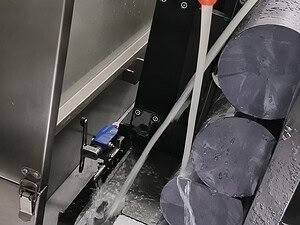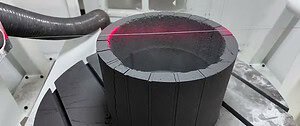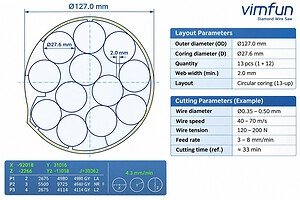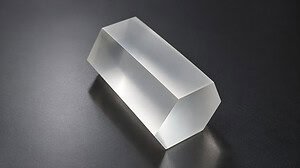
Transitioning from single-wafer prototyping to high-volume semiconductor, optical, and technical ceramic wafering requires scaling cutting throughput without sacrificing geometric precision. While single-wire saws excel at versatile R&D slicing and intricate 2D/3D profile cutting, volume production relies on multi-wire cutting technology. A modern industrial scie multifilaire employs a parallel array of high-tensile diamond wires wound across high-precision grooved guide rollers, slicing dozens or hundreds of uniform wafers simultaneously in a single automated stroke.
However, selecting the right machine requires navigating critical engineering parameters—including roller groove pitch, multi-wire tension uniformity, linear wire velocity, and fluid flushing dynamics. Selecting an improperly matched system leads to uneven wafer thickness (high TTV), kerf wander, or frequent multi-wire breakage. Below, our technical team provides the definitive engineering framework on comment choisir la scie multifilaire adaptée à vos besoins, eradicating amateur construction tool confusion and focusing on precision industrial manufacturing.

1. Eradicating Misconceptions: Industrial Multi-Wire Saws vs. Construction Cable Tools
A frequent error in amateur industrial buying guides confuses multi-wire wafer slicing equipment with construction tools—such as handheld concrete wall saws, demolition diamond cables, or outdoor string saws. These tools serve completely unrelated industries:
- Demolition & Wall Saws: Heavy, low-tolerance construction tools designed to cut reinforced concrete, bridge structures, and architectural masonry. Kerf losses exceed 10–25 mm, and dimensional tolerances are measured in centimeters.
- Industrial Multi-Wire Saws: High-precision CNC machine tools designed to process advanced crystalline and ceramic boules into wafers with Total Thickness Variation (TTV) ≤ ±0.005–0.010 mm, kerf losses ≤ 0.35–0.50 mm, and sub-micron surface finishes (Ra < 0.2–0.4 μm).
For high-throughput industrial slicing, the choice is between single-wire saws and dedicated multi-wire systems such as the SVM multi-wire saw.
2. Single-Wire vs. Multi-Wire Saws: When to Transition?
Before investing in multi-wire equipment, evaluate whether your production requirements justify the shift from single-wire to multi-wire kinematics:
| Paramètre opérationnel | Single-Wire Saw (e.g. SG 20 / SGD 52) | Multi-Wire Saw (e.g. SVM 60-60) |
|---|---|---|
| Throughput & Takt Time | 1 cut per cycle; ideal for R&D, failure analysis, and small-batch custom cuts | 5 to 50+ wafers sliced simultaneously; 10x–30x higher production throughput |
| Geometric Versatility | High: Can perform 2D contouring, 3D tapers, rotary prism cuts, and straight slicing | Dedicated to parallel straight wafering, ingot crooking, and multi-slice partitioning |
| Wafer Thickness Flexibility | Fully programmable via CNC servo axis; wafer thickness can change per cut | Governed by grooved roller pitch ($P = t_{ ext{wafer}} + w_{ ext{kerf}}$); requires roller swap for pitch change |
| Total Thickness Variation (TTV) | ±0.010 – ±0.020 mm | ≤ ±0.005 – ±0.010 mm across the entire wafer batch |
| Consumable Setup Time | Fast: 5–10 minutes to install an endless diamond wire loop | Moderate: Requires multi-groove web threading and individual tension balancing |
If your manufacturing line requires slicing more than 100–500 uniform wafers per week from ingots or blocks, a multi-wire saw provides dramatic reductions in unit labor cost and machine floor space.
3. 5-Point Engineering Checklist for Multi-Wire Saw Selection
When specifying a multi-wire slicing machine for semiconductor crystals, quartz, glass, or technical ceramics, evaluate these five critical technical factors:
A. Workpiece Envelope & Cutting Stroke Dimensions
Determine the maximum cross-sectional envelope of your ingots or blocks. Machines such as the SVM 60-60 accommodate workpieces up to 600 mm in length and cross-sections up to 60 mm × 60 mm (or specialized larger envelopes). Ensure the vertical travel stroke ($Z$-axis) provides sufficient clearance for the mounting chuck, adhesive bonding layer, and sacrificial substrate without wire interference.
B. Grooved Roller Pitch & Target Wafer Thickness
In a multi-wire saw, parallel wire spacing is dictated by the circumferential helical grooves precision-machined into the main guide rollers. The pitch ($P$) between adjacent grooves equals the sum of the desired wafer thickness ($t_{ ext{wafer}}$) and the kerf loss ($w_{ ext{kerf}}$):
P = twafer + wcoupe
When selecting a machine, ensure the manufacturer offers precision-ground guide rollers coated with wear-resistant polyurethane or ceramic sleeves, and check whether customized groove pitches (e.g., 0.5 mm, 0.8 mm, 1.0 mm, 2.0 mm) can be swapped rapidly between production batches.
C. Tensioning Uniformity Across the Wire Web
The greatest operational risk in multi-wire slicing is tension imbalance across parallel wire strands. If one strand experiences higher tension, it will fatigue prematurely and snap; if tension is too low, the wire will sag, causing severe wafer taper and bow. Look for machines with closed-loop pneumatic or individual spring-damping dancer systems that equalize wire tension across all parallel lines within ±2%.
D. Diamond Wire Compatibility & Kerf Loss Optimization
Modern multi-wire saws utilize continuous or reciprocating boucles en fil diamanté with core diameters ranging from ∅0.18 mm to ∅0.45 mm electroplated with micro-diamond grit (typically 15–40 μm). Minimizing wire diameter reduces kerf loss to below 0.35 mm, which directly increases wafer yield per ingot. For an in-depth analysis of kerf loss reduction, consult our engineering guide on coupe de plaquettes à fil diamanté réduction des déchets.
E. High-Volume Multi-Manifold Coolant Flushing
Slicing dozens of kerfs simultaneously generates substantial aggregate grinding swarf and frictional heat. A capable multi-wire saw must feature multi-channel coolant distributor manifolds that deliver symmetrical, high-flow fluid curtains across every single cutting kerf. Inadequate fluid delivery causes swarf packing, localized thermal shock, and catastrophic wafer edge chipping.

4. Supported Materials & Target Applications
Modern multi-wire saws process a wide array of hard, brittle, and composite materials across advanced industries:
- Semiconductor & Compound Substrates: Silicon (mono/polycrystalline), Silicon Carbide (SiC), Gallium Nitride (GaN), and Gallium Arsenide (GaAs) wafering.
- Piezoelectric & Laser Crystals: Quartz crystal blanks, Lithium Niobate (LiNbO3), Lithium Tantalate (LiTaO3), and Nd:YAG laser elements.
- Technical & Electronic Ceramics: Alumina (Al2O3), Zirconia (ZrO2), Silicon Nitride (Si3N4), and Aluminum Nitride (AlN) ceramic substrates.
- Optical & Filter Glass: Borosilicate, fused silica, and infrared optical filter glasses. For specialized multi-wire configurations, review our analysis on Quels matériaux une machine à découper 5 fils peut-elle couper ?.
5. Industrial Machine Solutions from Vimfun
Vimfun engineers advanced scies à fil diamanté tailored for research laboratories and high-volume production facilities. Our flagship multi-wire solution, the SVM 60-60 Multi-Wire Saw, delivers exceptional batch slicing capabilities:
- High-Rigidity Mineral Cast Frame: Eliminates vibration harmonics during multi-wire engagement, guaranteeing TTV ≤ ±0.005 mm across the entire workpiece batch.
- Synchronized Multi-Wire Drive: Precision servo-driven main rollers ensure steady wire speed from 5 to 40 m/s with micro-stepped vertical feed rates.
- Customized Roller Pitch: Interchangeable polyurethane-grooved guide rollers customized to exact customer wafer thickness specifications.
- Enclosed CE-Certified Chamber: Transparent interlocked safety enclosure with integrated water mist suppression and slurry collection.
Evaluate Multi-Wire Slicing on Your Production Materials
Choosing the optimal multi-wire configuration requires empirical verification of cutting speed, wafer bow, and surface roughness. Send your substrate boules or test blocks to our laboratory for our complimentary service de test de coupe au fil diamanté gratuit. Our engineering team will run multi-wire slicing trials and provide complete dimensional inspection, TTV measurements, and production takt time projections before you invest.