İçindekiler
Introduction
In modern manufacturing and engineering, efficient material cutting technology is crucial for producing high-quality products. High-Pressure Water-Abrasive Cutting (ASWJ) is an increasingly prominent precision cutting technique that demonstrates excellence in various fields. This article delves into the working principles, advantages, and a comparative analysis of ASWJ against other cutting technologies.
Working Principles of High-Pressure Water-Abrasive Cutting
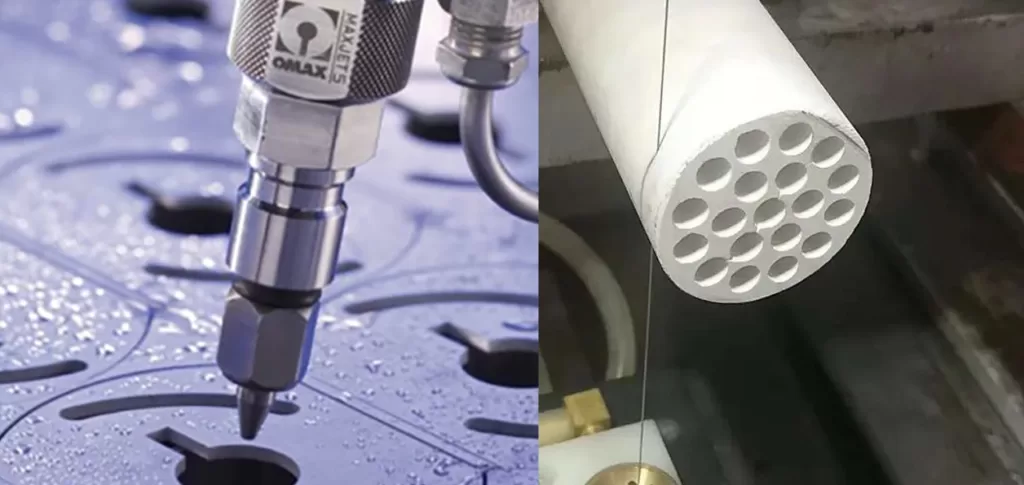
High-pressure water-abrasive cutting removes material through the impact of a water jet carrying abrasive particles. ASWJ means abrasive suspension waterjet: water and abrasive are premixed before passing through the cutting nozzle. This differs from an abrasive injection waterjet, where abrasive is entrained into an already formed water jet. Hydrogen is not a required ingredient. Both conductive and non-conductive materials can be processed; material grade, thickness and quality requirements determine suitability.
Advantages of High-Pressure Water-Abrasive Cutting
ASWJ offers several notable advantages, including:
- Precision Cutting: Achievable accuracy depends on the machine, nozzle condition, material, thickness and traverse speed. Verify taper, jet lag and cut-surface quality on representative parts rather than assuming micron-level accuracy.
- Material Versatility: Abrasive waterjets can process selected metals, stone, glass and ceramics. Some soft materials can be cut with pure water alone; added abrasive is not necessary for every application.
- Cold Cutting: Unlike traditional hot cutting methods, ASWJ is a cold-cutting process, reducing the risk of material distortion due to thermal stress.
- Waste Management: The process produces wastewater, spent abrasive and workpiece debris. Collection, separation and disposal requirements depend on the material being cut; the absence of a thermal cutting process does not make the waste harmless.
- High Speed and Efficiency: The high-velocity jet stream, combined with the abrasive material, makes ASWJ more efficient in certain scenarios compared to other cutting techniques.
Disadvantages of High-Pressure Water-Abrasive Cutting (ASWJ)
Despite its advantages, ASWJ is not without its limitations, including:
- Complex Setup: Implementing ASWJ technology can be intricate, requiring specialized equipment and a well-controlled environment. This complexity can make it challenging to set up for smaller operations.
- Abrasive Consumption: ASWJ uses abrasive materials in its cutting process. These abrasives wear down over time, leading to the need for frequent replenishment, increasing operational costs.
- Maintenance: The high-pressure pumps and nozzles used in ASWJ systems require regular maintenance to ensure optimal performance. This maintenance can be costly and time-consuming.
- Safety Concerns: ASWJ involves working with high-pressure fluids, which can be dangerous if not handled correctly. Operators need training to ensure safe and efficient operation.
- Water and Contamination Limits: Electrical conductivity is not required, unlike wire EDM. Instead, assess water absorption, corrosion, trapped abrasive and cleaning requirements, particularly for porous or contamination-sensitive workpieces.
- Potential Erosion: Over time, the high-speed jet stream can cause wear and tear on the cutting equipment, leading to potential erosion and degradation of precision.
It’s essential for manufacturers and businesses to consider these disadvantages alongside ASWJ’s advantages to determine its suitability for their specific applications and projects.
Comparative Analysis: ASWJ vs. Other Cutting Technologies
ASWJ carries loose abrasive in water, while closed-loop diamond wire cutting uses diamond abrasive attached to a moving wire. These are different material-removal methods, not interchangeable machine specifications. Compare them against the same drawing and acceptance criteria:
- Material Adaptability: Similar to ASWJ, closed diamond wire cutting can cut various materials, including non-conductive materials.
- Precision and Support: Diamond wire results depend on wire deflection, tension, guide alignment and fixture support. Thin or fragile parts require sample validation; neither method guarantees the required finish without further processing.
- Speed: Neither process is always faster. Compare setup, cutting, cleaning and finishing time for the same material, section size and accepted surface quality.
- Material Yield: Wire diameter and deflection affect the wire-cut kerf; nozzle configuration, thickness and traverse conditions affect the waterjet kerf. Measure both material loss and finishing allowance rather than assuming one method always wastes less material.
| Requirement | ASWJ / abrasive waterjet | Closed-loop diamond wire |
|---|---|---|
| Water restrictions | Water exposure is inherent to the process; assess absorption, corrosion and drying. | Wet or dry operation depends on the material, wire and machine. Dry cutting requires appropriate debris extraction. |
| Contamination | Loose abrasive and cutting debris require collection and cleaning. | Workpiece debris and wire wear still require control; the process is not contamination-free. |
| Cut geometry | The jet requires a suitable entry point and an unobstructed exit into the catcher. | The wire and guides need clearance. An internal contour requires a viable threading or entry method; a closed loop cannot simply enter an enclosed hole. |
| Thick or fragile sections | Check taper, jet lag, piercing damage and exit-edge condition through the full thickness. | Check wire bow, fixture loads, fragile features and support as the offcut separates. |
| Heat and surface quality | A non-thermal cutting process avoids the conventional heat-affected zone, but cut texture and edge quality still need inspection. | Abrasive contact generates frictional heat. Validate cooling or dry-process controls and any finishing allowance. |
| Cost comparison | Include abrasive, water treatment, nozzle wear, setup and finishing. | Include wire wear, fixtures, debris handling, setup and finishing. Compare cost per accepted part. |
For a broader process comparison, see waterjet versus diamond wire cutting. Before a trial, provide the material grade, workpiece dimensions, drawing, water restrictions and required edge and surface quality.
Applications of High-Pressure Water-Abrasive Cutting
Abrasive waterjet processes are used or evaluated across the following fields. An application of injection-type waterjet equipment is not automatically evidence of ASWJ suitability; confirm the actual jet system and qualification requirements:
- Aerospace Industry: Cutting aircraft components and engine parts.
- Medical Sector: Selected component-cutting applications require validation of edge quality, cleaning and contamination controls; this does not establish suitability for every medical device.
- Automobile Manufacturing: Cutting and processing automobile parts, including body and engine components.
- Construction: Cutting construction materials such as stone, steel structures, and concrete.
- Electronics Manufacturing: Evaluate water and abrasive exposure carefully for electronic materials. Suitability for a particular substrate does not establish suitability for semiconductor wafer production.
- Art and Creativity: Enabling creative work in art, sculpture, and decorative fields.
Applications for Challenging Materials
For hard ceramics, glass and other brittle materials, evaluate entry damage, edge chipping, cracking and the condition of the exit face. Waterjet piercing and support beneath the cut need particular attention. With diamond wire, evaluate clamping loads, wire access, deflection and support at final separation. Porous materials also need a cleaning and drying assessment. No fixed pressure, wire tension or feed setting is prescribed here without a representative trial.
Conclusion
High-pressure water-abrasive cutting can be useful where a water-and-abrasive process meets the material and geometry requirements. Closed-loop diamond wire is another option for compatible workpieces, but it has its own access, support and debris-control constraints. Select a method using measured cut quality, accepted yield and total processing cost. For diamond wire feasibility, provide a drawing and material details through our sample-cutting service.