
SOMIS-380
The smallest multi-wire saw on the market. Multi-wire saws are traditionally large, floor-hungry machines — the SOMIS 380 breaks that convention, delivering full industrial multi-wire cutting capability in the most compact footprint available anywhere.
It is specifically engineered for high-efficiency slicing of hard and brittle materials such as silicon ingots, sapphire, marble, alloys, and optical glass. By combining inverted processing with a precision swing motion, it delivers exceptional surface quality with minimal material loss
Advanced Inverted Oscillating Multi-Wire Cutting Technology for Semiconductor, Stone & Electronic Materials
SOMIS-380 is engineered for manufacturers who demand precision, efficiency, and reliability when cutting hard and brittle materials. Combining inverted cutting, oscillating swing mechanics, and a single-station integrated design, this machine delivers over 30% higher cutting efficiency compared to conventional wire saws — with superior surface quality and extended wire life.
Oscillating Multi-Wire Saw Product Overview
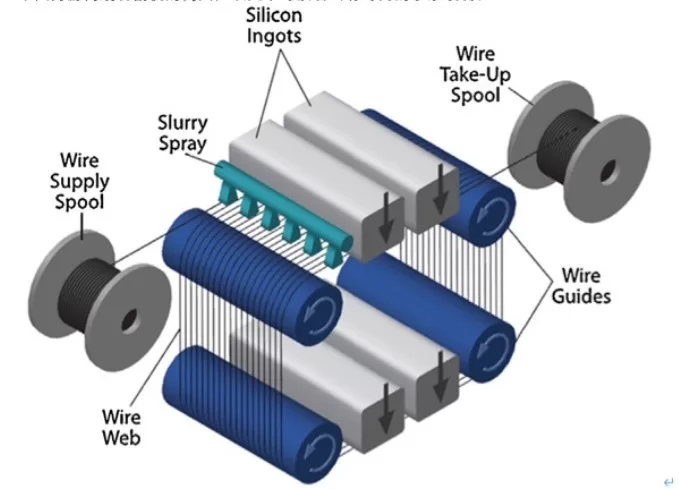
The SOMIS 380 multi-wire saw machine is a high-precision cutting solution developed for demanding applications in the semiconductor, stone processing, and electronics industries. It is purpose-built for slicing hard and brittle materials including silicon ingots, sapphire crystals, marble, and difficult-to-machine alloy materials.
At the heart of its performance is the inverted oscillating compound cutting technology: the wire moves back and forth across the rollers, contacting the workpiece at a diagonal angle. This dramatically reduces the contact area per cut, extends wire service life, and raises throughput — making the SOMIS 380 one of the most efficient multi-wire saws available for industrial production.
Multi-wire saws are conventionally large, space-intensive machines that require dedicated floor areas and purpose-built facilities. The SOMIS 380 challenges this norm entirely: it is the smallest multi-wire saw currently available on the market, purpose-engineered for operations where floor space is at a premium — without any compromise on cutting precision or production capability.
Oscillating Multi-Wire Saw SOMIS-380 TECHNICAL SPECIFICATION
| Category | Parameter | Value |
|---|---|---|
| Maximum Workpiece Size | L × W × H | 380 × 160 × 150 mm |
| Slice Thickness Range | 0.3 – 3 mm | |
| Roller (Grooved Wheel) | Material | Polyurethane (UHMW-PE) |
| Diameter | 140 – 160 mm | |
| Cutting Wire | Wire Diameter | 0.13 – 0.25 mm |
| Max Wire Storage (Spool) | 30,000 m | |
| Wire Travel | Max Speed | 1,200 m/min |
| Max Reciprocating Frequency | 10 cycles/min | |
| Direction | Reciprocating (bidirectional) | |
| Worktable | Max Lift Stroke | 150 mm |
| Feed Speed Range | 0.1 – 999.9 mm/min | |
| Power Supply | Input | 3-phase 4-wire AC 380V, 50 Hz |
| Average Power Consumption | ≤ 13 kW | |
| Main Spindle Motor | 7.5 kW × 2 | |
| Wire Payout / Take-Up Motor | 2.9 kW × 2 | |
| Tension Motor | 2 kW × 2 | |
| Wire Traversal Motor | 400 W × 2 | |
| Worktable Motor | 400 W × 1 | |
| Chiller | 4 kW | |
| Total Installed Power | 26 kW | |
| Number of Spindles | 2 axes | |
| Spindle Type | Clamping-type new spindle | |
| Roller Diameter | 150 ± 10 mm | |
| Cutting Mode | Inverted oscillating cut | |
| Machine Dimensions | L × W × H | 2,450 × 2,000 × 2,000 mm |
| Machine Weight | 3,000 kg |
Video of How this multi wire saw works
Key Features & Technical Advantages
1. Inverted Oscillating Cutting System
The SOMIS 380 uses an inverted-cut swing mechanism that reduces the wire-to-material contact area on each pass. This translates directly into:
- 30%+ improvement in cutting efficiency over traditional wire saw equipment
- Reduced wire wear and longer wire service intervals
- Better surface finish on finished slices
2. Clamping-Type Spindle & Multi-Spindle Synchronous Control
The machine features a newly designed clamping-type spindle structure with multi-spindle synchronous control. This system:
- Maintains consistent wire speed across all cutting lines
- Minimizes thickness variation in finished slices
- Supports versatile configurations for diverse materials and dimensions
3. Oil-Cooled Roller Bearing Housing
The roller bearing housing uses an oil-cooled sleeve structure, ensuring stable thermal performance at high operating speeds. Benefits include:
- Maintained cutting precision during extended production runs
- Extended bearing service life
- Consistent product quality regardless of ambient conditions
4. Oscillating Worktable Mechanism
The worktable is equipped with a swing mechanism using premium high-strength rolling linear guides and ball screws combined with a one-piece casting frame. This provides:
- High rigidity and operational stability
- Precision feed control at speeds from 0.1 to 999.9 mm/min
- Expandable from dual-axis to three-axis inverted cutting for thick-slice applications
- Oscillation can be paused at any time to adapt to different cutting requirements
5. Full Servo Control via EtherCAT Bus
All motion axes — spindle, wire payout, wire take-up, wire traversal, wire tension, and worktable feed — are independently driven and controlled by servo motors via an EtherCAT fieldbus control system, delivering:
- High-speed, high-precision coordinated motion
- Real-time process monitoring and adaptive control
- Responsive fault detection and protection
6. Real-Time Monitoring & Wire Break Protection
The SOMIS 380 monitors all critical process parameters — including cutting tension — in real time. An intelligent alarm system classifies faults by severity:
- Warning-level alerts allow the operator to acknowledge and continue
- Critical faults trigger immediate machine stop
- Automatic wire break detection halts the machine instantly to prevent roller damage and workpiece loss
7. The Smallest Multi-Wire Saw on the Market
Multi-wire cutting machines have traditionally demanded large factory footprints, making them inaccessible for smaller production facilities, R&D labs, and operations with limited floor space. The SOMIS 380 was designed to change that. At just 2,450 × 2,000 × 2,000 mm and 3,000 kg, it is the most compact multi-wire saw available anywhere on the market today — yet it delivers full industrial-grade cutting performance.
- Smallest footprint of any multi-wire saw available — fits where other machines simply cannot
- Stainless steel sheet metal panels for key operating areas
- Imported premium components throughout: linear guides, ball screws, drive belts, bearings, and electrical control elements
- Critical spindle components machined from high-grade specialty steel with multiple heat treatment, machining, and surface finishing stages, then precision-ground for final tolerances
- Low center of gravity for stability; no special floor reinforcement required in most installations
Why Choose the SOMIS 380?
- ✅ Smallest multi-wire saw on the market — fits in spaces where conventional machines cannot
- ✅ 30%+ productivity gain over conventional multi-wire saws
- ✅ Reduced wire consumption — lower cost per cut
- ✅ Tight slice thickness tolerances — less downstream rework
- ✅ Flexible configuration: 2-axis or 3-axis, swing on/off
- ✅ Fully servo-driven with EtherCAT for precision and repeatability
- ✅ Built-in wire break protection prevents costly roller and workpiece damage
- ✅ Proven in semiconductor, sapphire, and stone applications
CUTTING APPLICATIONS

Semiconductor manufacturing
Silicon ingot slicing, compound semiconductor wafer production

Sapphire processing
LED substrate and optical component cutting

Stone & architectural materials
Marble slab and tile production

Advanced materials
Hard ceramic, ferrite, and piezoelectric material dicing
Customer Testimonials

Frequently Asked Questions
How does the SOMIS 380 compare in size to other multi-wire saws?
What is the minimum slice thickness?
The machine can produce slices as thin as 0.3 mm, making it suitable for wafer and thin substrate production.
What is the advantage of oscillating cutting?
The oscillating motion continuously changes the contact point between the diamond wire and the workpiece. This helps:
reduce wire wear
improve cutting efficiency
increase cutting stability
extend diamond wire lifetime
This is particularly useful when cutting super hard materials.