Precision Machining Technologies
Magnet Machining
Technical Comparison and the Advantages of Endless Diamond Wire Cutting
Why Magnet Machining Is Important?
The Challenge: Raw Material Limitations
Magnetic materials (NdFeB, SmCo, Ferrite) produced via Powder Metallurgy often fail to meet final requirements.
- Poor Tolerances: Sintered blanks lack dimensional precision.
- Rough Surfaces: Surface from mold is often too rough.
- Extreme Brittleness: Sensitive to thermal and mechanical stress.
The Solution: Precision Machining
Machining transforms "Raw Blanks" into "Functional Components".
- Achieve Tight Tolerances: Essential for motor segment arrays.
- Edge Integrity: Preventing chipping during performance.
- Surface Quality: Ensuring perfect flatness for coating.
How to do Magnet Machining?
Overview of the Magnetic Material Processing Chain
Although different magnetic materials have different production routes, the generalized manufacturing flow includes three critical stages.
- Powder preparation & pressing
(dry pressing, isostatic pressing) - Sintering or cast solidification
- Aging or heat stabilization
- Initial shaping (rough blanks)
*Components typically carry significant dimensional allowance here.
Determines final accuracy, surface integrity, and yield. Mainstream processes:
- Blade slicing / dicing
- EDM wire cutting
- Reciprocating long-wire diamond cutting
- Endless diamond wire cutting
(closed-loop, high-speed, thin-kerf) - Grinding, lapping, and superfinishing
- Deburring / chamfer formation
- Surface finishing (grinding, lapping)
- Protective coatings
(Ni, NiCuNi, epoxy, Parylene) - Magnetic stabilization or demagnetization
Magnet Machining Solutions
Magnetic materials are difficult to machine due to high hardness, pronounced brittleness, and susceptibility to thermal demagnetization. The following is a comparative analysis of mainstream machining technologies.
Blade Cutting
(Diamond Slicing Blade)
- Common for ferrite and small NdFeB blocks
- Tool rigidity is limited; blade thickness 0.3–0.5 mm
- Generates lateral cutting force → risk of edge chipping
- Heat accumulation increa ses risk of micro-cracks
- Equipment cost relatively low
- Suitable for small-size or thin parts
- Kerf loss relatively large
- Surface roughness requires additional grinding
- Not suitable for large blocks or brittle SmCo
EDM Wire Cutting
- Used for NdFeB, SmCo, soft magnetic steels
- Cutting is thermal; heat-affected zones alter local magnetic behavior
- Edge carbonization may require post-operations
- High shape-complexity capability
- Stable for thick and dense materials
- Heat input unavoidable → risk of demagnetization
- Cutting speed relatively slow
- Kerf ≈ 0.25 mm, not optimal for yield
- Cannot include ferrite or non-conductive ceramics
Traditional Reciprocating
Diamond Wire Saw
- Wire length >1000m, reciprocating motion
- Direction change introduces vibration
- Wire speed limited due to reversal
- Used for large blocks and long parts
- Cutting cost per hour relatively low
- Wire marks visible on surface
- Fixed slice size, lacking flexibility
- Complex structure, difficult to operate
- High equipment costs
Endless Diamond Wire Saw
- Short closed-loop wire (< 10m)
- Single-direction continuous motion without reversal
- Stable tension (150–250 N) & High speed (70–84 m/s)
- Low cutting force, minimal vibration
- Smooth, low-damage surfaces, no wire marks
- Higher dimensional accuracy and consistency
- Reduced need for post-grinding
- 2-4x Higher Efficiency
- Not suitable for very large block sizes (Giant blocks)
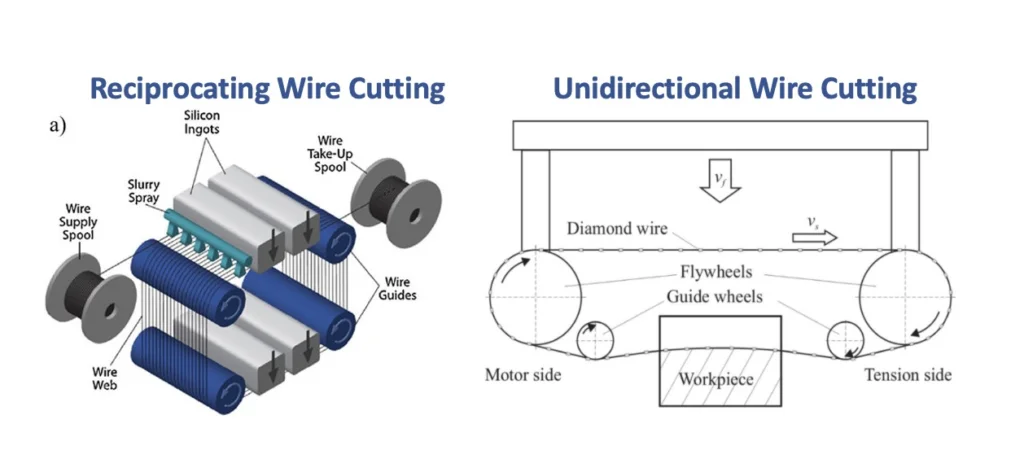
The difference of traditional Diamond Wire and Endless Diamond Wire
Why Choose Endless Diamond Wire Cutting?
A Closed-Loop, High-Stability Precision Cutting Technology
The endless diamond wire is a short, closed-loop wire (typically <10 m) running continuously in a single direction at high linear speed (up to 80 m/s). The system maintains constant tension (150–250 N), eliminating the vibration and direction reversal inherent in conventional long-wire systems.
Ultra-Thin Kerf & High Yield
- Wire diameter down to 0.30 mm.
- Kerf width typically 0.35–0.45 mm.
- For high-value NdFeB and SmCo blocks, this translates directly into cost reduction.
Low Cutting Stress, Minimal Chipping
- Perfect for brittle Magnetic ceramics (ferrite) & sintered rare-earth magnets.
- Uniform unidirectional motion & Reduced lateral load.
- Edge chipping is significantly reduced.
- Subsurface damage depth is smaller.
Superior Surface Quality
- Produces smooth, scratch-free surfaces.
- Improved flatness and parallelism.
- Reduced requirement for lapping or grinding.
- Essential for precision components in motors & sensors.
High Cutting Efficiency
- No wire reversal = much higher stable linear speed.
- Typically demonstrate 2–4× higher efficiency than reciprocating systems in hard, brittle magnetic materials.
Greater Process Consistency
- Constant tension & one-direction motion = higher dimensional stability.
- Cut-to-cut variation is minimized.
- Critical for multi-segment magnet arrays where tolerance stack-up cannot be tolerated.
Where Endless Wire Fits in the Workflow
Understanding the value creation stages in Magnet Machining.
| Process Stage | Typical Method | Endless Wire Role |
|---|---|---|
| Blank shaping | Pressing, Sintering, Casting | Not involved |
| Primary Cutting | Inner-circle Blade, Long-wire | Core Advantage ★BEST FIT |
| Precision Slicing | Multi-wire, Dicing Blade | High Flexibility ✓RECOMMENDED |
| Grinding & Finishing | Double-end Grinding | Not involved |
| Surface Coating | Electroplating (Ni/Zn) | Not involved |
Typical Applications
Endless diamond wire saw is the ideal solution for difficult-to-machine magnetic materials.
Sintered NdFeB
- High hardness + brittleness.
- Blade cutting often causes chipping.
- EDM introduces thermal damage.
Optimal for slicing large blocks with minimum kerf loss.
SmCo (Samarium–Cobalt)
- Extremely brittle material.
- Sensitive to thermal stress → EDM not suitable.
Produces clean, low-stress cuts without thermal shock.
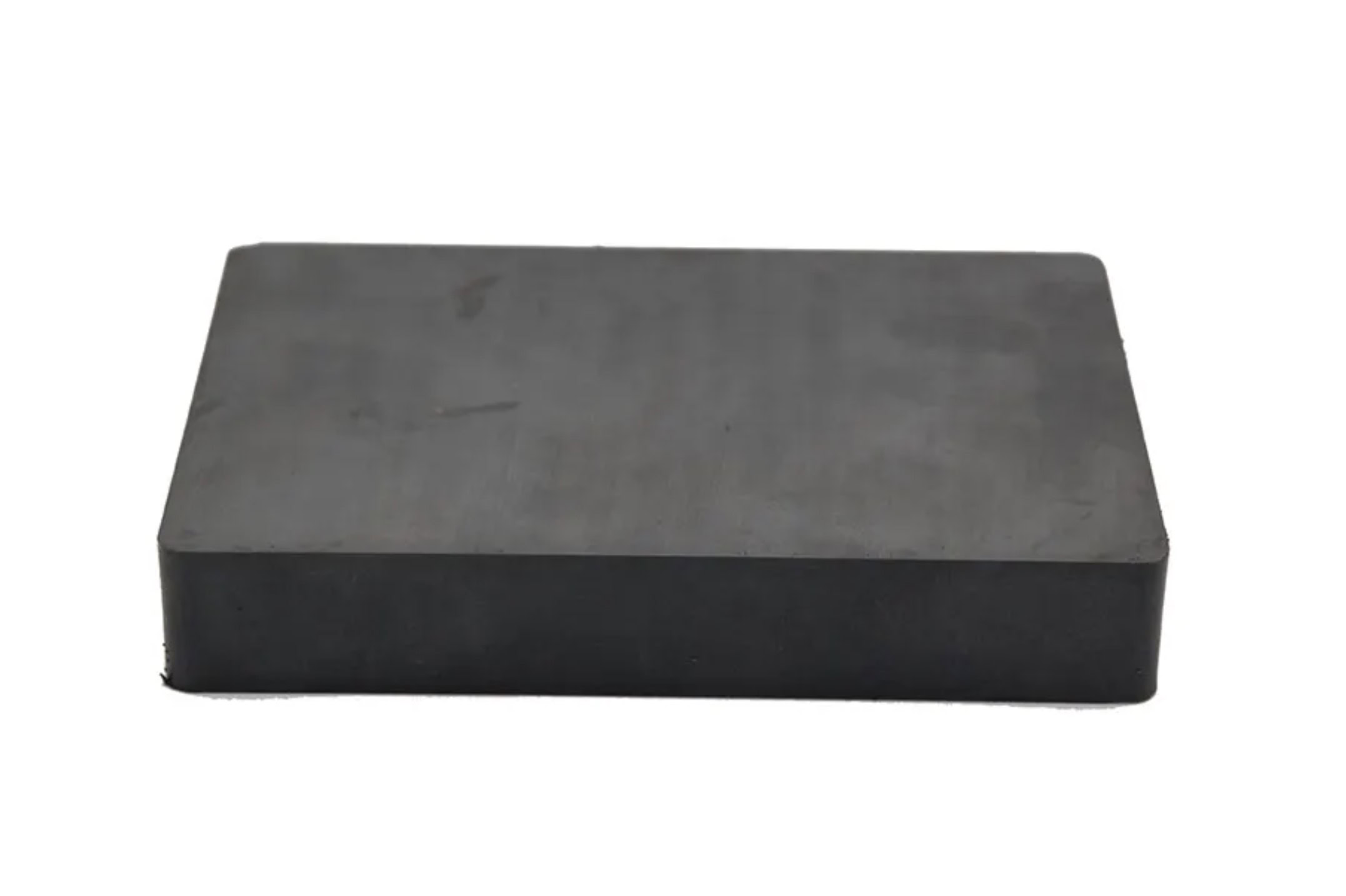
Ferrite (Ceramics)
- Ceramic-like structure.
- Prone to edge fracture.
Outperforms blade slicing with significantly less vibration.
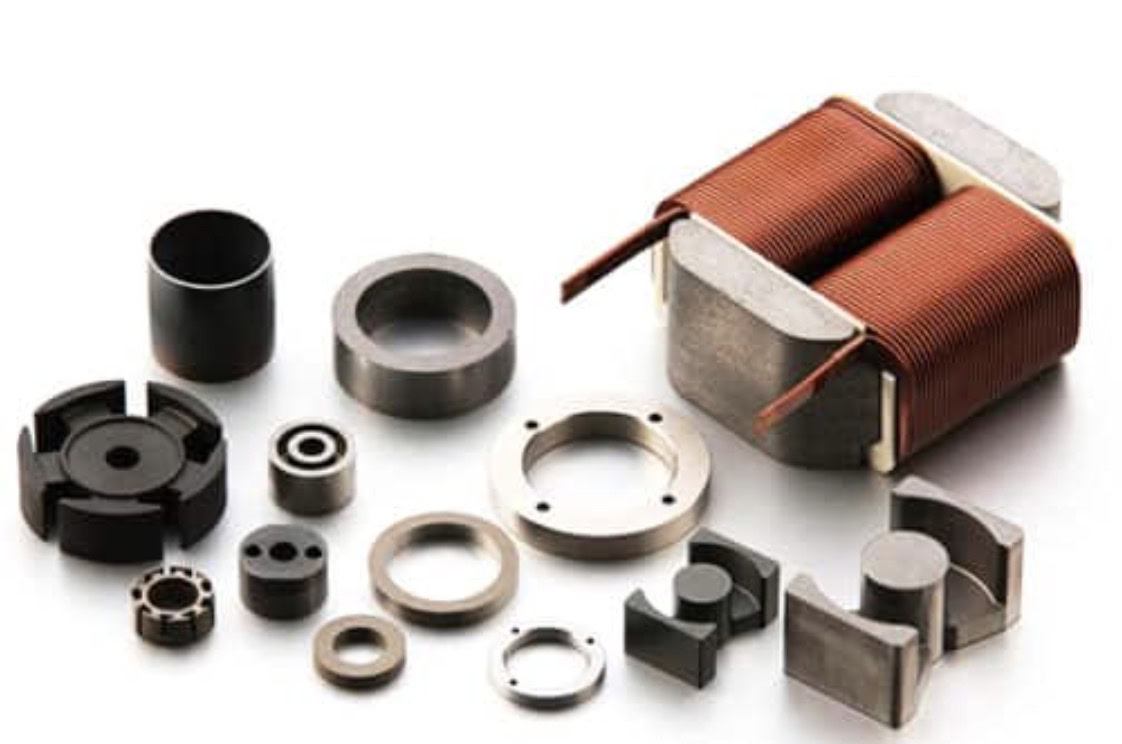
Soft-Magnetic Alloy Cores
- Laminated or precision machined cores.
- Requires strictly non-thermal process.
Enables precision segmentation without thermal alteration.
Demonstration Videos of Magnet Machining
All Diamond Wire Saw Products
Endless diamond wire cutting machinery you can choose from
QUARTZ GLASS WIRE CUTTING MACHINE
- Max Workpiece Dia (mm): 600
- Max Workpiece Height (mm):400
3D TAPER CUT ENDLESS DIAMOND WIRE SAW MACHINE
- Max Workpiece Length (mm):600
- Max Workpiece Width (mm):600
- Max Workpiece Height (mm):600
Swinging Diamond Wire Cutting Equipment
- Max Workpiece Length (mm):400
- Max Workpiece Width (mm):400
- Max Workpiece Height (mm):375
BIG SIZE QUARTZ CUTTING WIRE SAW MACHINE
- Max Workpiece Dia (mm):2000
- Max Workpiece Height (mm):600
Ultra-huge Diamond WIre Saw
- Max Workpiece Length (mm): 2500
- Max Workpiece Width (mm): 800
- Max Workpiece Height (mm): 800
Best Seller Graphite Wire Saw
- Max Workpiece Length (mm): 800
- Max Workpiece Width (mm): 800
- Max Workpiece Height (mm): 800
FAQ For Magnet Machining
Vimfun Diamond Wire Saw
ask us
anything
How do wire speed and tension affect surface quality?
*Higher wire speed improves grinding efficiency and reduces surface scratches, while stable tension (150–250 N) minimizes vibration. Low tension causes waviness and chatter marks; excessive tension increases risk of wire breakage.
Why is diamond wire cutting considered a low-stress and low-temperature process?
*The wire contacts the material along a narrow line, reducing frictional heat and limiting thermal expansion. Although some heat is generated, the temperature rise is minimal, preventing cracks or deformation in brittle materials such as sapphire or alumina.
what is your opening hours?
*Initial one-to-one consultation, Health & Fitness Assasments Bespoke training program planing, Custom Nutrition plan & recipes. Weekly Progress Reviews
What is the optimal wire speed for high-quality cutting?
*For most brittle crystalline materials, the optimal wire speed is 50–80 m/s. Higher speeds improve material removal efficiency but require stable tension and precise alignment of guide wheels.
What causes wire vibration, and how can it be avoided?
*Wire vibration is usually caused by incorrect tension, worn grooves, or improper wheel alignment. Maintaining stable tension, using intact guide grooves, and ensuring clean coolant flow significantly reduces vibration.
Why is diamond wire cutting preferred for high-value materials such as sapphire and semiconductor crystals?
*It offers:
Minimal subsurface damage
Low kerf loss (cost saving)
Smooth cutting surfaces
Consistent thickness across the entire cut
Cold and low-stress processing
This combination makes it ideal for expensive materials where yield and quality are critical.