Introduction: Structural Limits Define Cutting Accuracy
Rigid machine frame design is the physical foundation of precision in diamond wire saw machines.. Control software and servo systems can optimize motion, but they cannot compensate for a frame that vibrates, deflects, or deforms under load.
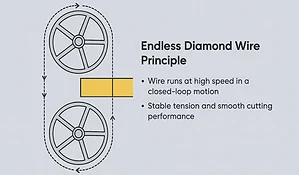
In diamond wire sawing, wire speeds can exceed 60 m/s while dimensional tolerances are measured in microns. Under these conditions, the machine frame is not simply a housing for components. It directly determines cutting stability, surface roughness (Ra), and thickness variation (TTV).
This article examines how mechanical frame design—specifically rigidity, vibration damping, and thermal stability—affects cutting performance in modern diamond wire saw machines.
1. Material Selection: Why Cast Iron Is Still Used
One of the most visible differences between precision wire saws and low-cost machines is weight. High-end systems often exceed two tons, while lighter machines may weigh only a few hundred kilograms. This difference is primarily driven by frame material selection.
1.1 Welded Steel Versus Cast Iron
Many entry-level machines use welded steel frames assembled from plates or tubes.
Advantages:
- Lower material cost
- Reduced manufacturing time
- Easier transportation and installation
Limitations:
Steel exhibits low intrinsic vibration damping. Once excited by cutting forces or motor-induced vibration, oscillations tend to persist and propagate through the structure. These vibrations are transmitted to the wire, increasing the risk of micro-chatter and surface waviness.
Precision wire saw machines typically use gray cast iron (such as HT250 or FC30) for the machine bed and major structural components.
Cast iron contains a graphite flake microstructure that dissipates vibrational energy internally. Compared to steel, its damping capacity is approximately five to ten times higher. As a result, transient cutting disturbances—such as local hardness variations—are absorbed by the frame rather than amplified.
1.2 Stress Relief and Long-Term Stability
Casting inherently introduces residual internal stress. If these stresses are not relieved, slow deformation can occur over time, gradually degrading geometric accuracy.
To mitigate this risk, precision machine frames undergo stress-relief processes before final machining. These typically include controlled thermal aging and vibration aging. The purpose is to stabilize the material so that guide rail alignment and reference surfaces remain consistent throughout long-term operation.
2. Structural Architecture: Gantry Versus Cantilever Designs
Beyond material selection, structural geometry plays a critical role in overall stiffness.
2.1 Cantilever Structures
In a cantilever design, the cutting head is supported from one side only. This configuration creates an asymmetric load path.
Under gravity and cutting forces, bending moments develop along the unsupported span. As cutting load increases, the free end of the structure is more susceptible to vertical deflection and torsional twist.
In wire sawing applications, this behavior often appears as yaw errors and gradual taper when slicing larger workpieces.
2.2 Gantry Structures
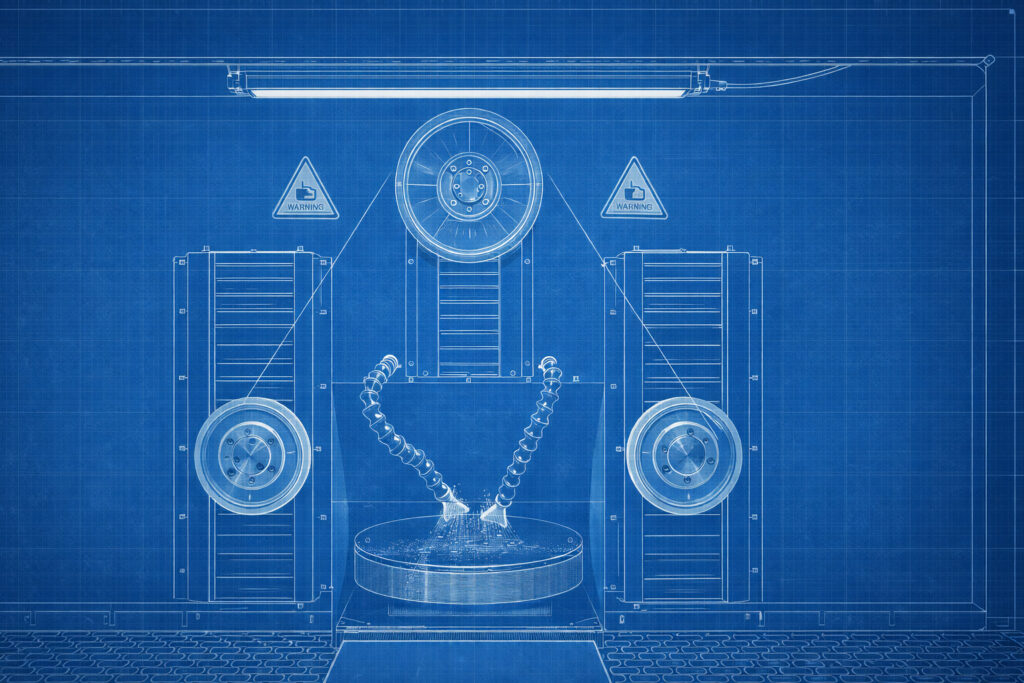
Gantry (or bridge-type) designs support the cutting assembly from both sides, forming a closed and symmetrical force loop.
Because loads are distributed evenly, deflection under identical cutting conditions is significantly reduced. The wire plane remains perpendicular to the worktable even under high wire tension and sustained feed forces.
For large-diameter silicon carbide or sapphire ingots, gantry structures provide the stiffness necessary to maintain uniform thickness across the entire cutting width.
3. Structural Optimization Using Finite Element Analysis
Modern frame design relies on simulation rather than empirical trial-and-error.
3.1 Static Load Analysis
Finite Element Analysis (FEA) is used to model the combined effects of wire tension, feed force, and component weight. These simulations identify regions of high stress concentration within the frame.
Structural ribs and internal reinforcements are then added selectively to these areas. This approach increases stiffness where it is most effective without unnecessarily increasing overall mass.
3.2 Modal Analysis and Resonance Avoidance
Every mechanical structure has natural resonance frequencies. If these frequencies overlap with excitation sources—such as motor rotation or periodic cutting forces—vibration amplitude can increase dramatically.
Modal analysis allows designers to adjust mass distribution and stiffness so that structural resonance frequencies remain well outside the operating range of the machine. This reduces the likelihood of vibration-induced surface defects during cutting.
4. Thermal Stability and Heat Isolation
Thermal effects are often underestimated in mechanical frame design.
Electric motors, drive systems, and control cabinets generate heat during operation. If this heat is transferred directly into the machine casting, uneven thermal expansion can occur.
4.1 Managing Thermal Distortion
Localized temperature gradients cause gradual frame deformation, which may shift axis alignment by several microns. In precision slicing applications, this level of drift is unacceptable.
To control thermal influence, heat-generating components are typically isolated from the main casting using thermal barriers or mounting interfaces. Symmetrical frame layouts further ensure that any unavoidable thermal expansion occurs uniformly, preserving geometric alignment.
Conclusion
The mechanical frame defines the baseline performance of a diamond wire saw. High-resolution encoders, advanced control algorithms, and adaptive feed logic can only operate within the physical limits imposed by structural design.
A rigid cast iron bed, a gantry-based architecture, and an FEA-optimized structure provide the mechanical stability required for consistent, high-precision slicing. When evaluating a wire saw system, the integrity of the frame deserves the same level of scrutiny as cutting parameters or control software.
Mechanical stability ensures that the only component intentionally moving during the process is the diamond wire itself—and that it moves exactly as intended.
FAQ
Q1: Why are precision wire saw machines so heavy?
High mass increases inertia and reduces sensitivity to vibration. A heavier frame isolates the cutting process from both internal disturbances and external floor vibration.
Q2: Does a gantry design require more installation space?
Gantry structures may occupy slightly more space, but the resulting gains in stiffness and cutting consistency typically outweigh the footprint difference in precision applications.
Q3: Is a special foundation required?
For high-precision systems, a stable concrete floor is recommended. Leveling elements must be adjusted carefully to prevent torsional stress in the machine bed.