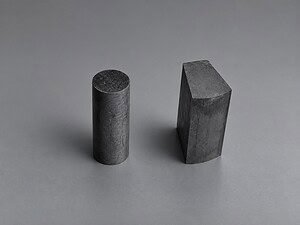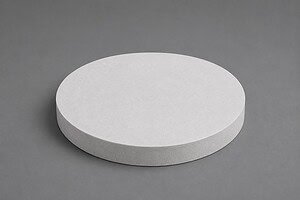
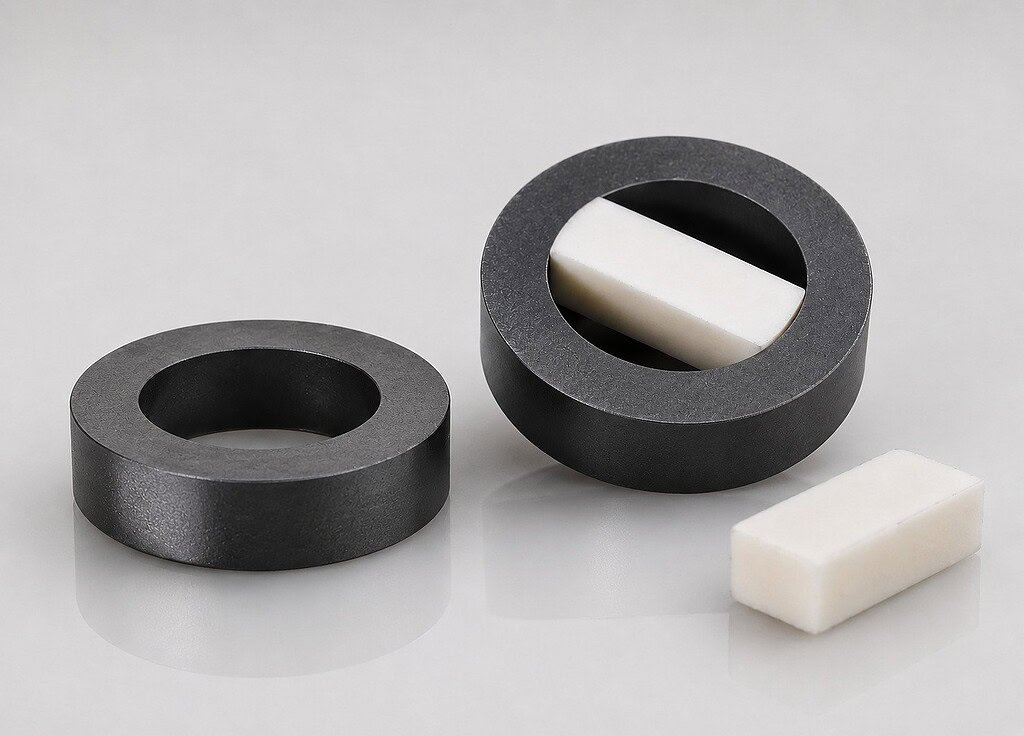
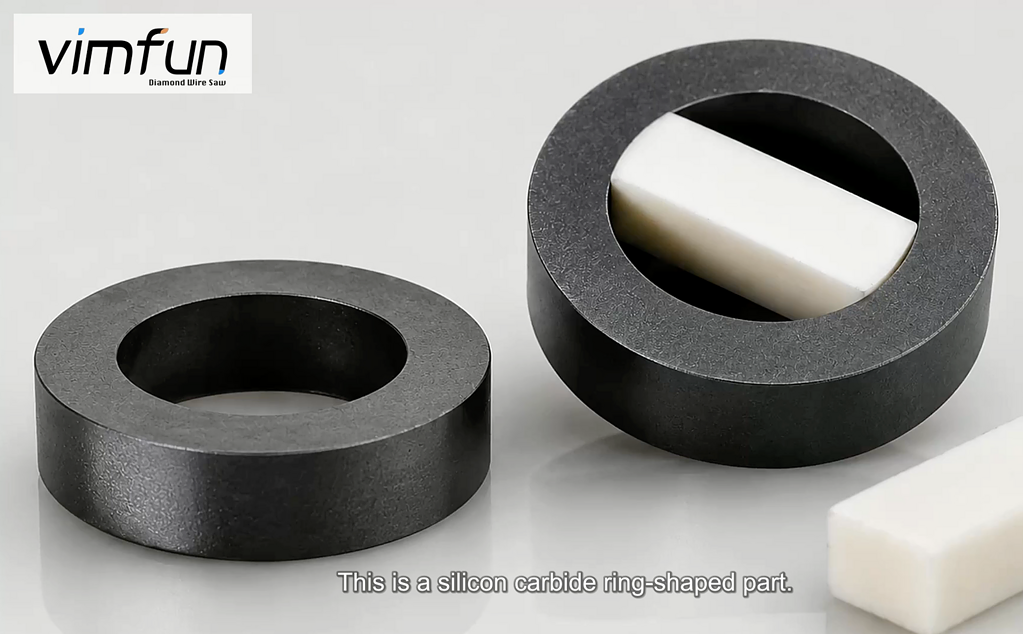
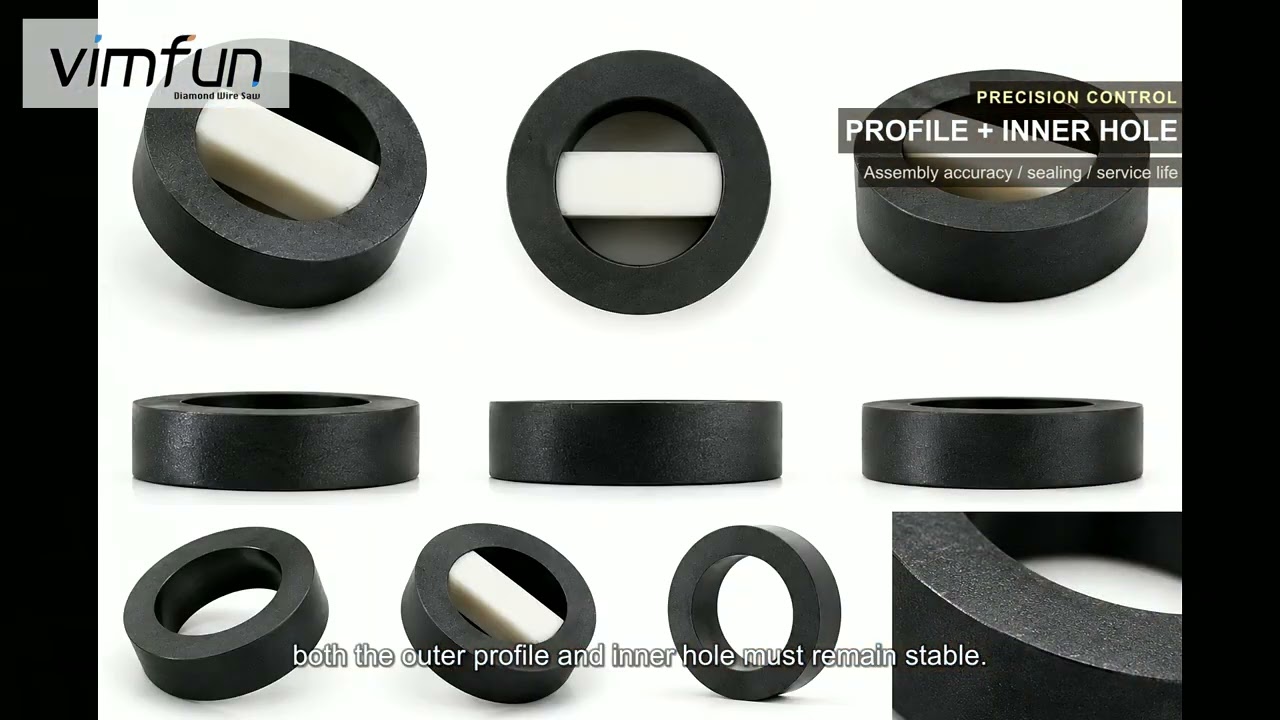
탄화규소 씰 링은 펌프 하우징, 자동차 워터 펌프 및 화학 공정 장비 내부에 사용됩니다. 이 응용 분야에서는 링 하나만 고장 나도 밀봉하고 있는 장치가 작동을 멈춥니다. 이 경우 링의 외경은 60mm, 내경은 10mm, 두께는 10mm입니다. 작아서 눈에 띄지 않을 정도입니다. 단단하기 때문에 기존 연삭으로는 가장자리가 깨지고 미세 균열이 발생하여 고객이 폐기하거나 재작업해야 합니다.
서비스에서 탄화규소를 유용하게 만드는 특성 — 내마모성, 화학적 불활성, 부하 시 열 안정성 — 은 완성된 부품을 손상시키지 않고 절단하기 어렵게 만드는 특성과 동일합니다. 연삭 휠 절단은 외부 프로파일과 내부 보어에 가장자리 깨짐을 발생시키고, 씰링 면을 손상시키는 표면 아래 손상층을 생성합니다. 이처럼 작은 링에서 두 직경 모두 엄격한 공차를 유지해야 하므로, 후처리로 해결할 방법이 없습니다. 절단된 표면이 그대로 출하되기 때문입니다. 이 사례에서는 Vimfun이 다이아몬드 와이어 기술을 사용하여 부품을 절단한 방법을 설명하며, 더 넓은 재료 맥락에 대한 개요를 참조합니다. 세라믹 커팅 개요.
응용 분야: SiC 링을 구하기 어려운 이유
이 크기의 탄화규소 링은 일반적으로 기계적 씰 — 펌프 씰, 화학 공정 씰, 자동차 워터 펌프 씰 — 에 사용됩니다. 이 응용 분야에서는 화학적 불활성, 내마모성 및 열 안정성의 조합이 금속 또는 폴리머 대안보다 우수합니다. 최종 고객은 다음과 같은 엄격한 공차를 가진 링을 지정합니다.
- 외부 직경 — 씰 하우징 맞춤 설정
- 내부 보어 직경 — 샤프트 간극 설정
- 평행한 면 — 맞물리는 링과의 접촉면 평탄도 설정
- 가장자리 상태 — 깨진 가장자리는 응력을 집중시키고 조기 고장을 유발합니다.
이 범주의 부품의 경우, 링 자체는 비싼 부품이 아닙니다. 후속 완성 조립품의 고장이 더 큰 문제입니다. 서비스 중에 고장난 펌프 씰은 생산 라인을 중단시킬 수 있습니다. 따라서 부품 자체는 작지만 절단 공차 사양은 엄격합니다.
과제: SiC + 작은 링 형상
Two problems multiply in this case:
| 제약 | 왜 중요한가 |
|---|---|
| Silicon carbide hardness | Knoop ~2800 kg/mm² — among the hardest non-diamond industrial materials |
| Brittleness | Low fracture toughness; microcracks initiate easily under cutting force |
| Wear resistance | The same property that makes SiC valuable in service makes it cut tool wear severely |
| Small outer diameter (~60 mm) | Limited workpiece mass to absorb cutting forces — vibration transmits straight into the cut |
| Small inner bore (~10 mm) | Wall thickness ~25 mm — stress concentrates at the inner edge |
| Tight thickness control (~10 mm) | Both faces must remain parallel after cutting |
The combination is harder than the sum. SiC by itself is cuttable. A 60 mm ring by itself is cuttable. SiC plus a small ring geometry plus clean inner and outer edges — that combination is where most general-purpose ceramic cutting setups fail.
Why Conventional Methods Struggle
Two common approaches show predictable failure modes on this geometry:
Resin-bond abrasive cutting
Standard abrasive wheel cutting was the historical default for SiC. The problems on a small ring:
- Edge chipping at both the outer cut entry and exit, and at the inner bore
- Microcrack network propagating from the cut surface into the bulk material
- Surface damage layer typically 10–30 µm deep, requiring additional lapping to remove
- Dimensional drift as the abrasive wheel wears unevenly across the cut
Internal grinding for the bore
The 10 mm inner hole is sometimes machined separately by internal grinding rather than cut in the same operation. This introduces:
- A two-step process where outer and inner geometries are produced on different setups
- Concentricity error between outer profile and inner bore (the two operations have separate datum surfaces)
- Extra handling and re-fixturing, each step adding chipping risk
For high-end seal applications, neither path delivers the geometry consistency the customer needs at the volume they need.
접근 방식: 정밀 다이아몬드 와이어 절단
Vimfun cut this SiC ring using a 좁은 컷, 저력 다이아몬드 와이어 공정으로 절단했습니다. designed for hard, brittle ceramics. Three properties of diamond wire cutting matter for this part:
- Distributed cutting force along the wire contact, rather than concentrated at a small abrasive grit footprint. Lower per-unit-area force means lower microcrack initiation rate on brittle SiC.
- 좁은 톱니 — typically 0.55–0.7 mm with the fine wire diameters used for small SiC rings — minimizes material loss and reduces stress at cut entry/exit points.
- Continuous wire path — the closed-loop wire used by Vimfun cutting platforms (see 다이아몬드 와이어 톱 구조 그리고 전기 도금된 다이아몬드 와이어 루프) traces the outer and inner geometries in coordinated motion, holding concentricity that two-step grinding cannot match.
For background on diamond wire cutting across ceramic materials in general, see our 세라믹 커팅 overview page.
프로세스 매개변수
| 매개변수 | 가치 |
|---|---|
| 작업물 | Silicon carbide ring, ~60 mm OD × ~10 mm ID × ~10 mm thickness |
| 다이아몬드 와이어 직경 | 0.5–0.6 mm |
| 와이어 유형 | 전기 도금된 다이아몬드 와이어 루프 |
| 와이어 장력 | 150–200 N |
| 와이어 속도 | 30~60m/s |
| 피드 속도 | 1–2 mm/min |
| 냉각수 | Water-based, recirculated with filtration |
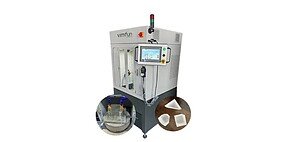
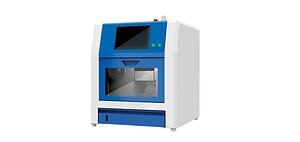
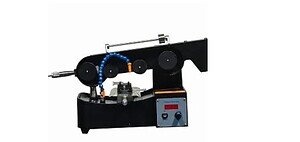
| 기계 플랫폼 | SH-series horizontal rotary with fine feed control |
Values shown reflect VIMFUN’s process envelope for SiC seal rings of this size class, validated against alumina, zirconia, and other hard brittle ceramics. The 1–2 mm/min feed range is deliberately conservative — SiC’s brittleness rewards slower cuts with cleanly fractured edges instead of torn material. See 와이어 속도, 장력 및 공급 속도 for how these parameters interact, and 냉각 및 윤활 for slurry handling on hard ceramics.
The Result: Stable Geometry on Both Faces
The diamond wire approach delivered the three properties this seal application needs at the same time:
- Cleaner edges at both outer profile and inner bore — chipping reduced to within the inspection threshold, not exceeding it
- 지하 손상 감소 — measured damage depth comparable to fine-lapped surfaces, reducing or eliminating the downstream lapping operation
- Consistent geometry — outer diameter, inner bore, and thickness held to the customer’s tolerance without per-part rework
For seal manufacturing the meaningful outcome is downstream: lower scrap at the seal assembly stage, fewer field warranty claims, and the ability to ship parts with a tighter quality guarantee than the customer could get from conventionally cut SiC blanks.
Why Distributed Force Matters on Hard Brittle Ceramics
It comes down to how cutting force interacts with brittle fracture mechanics. Abrasive grinding concentrates load at the contact point of each abrasive grit. On a brittle material, every grit footprint is a potential microcrack initiation site. Multiply by the number of grits in contact at any moment and the cumulative damage adds up fast.
Diamond wire spreads the cutting load along the wire contact arc inside the kerf. Per-unit-area force drops. For SiC and similar hard ceramics, that drop is what separates a clean cut from a chipped one. Three additional factors finish the job:
- 와이어 장력 안정성 — uniform tension across the cut path keeps the wire from walking and creating asymmetric edge damage. See 와이어 장력 교정 for the calibration protocol.
- 제어된 공급 속도 — low feed on a thick SiC cross-section trades cycle time for cleanly fractured material at the cut zone, rather than torn material.
- Adequate cooling — water-based slurry at sufficient volume keeps the cut zone temperature stable, preventing thermal microcracking that would compound the mechanical damage.
This approach extends to other hard brittle materials in the same class — alumina, zirconia, silicon nitride, aluminum nitride, quartz, sapphire. The parameter envelope shifts material by material; the underlying mechanics stay the same. For related cases in this material family, see our 알루미나 세라믹 링 절단 사례 연구 그리고 hexagonal bore quartz tube cutting case study.
산업 및 애플리케이션
Diamond wire cutting of small SiC rings serves manufacturers in:
- Mechanical seal production — pump seals, automotive water pumps, chemical process seals
- Semiconductor equipment — wafer carrier rings, chamber components
- High-temperature industrial systems — burner nozzles, kiln furniture, heat exchanger inserts
- Specialty wear components — abrasive nozzles, slurry pump linings, ballistic ceramics
If you have a small ring, disc, or precision-shaped part in any hard brittle material — SiC, alumina, zirconia, silicon nitride, quartz, sapphire, or fused glass — and conventional grinding is leaving chipping or microcrack issues that fail downstream inspection, the same diamond wire approach typically applies. The parameter set adjusts; the process logic does not.
Can We Cut This for Your Application?
If any of these match your situation, send us your part drawing:
- Hard brittle materials (SiC, alumina, zirconia, silicon nitride) in ring, disc, or tile form
- Small geometry (sub-100 mm features) where chipping is unacceptable
- Tight inner-to-outer concentricity requirement
- Seal, semiconductor, or specialty wear-component end use where downstream failure cost is high
- Production volume from sample runs through several thousand parts per month
Include material grade, part geometry with tolerances, and downstream quality requirements. We will return a process feasibility assessment within 3 business days, including representative parameters and yield projections. Where the geometry is within our envelope, we typically cut a sample piece for verification before committing to production tooling. See our broader 와이어 톱 절단 개요 for the equipment platform behind this approach.