Introduction
In micro abrasive wire cutting, the characteristics of the abrasive layer strongly determine cutting precision, kerf width stability, surface integrity, and subsurface damage. Among all parameters influencing abrasive wire performance, diamond grit size is one of the most critical.
When processing brittle and high-value materials such as sapphire, silicon carbide (SiC), quartz, advanced ceramics, and graphite, abrasive particle size governs the mechanics of brittle fracture and micro-cutting. This article provides an engineering-level explanation of how diamond grit size affects cutting accuracy, how it interacts with process variables, and how engineers can select appropriate grain sizes for precision slicing applications.
How Abrasive Particle Size Affects Cutting Accuracy
Material removal in abrasive wire cutting is dominated by micro-cutting and controlled brittle fracture. The dimensions of each diamond abrasive particle determine its penetration depth, stress distribution, and local interaction with the material surface.
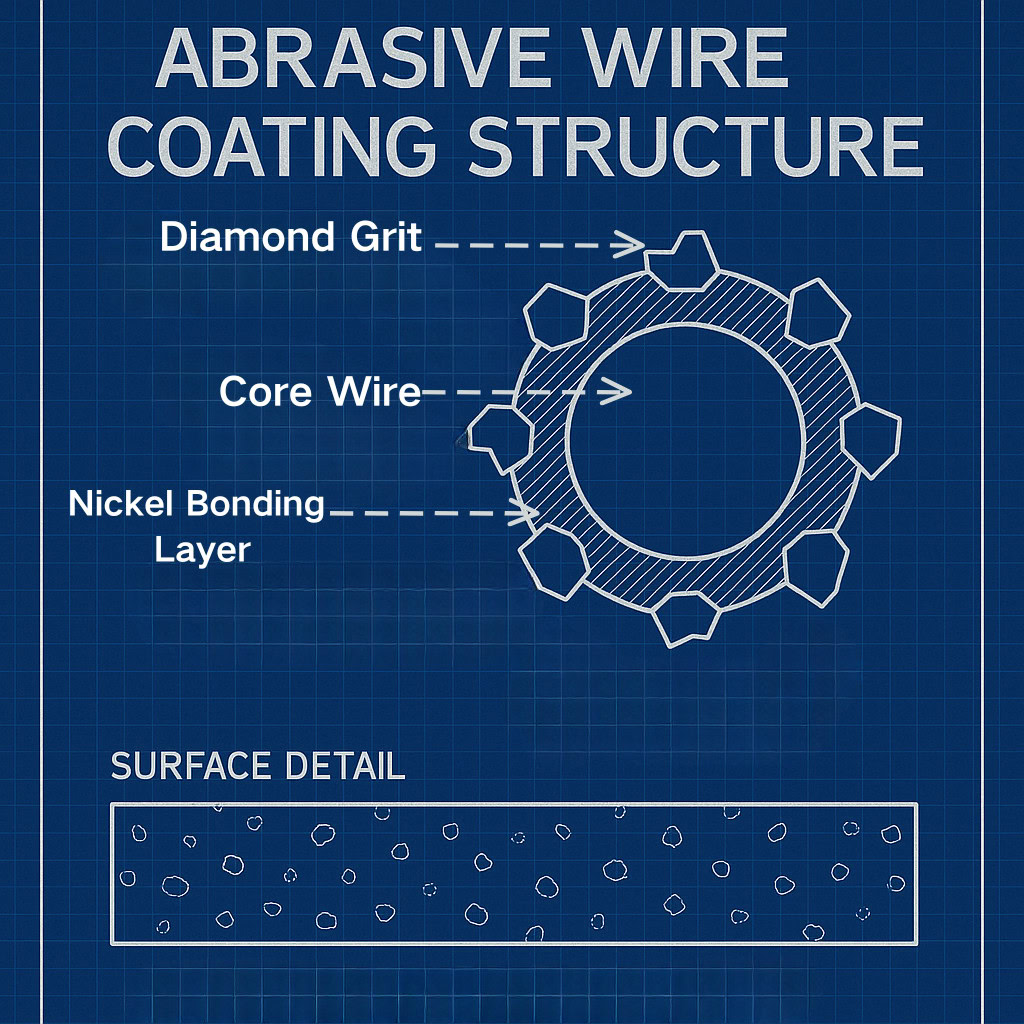
1. Coarse Diamond Grit Size
Coarse grit provides greater protrusion height and more aggressive material removal.
Characteristics:
- High removal rate
- Larger kerf width variation
- Increased risk of brittle chipping
- Deeper subsurface damage
- Rougher surface texture
- Requires higher wire tension
- Suitable for graphite, dense ceramics, and thick SiC slices
Coarse grit is appropriate when throughput is prioritized over surface refinement.
2. Fine Diamond Grit Size
Fine abrasive grains distribute cutting forces across many contact points.
Advantages:
- Lower penetration depth
- Reduced micro-vibration
- Narrower and more stable kerf
- Superior surface finish
- Minimal subsurface damage
- Ideal for micro abrasive wire systems used on brittle substrates
Fine grit is essential for sapphire optics, thin filters, semiconductor wafers, and precision glass components.
Grain Size Selection for Different Materials
| Material | Recommended Grit Size | Technical Reason |
|---|---|---|
| Sapphire | Fine–Medium | Minimizes anisotropic chipping on crystal planes |
| SiC wafers | Medium–Coarse | High hardness requires stronger abrasive penetration |
| Optical glass / quartz | Fine | Reduces crack initiation and lateral fracture |
| Advanced ceramics | Medium | Balances efficiency and surface quality |
| Graphite | Coarse | Porous structure tolerates aggressive removal |
For more detailed information on abrasive coating structure and bonding behavior, please refer to our technical page on abrasive coating materials. In practical applications, grit size selection is typically considered alongside material-specific wire selection criteria during process planning.
How Diamond Grit Size Controls Cutting Precision
Three core engineering parameters are directly influenced by diamond grit size:
1. Kerf Width Stability
- Coarse grit → wider kerf, greater variation
- Fine grit → narrow, repeatable kerf geometry
Stable kerf width is essential for obtaining uniform wafer thickness in semiconductor slicing.
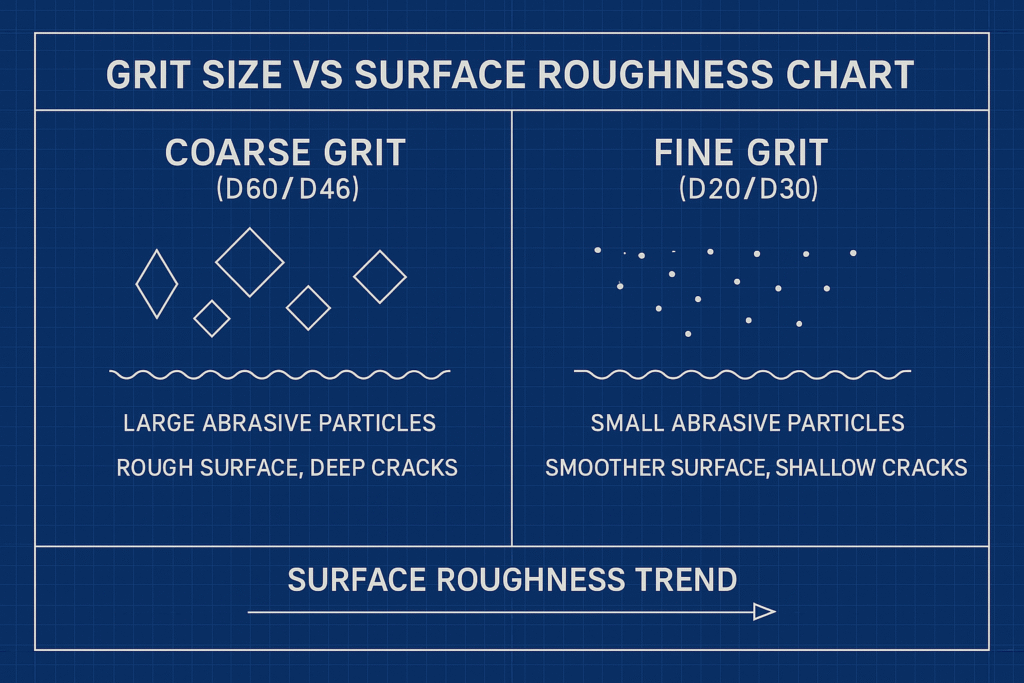
2. Surface Roughness
Surface profile correlates with abrasive protrusion height:
- Coarse grit → deeper scratch marks
- Fine grit → smoother texture and reduced polishing load
Optical and electronic components depend heavily on fine-grain configurations.
3. Subsurface Damage Depth
Stress field intensity increases with abrasive size:
- Coarse grit → deeper micro-crack propagation
- Fine grit → minimal internal damage
This is especially important for SiC, sapphire, optical substrates, and ceramics.
Interaction Between Grit Size and Cutting Parameters
Diamond grit size interacts closely with wire speed, wire tension, and feed rate.
Wire Speed
- Coarse grit performs best at high speeds
- Fine grit benefits from moderate speed to limit heat and vibration
Wire Tension
- High tension stabilizes coarse-grit cutting
- Fine grit requires controlled tension to avoid stress concentration
Feed Rate
- Coarse grit → faster feed allowed
- Fine grit → slower, stable feed required for clean slicing
Balanced parameter tuning is necessary to achieve high precision with any abrasive size,In industrial environments, grit size selection is always validated through systematic wire quality inspection and process control.
Comparison: Diamond Wire Cutting vs Traditional Cutting Methods
To understand the advantages of diamond grit size control, it is useful to compare diamond wire cutting with traditional mechanical and thermal processes. These conventional processes do not utilize abrasive grit size as a control parameter.
| Feature | Diamond Wire Cutting (Abrasive Micro-Cutting) | Laser Cutting (Thermal) / Blade Sawing (Mechanical) |
|---|---|---|
| Material Removal Mechanism | Micro-cutting + controlled brittle fracture | Laser: melting/vaporization; Blade: friction + shear |
| Thermal Impact | Minimal | Significant (laser) |
| Micro-crack Risk | Low with fine diamond grit | High due to thermal shock or tool vibration |
| Kerf Width | Narrow, uniform | Laser widens kerf; blades have inherent kerf thickness |
| Surface Quality | Adjustable by grit size; excellent finish | Laser: recast layer; blades: rougher surface |
| Suitability for Brittle Materials | Excellent | Laser unsuitable for transparent materials; blades unsuitable for ultra-hard ceramics |
Diamond wire cutting provides controllable abrasive mechanics, enabling accuracy levels that are unattainable with thermal or mechanical sawing.
Application Examples of Grit Size Selection
Sapphire Wafer Cutting
Fine grit significantly reduces chipping along r-plane and c-plane surfaces, improving roughness by up to 40%.
Quartz Optics
Fine grit limits lateral crack propagation and improves transmission uniformity.
Graphite Blocks
Coarse grit increases efficiency with no meaningful impact on dimensional accuracy.
SiC Semiconductor Wafers
Medium–coarse grit balances removal rate and surface integrity.
Conclusion
Diamond grit size is one of the most influential parameters in micro abrasive wire cutting. Correct grit selection—combined with appropriate wire speed, tension, and feed rate—enables:
- High dimensional accuracy
- Stable kerf geometry
- Reduced subsurface damage
- Superior surface finish
- Lower micro-vibration and improved process control
These advantages make grit size optimization essential for sapphire optics, SiC power devices, ceramics, quartz components, and precision graphite machining.
👉 Read about our abrasive wire technology in precision cutting applications.
FAQ — Diamond Grit Size and Cutting Precision
1. Why does diamond grit size affect cutting precision?
Because abrasive grain size determines penetration depth, stress distribution, and micro-fracture behavior.
2. Is fine grit always better?
Fine grit improves surface finish but reduces removal rate. Optimal grit depends on material hardness and precision needs.
3. How does grit size influence kerf width?
Coarse grit → wider kerf.
Fine grit → narrow, stable kerf geometry.
4. What grit size is suitable for ceramics?
Medium grit offers a balance between removal rate and surface integrity.
5. Can process parameters compensate for incorrect grit size?
Parameters can optimize performance, but grit size remains the primary determinant of cutting precision.