Introduction
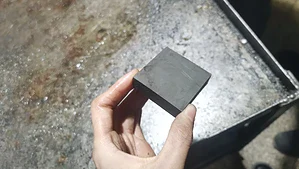
SiC cutting has become a pivotal process in the development of next-generation energy solutions. As the global race for commercial fusion energy intensifies, material science remains the ultimate gatekeeper. Whether it is the plasma-facing components of a Tokamak or complex heat exchanger systems, Silicon Carbide (SiC) and SiC-composites are the materials of choice due to their exceptional thermal stability and radiation resistance. However, the extreme hardness and inherent brittleness of these “space-age” ceramics make precision SiC cutting a significant industrial bottleneck that requires specialized technology to overcome.

Why Traditional SiC Cutting Fails
Traditional reciprocating wire saws or mechanical grinding often fail when meeting the rigorous standards of fusion engineering. High friction during the SiC cutting process leads to rapid heat accumulation, which is detrimental to the structural integrity of the ceramic. Standard methods often result in:
- Thermal Stress: Altering the material’s carefully engineered physical properties.
- Micro-cracking: Surface defects that can expand under the extreme pressure and temperature of a fusion reaction, leading to catastrophic component failure.
- Material Waste: High kerf loss during the SiC cutting phase is financially prohibitive when slicing expensive, high-purity research-grade ingots.
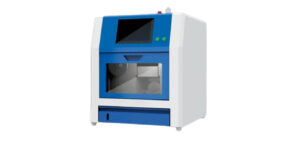
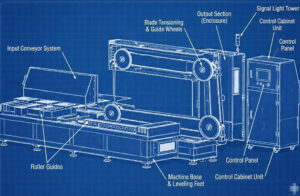
The Vimfun Advantage: Engineering “Cold Cutting” for SiC Vimfun’s Endless Diamond Wire Saw technology redefines the boundaries of SiC cutting through a “Cold Cutting” philosophy. By focusing on high linear speed and low constant tension, we provide a solution that addresses the core pain points of fusion material processing.
1. Ultra-High Linear Speed (80 m/s) By operating at speeds up to 5 times faster than traditional reciprocating saws, the interaction between the diamond grit and the SiC surface is instantaneous. In a high-speed SiC cutting environment, heat is dissipated through the wire and cooling system before it can penetrate the substrate. This prevents the “Heat Affected Zone” (HAZ) from forming, ensuring the material remains stress-free.
2. Endless Loop Stability and Surface Integrity The continuous, unidirectional movement of our endless wire eliminates the vibration and impact spikes associated with the direction-switching found in older SiC cutting machines. This stability is crucial for achieving a mirror-like surface finish. A lower Ra (roughness average) value post-SiC cutting means significantly less time spent on secondary polishing, which is often the most expensive part of the production cycle.
3. Sub-Millimeter Precision and Yield Optimization When dealing with rare isotopes or high-density SiC composites, every millimeter counts. Our SiC cutting technology utilizes diamond wire as thin as 0.3mm. This allows for a total kerf loss of only 0.35mm. By maximizing the number of usable wafers or components from a single ingot, Vimfun helps research facilities and commercial fusion startups drastically reduce their R&D costs.
Applications in the Fusion Sector Beyond basic SiC cutting, our equipment is versatile enough to handle a variety of advanced materials essential for fusion reactors:
- Reaction-Bonded Silicon Carbide (RBSiC): Achieving clean cuts without edge chipping.
- Sintered Silicon Carbide (SSiC): Maintaining high dimensional accuracy in complex geometries.
- CVD Silicon Carbide Coatings: Precise slicing without delaminating the surface layers.
The Future of Material Processing In the realm of fusion energy, the quality of your SiC cutting determines the integrity of your reactor. As companies move toward pilot-scale power plants, the demand for repeatable, high-throughput SiC cutting will only grow. Vimfun is proud to empower energy pioneers by turning “un-machinable” materials into precision-engineered components that will eventually power our grid with clean, carbon-free energy.
Conclusion Vimfun is more than just a machine manufacturer; we are a partner in the global energy transition. Our expertise in SiC cutting ensures that your research is not hindered by the limitations of traditional manufacturing. By choosing the right tool for the job, you ensure the longevity and safety of your fusion components.