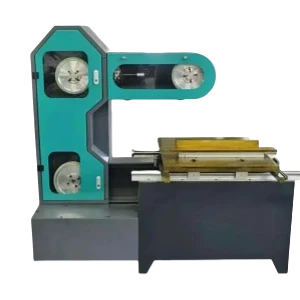
In the realm of advanced material processing, the diamond wire saw is more than just a cutting tool; it is a complex mechanical system under constant dynamic load. While the move from reciprocating saws to endless wire loops has significantly stabilized the process, engineers must still contend with three fundamental vibration modes that can compromise the final product’s quality.
Understanding these vibrations—Transverse, Longitudinal, and Torsional—is the first step toward achieving sub-micron surface finishes and maximizing material yield.
1. Transverse Vibration (Lateral Oscillation)
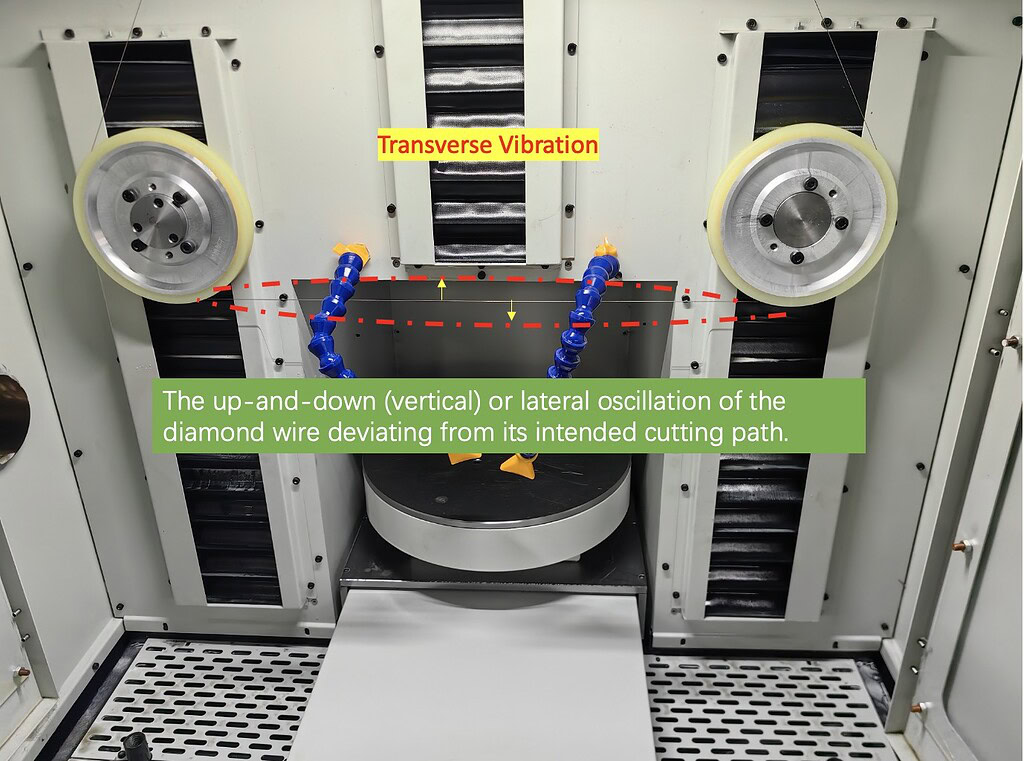
Transverse vibration is defined as the periodic displacement of the diamond wire perpendicular to its path of travel.
Primary Characteristics
- Physical Behavior: The wire acts like a vibrating guitar string, oscillating between the two main pulleys or guide rollers.
- Exertion Sources: It is typically excited by the impact forces between individual diamond grits and the workpiece, or by resonance frequencies within the machine frame.
Engineering Impact
- Surface Waviness: This is the primary culprit behind macroscopic surface “waves,” which require extensive post-processing (grinding/polishing) to remove.
- Kerf Loss Expansion: As the wire wobbles, the effective width of the cut increases, leading to higher material waste—a critical factor when slicing expensive substrates like SiC or sapphire.
2. Longitudinal Vibration (Elastic Fluctuation)
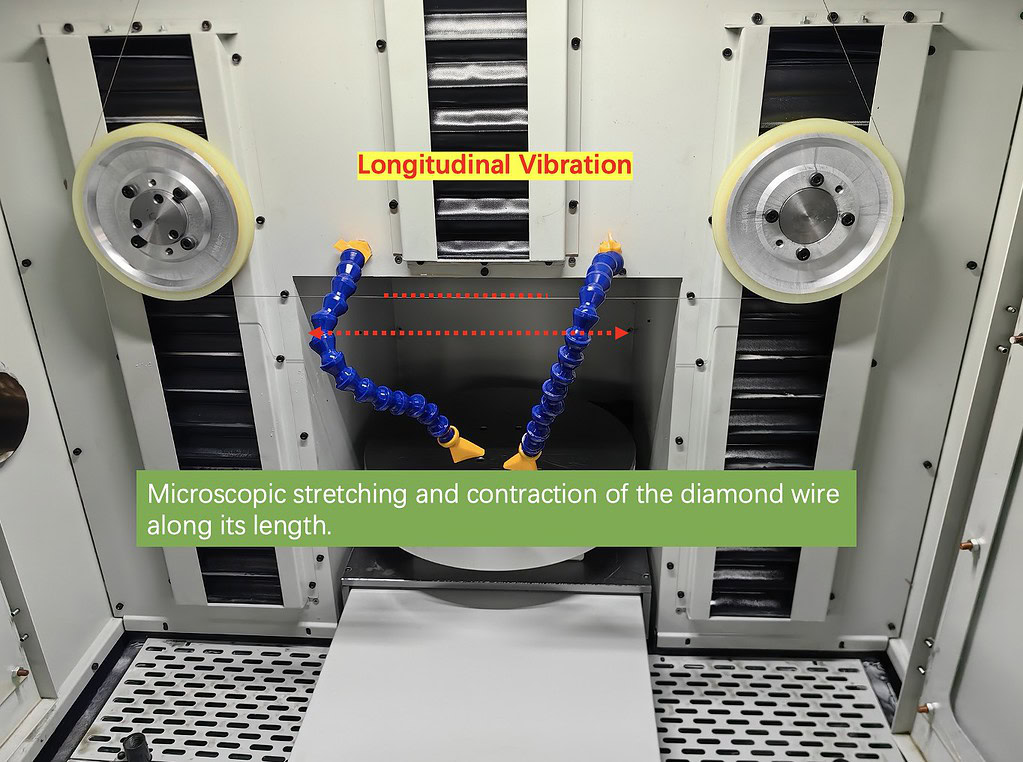
Longitudinal vibration involves the microscopic, high-frequency stretching and contraction of the diamond wire along its longitudinal axis.
Primary Characteristics
- Physical Behavior: This manifests as a “pulse” or tension wave traveling through the wire, often caused by the stick-slip effect during material penetration.
- Exertion Sources: Inconsistent drive synchronization, variations in the wire’s core density, or the sudden release of internal stresses in materials like optical glass can trigger these waves.
Engineering Impact
- Fatigue & Breakage: Constant longitudinal stress cycles accelerate the fatigue of the wire core, leading to unexpected “snaps” during long-duration cuts.
- Cutting Force Instability: These fluctuations prevent a steady material removal rate, which can lead to localized thermal damage or uneven surface roughness.
3. Torsional Effects (Axial Twisting)
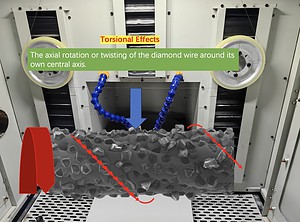
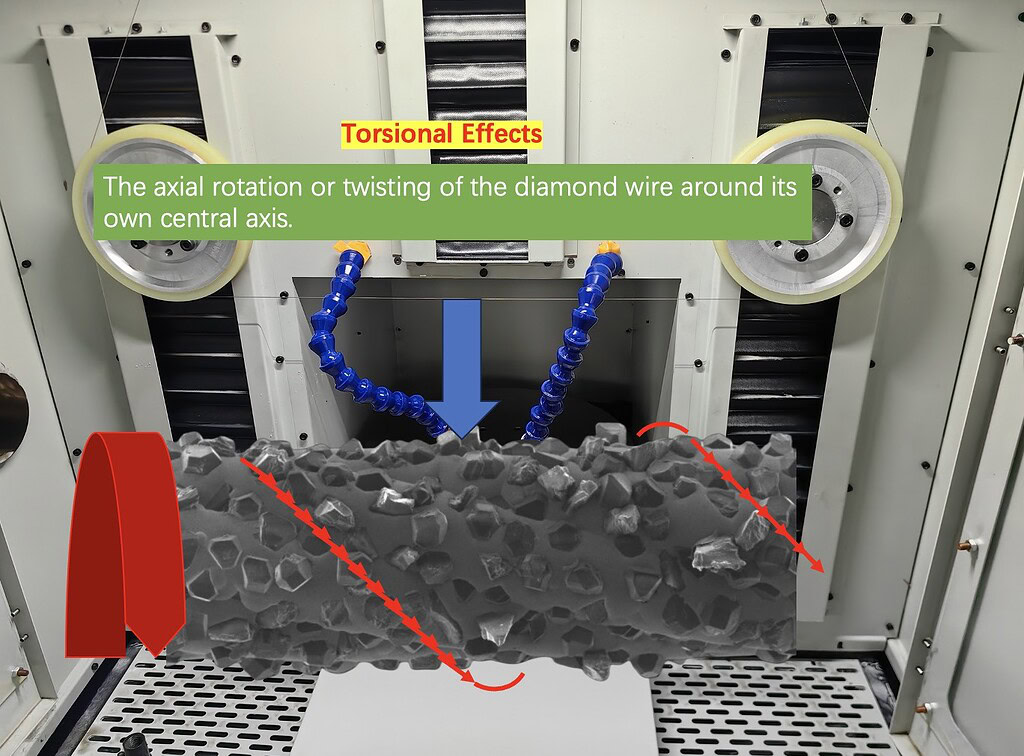
Torsion is the axial rotation or twisting of the wire around its own center, a phenomenon often overlooked in standard process analysis.
Primary Characteristics
- Physical Behavior: The wire rotates as it enters the kerf, often due to an imbalance in the cutting forces acting on the abrasive grains.
- Exertion Sources: Asymmetric distribution of diamond particles or cutting through materials with non-uniform hardness gradients can force the wire to twist.
Engineering Impact
- Subsurface Damage (SSD): Torsional movement creates complex shear stresses in the material, resulting in micro-cracks that penetrate deeper into the substrate.
- Edge Chipping: In brittle materials, the twisting motion at the exit point of the cut often causes “blowouts” or chipping, significantly reducing the yield of usable parts.
Summary: The Synergy of Control
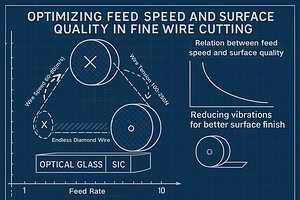
To mitigate these vibrations, a holistic engineering approach is required. Implementing High-Precision Tension Control shifts the natural frequencies of the wire to avoid resonance, while Endless Loop Architecture eliminates the violent transients associated with reciprocating reversals.
By understanding the mechanics behind these three modes, process engineers can fine-tune their parameters to achieve the perfect balance of cutting speed, tool life, and surface integrity.