Introduction: Stability Is an Engineering Discipline
In high-precision diamond wire cutting, achieving micron-level accuracy is not a matter of static parameter settings but a result of continuous system stability. For industries processing semiconductor-grade quartz, sapphire, and silicon carbide, the cost of unplanned downtime or material scrap is prohibitive. Diamond wire saw troubleshooting is therefore not a reactive repair task; it is a structured discipline aimed at identifying mechanical, pneumatic, and thermal instabilities before they escalate into catastrophic failure. This guide provides an engineering-grade roadmap for diagnosing common cutting defects and implementing a rigorous preventive maintenance (PM) regime.
1. Systematic Diamond Wire Saw Troubleshooting Logic
When a failure occurs—whether it is an unexpected wire break or a surface finish deviation—engineers must evaluate the system as an integrated loop. Effective diamond wire saw troubleshooting focuses on the interaction between the wire tension, feed rate, and the material removal rate (MRR).
Case A: Wire Breakage During High-Load Cutting
If wire breakage occurs repeatedly, especially as the cut depth increases, the root cause is often a localized tension spike that exceeds the wire’s yield strength.
- Adaptive Feed Failures: Modern machines use adaptive feed logic to reduce the downward velocity when spindle load increases. If this sensor feedback loop is uncalibrated, the wire will be “over-pushed” into the material, leading to excessive bowing and snapping.
- Coolant Insufficiency: At high wire speeds (up to 80 m/s), friction in the kerf generates intense localized heat. If the cooling nozzles are misaligned, the diamond wire undergoes thermal softening, significantly reducing its tensile limit.
Case B: Surface Waviness and Periodic Ripple Marks
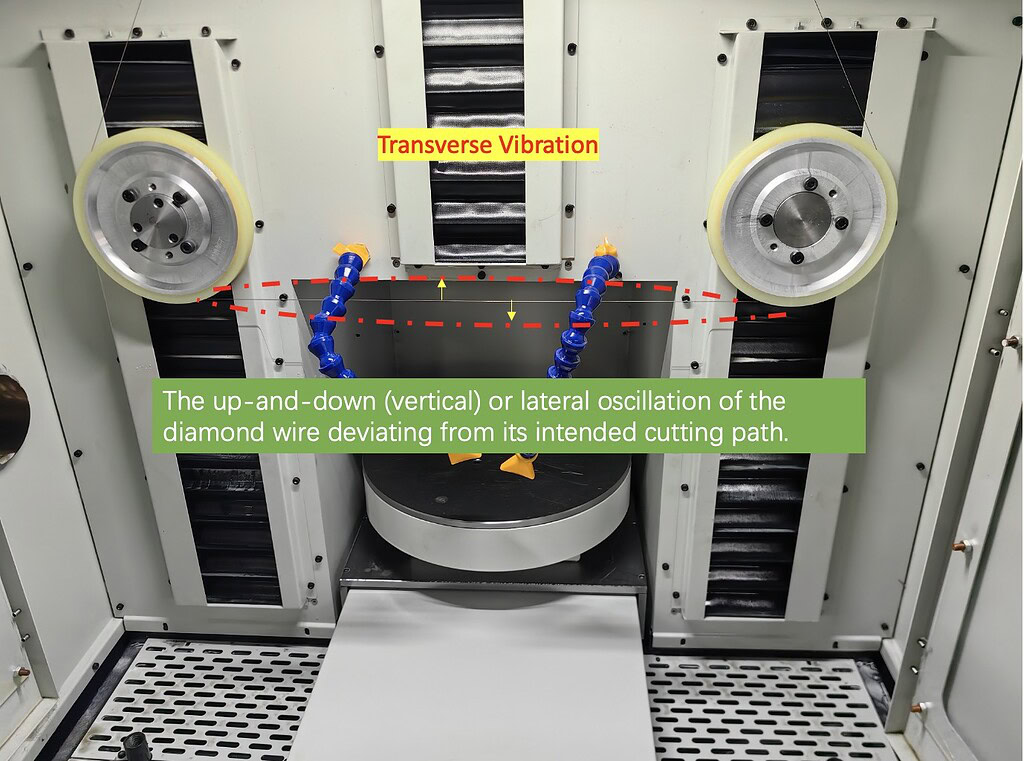
Visible “washboard” patterns or ripples on the sliced surface are typically symptoms of mechanical vibration or harmonic resonance.
- Guide Wheel Runout: Any eccentricity in the guide pulleys ($>10$ µm) introduces a cyclical displacement of the wire. This periodic oscillation is “recorded” on the workpiece surface as waviness.
- Tension Hunting: In poorly tuned systems, the tensioning motor or pneumatic regulator may “hunt” for the setpoint, causing the wire stiffness to fluctuate during the cut.
[Image placeholder required: Macro view of surface waviness on a sapphire wafer]
2. Daily Inspection: The First Line of Defense
Routine operator-level checks are essential to prevent the gradual drift of system parameters. A standard daily checklist for diamond wire saw troubleshooting includes:
- Groove Integrity: Inspect the guide wheel U-grooves for slurry buildup or wear. Accumulation of fine particles alters the wire’s trajectory and increases lateral friction.
- Pneumatic Response: Verify that the dancer arm (tension compensator) moves smoothly without stiction. Any mechanical resistance in the pivot point will introduce noise into the tension control loop.
- Wire Wear Patterns: Inspect the spent wire for irregular coating loss or “necking,” which are early indicators of pulley misalignment.
3. Weekly Engineering Calibration and Metrology
Beyond daily checks, a weekly engineering-level inspection ensures the geometric accuracy of the machine remains within the specified $\pm$ 0.01 mm envelope.
- Runout Measurement: Use a high-precision dial indicator to verify that the radial and axial runout of all primary pulleys is within $10$ µm. Excessive runout is the primary driver of high-frequency vibration.
- Spindle Alignment: Ensure the wire web is perfectly perpendicular to the Z-axis feed direction. Even a $0.05°$ misalignment will result in a “tapered” or “wedged” cut.
- Tension Load Cell Verification: Conduct a static check of the diamond wire saw troubleshooting data by hanging standard weights from the wire to verify that the sensor reading matches the physical load.
[Image placeholder required: Engineering diagram showing dial indicator setup on a pulley]
4. Diagnosing Tension Fluctuation Patterns
Tension stability is the most critical diagnostic signal in any wire saw operation. A healthy process should maintain tension within $\pm$ 5% of the setpoint. Engineers should categorize abnormal patterns to expedite the diamond wire saw troubleshooting process:
- Slow Drift: Usually indicates a pneumatic leak in the tensioning cylinder or thermal drift in the load cell electronics.
- Erratic Spikes: Often caused by “wire jumping” in the grooves or electrical interference (EMI) affecting the feedback signal.
- Step-Changes: Indicates a mechanical slip in the drive coupling or a sudden change in material density.
5. Preventive Maintenance (PM) Framework
Reactive repairs increase the total cost of ownership. A structured PM schedule ensures the machine operates in its peak performance zone.
6. Engineering Conclusion
Effective diamond wire saw troubleshooting and maintenance is a continuous process of managing mechanical tolerances and control loop stability. Most processing defects—from TTV errors to wire breaks—originate from a failure to maintain the machine’s geometric and tensioning integrity. By adopting a data-driven approach to maintenance, manufacturing facilities can maximize wire life and ensure consistent, high-quality output for demanding hard-and-brittle material applications.
FAQ
Q1: What is the primary cause of sudden wire breakage in an endless wire system?
While tension is a factor, the most common cause is “thermal fatigue” caused by insufficient coolant flow at the entry point of the kerf. Without proper lubrication, the diamond coating fails, and the steel core snaps under friction.
Q2: How do I distinguish between mechanical vibration and electronic noise in tension data?
Mechanical vibration usually follows the frequency of the pulley rotation. Electronic noise is typically erratic and unrelated to machine speed. Use an FFT (Fast Fourier Transform) analysis of the tension signal to identify the specific source frequency.
Q3: Can I extend the life of guide wheels through maintenance?
Yes. Regular cleaning of the grooves to remove accumulated abrasive slurry can double the life of the polyurethane or ceramic coatings on the guide wheels, directly reducing the frequency of diamond wire saw troubleshooting for surface finish issues.