Clearceram-Z HS is one of the most demanding optical materials to cut and process. With a near-zero coefficient of thermal expansion and exceptional mechanical stability, it is the material of choice for astronomical telescopes, lithography systems, and high-precision optical instruments — but its very properties make it challenging to machine. This article covers everything you need to know about cutting Clearceram-Z HS with a diamond wire saw.
~70%
Ceramic content by volume
≈0
Thermal expansion (CTE near room temp)
0.01mm
Positioning accuracy of SH200-R
What is Clearceram-Z HS?
Clearceram-Z HS is an ultra-low expansion glass-ceramic manufactured by Ohara Inc. of Japan. It belongs to the SiO₂-Al₂O₃-Li₂O family of glass-ceramics and achieves near-zero thermal expansion by balancing the positive CTE of the mother glass matrix against the negative CTE of the β-quartz solid solution crystals grown uniformly within it.
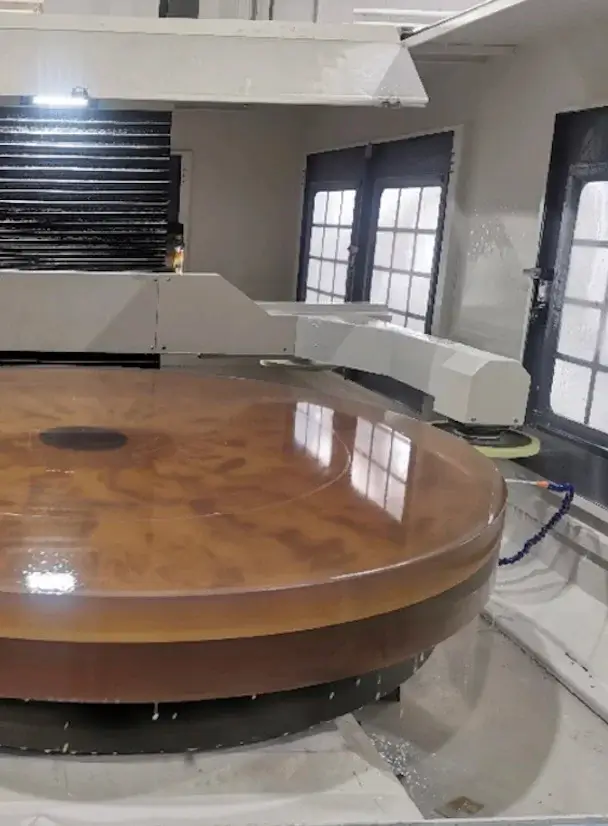
The “HS” designation refers to a high-stability grade with even tighter CTE uniformity compared to the standard grade, making it ideal for large-format optics such as telescope primary mirror blanks, semiconductor stepper components, interferometer elements, and precision laser mirrors. Companies such as Ohara have supplied Clearceram-Z HS blanks for major international telescope projects including TMT (Thirty Meter Telescope).
Its composition also avoids Na, K, B, F, and Pb — making it chemically resistant and stable through repeated cleaning and thin-film coating processes.
“For full material specifications, visit the official CLEARCERAM®-Z product page by Ohara Corp.”
Why is Clearceram-Z HS difficult to cut?
◆
High hardness and brittleness
At approximately 70% ceramic by volume, Clearceram-Z HS is far harder than standard optical glass. It resists conventional cutting while remaining brittle — a combination that demands precise force control to prevent cracking or chipping.
◆
Thermal sensitivity during machining
Ironically, the material’s ultra-low expansion makes heat management critical during machining. Uneven thermal gradients from cutting can introduce stress and microcracking. Coolant temperature must be carefully controlled.
◆
Subsurface damage risk
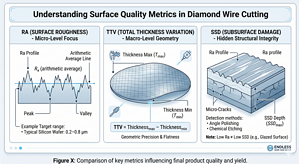
Aggressive cutting parameters can introduce subsurface damage that is not visible on the cut surface but compromises downstream polishing and optical performance. Controlled feed rate and wire tension are essential.
◆
Large blank dimensions
Clearceram-Z HS blanks are often very large — mother blanks exceeding 1,500mm in diameter have been produced. Cutting at scale requires a machine with a stable cast body and consistent wire tension throughout the cut.
Why diamond wire sawing is the preferred cutting method
For ultra-hard and brittle optical materials like Clearceram-Z HS, diamond wire sawing offers significant advantages over conventional blade sawing or waterjet cutting. The continuous diamond wire produces a narrow kerf, minimizes material loss from these high-value blanks, and distributes cutting forces evenly — reducing the risk of fracture.
Unlike blade cutting, wire sawing does not require direct clamping pressure perpendicular to the cut face, which lowers the risk of crack propagation in brittle materials. The thin wire also allows more complex cut geometries, including slanted cuts and custom polygon shapes without repositioning the workpiece.
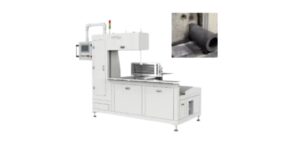
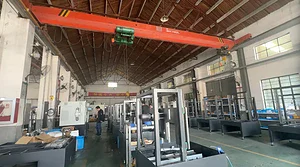
Our SH200-R diamond wire saw is designed specifically for materials like Clearceram-Z HS. The machine body is a precision cast iron structure for superior vibration damping, and the positioning system achieves 0.01mm accuracy — a critical requirement when slicing large, high-value optical blanks where every micron counts.
Key cutting parameters for Clearceram-Z HS
Optimal cutting of Clearceram-Z HS depends on precise control of several interdependent parameters. Based on our test experience with this material, the following considerations are most important:
Wire speed and feed rate
A moderate wire speed combined with a controlled, slow feed rate is recommended. Excessively high feed rates increase cutting forces and raise the risk of subsurface cracking. The SH200-R allows precise independent control of both parameters, enabling operators to find the optimal balance for each blank size and geometry.
Coolant management
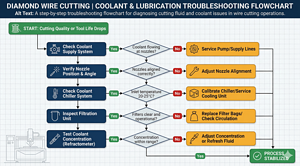
Consistent coolant supply is critical for two reasons: thermal management and swarf removal. We recommend using a fully synthetic coolant optimized for glass and ceramic cutting. Coolant temperature should be monitored and kept stable, as even small temperature fluctuations affect the material’s dimensional behavior during cutting.
Wire tension and wire consumption
Maintaining consistent wire tension throughout the cut ensures a straight, flat kerf. As the diamond wire wears, tension naturally changes — the SH200-R compensates for this automatically, maintaining cut quality from the start to the end of each slice.
Clearceram-Z HS vs. comparable materials
| Material | Manufacturer | CTE (×10⁻⁷/°C) | Machinability | Primary application |
|---|---|---|---|---|
| Clearceram-Z HS | Ohara (Japan) | ≈0 ± 0.02 | Moderate — diamond tools required | Telescope mirrors, lithography |
| Zerodur | Schott (Germany) | ≈0 ± 0.02 | Moderate — similar to CCZ-HS | Telescope mirrors, metrology |
| ULE | Corning (USA) | ≈0 ± 0.03 | Easier — amorphous glass | Space optics, lithography |
| Fused silica | Multiple | 5.5 | Good — standard diamond tools | General precision optics |
Case study: Cutting a 256 × 242 × 517 mm Clearceram-Z HS block
We are currently preparing a cutting test on a 256 × 242 × 517 mm Clearceram-Z HS blank supplied by a client in the optical industry. At these dimensions, the block represents a substantial and high-value workpiece — errors are not recoverable.
Our approach for this test centers on the SH200-R with fully supported workpiece fixturing, conservative feed rate parameters, and temperature-controlled coolant throughout the cut. We will share results and measurements from this test in a follow-up post.
This kind of real-world testing demonstrates our commitment to validating cutting parameters on actual client materials — not just standard glass — before full production runs begin.
Conclusion
Clearceram-Z HS is a remarkable material that enables some of the most precise optical systems ever built. Cutting it correctly requires a machine built for stability and precision, parameters carefully matched to the material’s hardness and brittleness, and a team with real experience processing ultra-low expansion glass-ceramics.
If you are working with Clearceram-Z HS, Zerodur, fused silica, or other hard optical materials and need a reliable cutting solution, we welcome you to contact us about a cutting test on your material.
Contact our team to discuss your Clearceram-Z HS or other optical material cutting requirements. We offer cutting tests before full production orders.