Introduction: More Than Just “Water”
Effective diamond wire saw coolant management is essential for controlling heat, friction, and surface integrity during high-speed slicing. In many diamond wire saw applications, cutting fluid is often treated as a secondary utility rather than a core process variable. From a tribology and thermal engineering perspective, however, the coolant is just as critical to cutting performance as the diamond wire itself.
At wire speeds typically ranging from 40 to 60 meters per second, intense localized heat is generated at the microscopic contact points between diamond grit and the workpiece. Without proper thermal control and lubrication, several failure mechanisms can occur:
- Diamond graphitization: At temperatures above 700°C, diamond transforms into graphite, dulling the cutting wire.
- Micro-cracking: Thermal shock induces subsurface damage in brittle materials like sapphire.
- Swarf re-welding (loading): Debris adheres to the wire surface, increasing cutting force.
1. Coolant Selection in Diamond Wire Saw Cutting: Thermodynamics vs. Lubricity
Selecting the appropriate coolant always involves a balance between heat removal capability and friction reduction.
1.1 Water-Based Coolants (Aqueous Solutions)
Primary function: heat removal
Water-based coolants are highly effective at thermal control because water has a very high specific heat capacity, meaning it can absorb a large amount of heat with only a small temperature rise. This makes water-based fluids particularly suitable for high-speed diamond wire cutting where heat generation is continuous.
Pure water, however, is not suitable for industrial use. Modern aqueous coolants are engineered fluids that typically contain:
- Surfactants, which reduce surface tension and allow the fluid to penetrate deep into the narrow cutting kerf
- Rust inhibitors, which protect machine components and fixtures
- Chelating agents, which prevent fine particles from clumping and forming sludge
Best suited for:
Silicon, sapphire, optical glass, ceramics, and other hard and brittle non-metallic materials where temperature control is critical.
1.2 Oil-Based Coolants (Neat Oils)
Primary function: lubrication
Oil-based coolants primarily reduce friction by forming a lubricating film between the diamond wire and the workpiece. This significantly lowers mechanical resistance and can improve surface finish in certain applications.
Engineering trade-offs include:
- Lower heat removal efficiency compared to water-based fluids
- Higher cost and potential flammability considerations
Best suited for:
NdFeB magnets (which are highly sensitive to oxidation), metallic materials, and applications that require extremely low surface roughness.
2. Fluid Dynamics: Breaking the Air Barrier
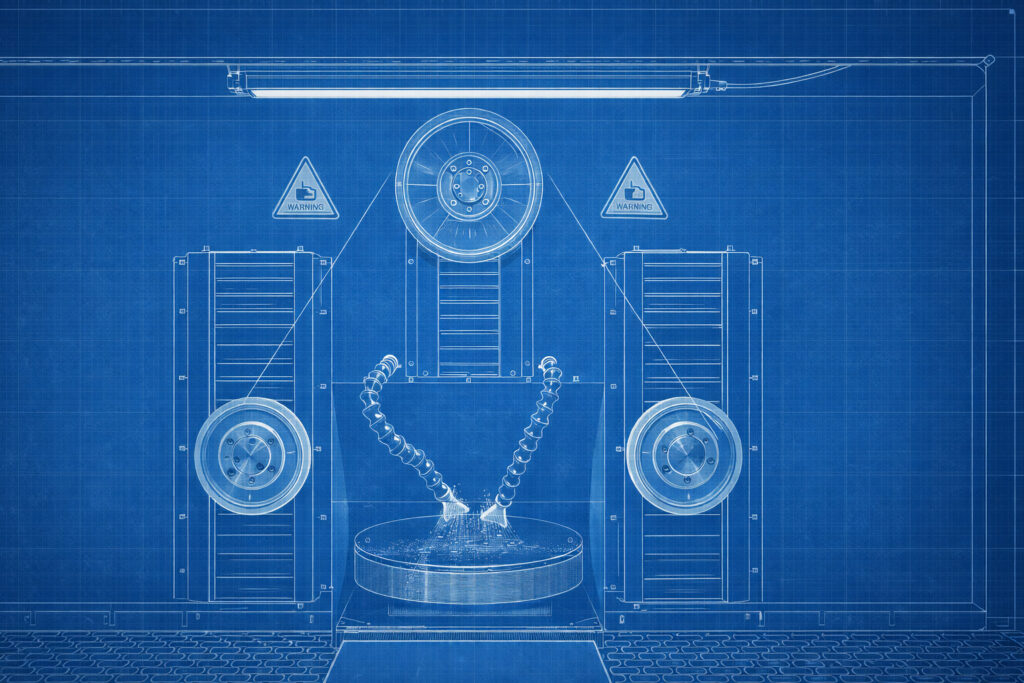
A common misconception in diamond wire saw coolant management is that volume equals cooling. In practice, fluid velocity and delivery pressure are the critical cutting parameters that determine slicing success.
2.1 The Air Barrier Effect
A diamond wire moving at high speed drags a thin boundary layer of air along its surface. This aerodynamic barrier can deflect low-pressure coolant, leading to “dry cutting” conditions even when fluid appears abundant.
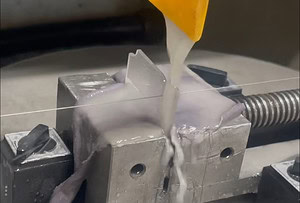
Engineering Solution: High-velocity coolant jets with sufficient pressure are required to penetrate the air barrier and deliver fluid directly to the cutting interface.
2.2 Nozzle Orientation and Flow Direction
- Target location: the wire entry point into the material
- Flow direction: aligned with the direction of wire travel
Spraying against the wire direction introduces turbulence and air entrainment, which promotes foaming and reduces effective heat transfer.
3. Filtration: The Hidden Factor Behind Surface Quality
Recirculating contaminated coolant is equivalent to introducing uncontrolled abrasives. In professional diamond wire saw coolant management, filtration is a pillar of surface quality. If debris particles are larger than the diamond grit protrusion, they act as “rogue particles,” causing random surface scratches and accelerated wire wear.
3.1 The Rogue Particle Effect
If diamond grit protrusion on the wire surface is on the order of ten microns, but the coolant contains recirculated debris particles larger than that, those particles act as uncontrolled cutting tools.
This can lead to:
- Random surface scratches and wire marks
- Accelerated diamond wire wear
- Lateral force imbalance that produces wedge-shaped or tapered cuts
3.2 Filtration Strategies
Effective diamond wire saw coolant management requires consistent filtration:
- Magnetic separation for ferrous materials such as NdFeB and steel
- Cyclone separation to remove heavy sludge without consumable filter media
- Precision filtration using fine filter bags for high-precision or semiconductor-grade slicing
Maintenance guideline:
Monitor the pressure difference across the filter housing. A rising pressure difference usually indicates clogging, while a sudden drop often signals filter damage or bypass.
Conclusion
A well-designed diamond wire saw coolant strategy is not an auxiliary function; it is a core process parameter. By selecting the correct chemistry, ensuring high-velocity delivery, and maintaining effective filtration, manufacturers can significantly extend wire life and reduce surface defects.
Learn more about how a well-designed diamond wire saw system supports clean, stable cutting performance:
diamond wire saw.
FAQ
Q1: How do I know when coolant needs to be replaced?
Monitor pH, conductivity, and concentration. When pH drops below recommended levels or concentration falls outside the manufacturer’s specified range, lubricity and corrosion protection degrade. Unpleasant odor often indicates bacterial contamination.
Q2: Can tap water be used to mix coolant?
No. Tap water contains dissolved minerals that react with coolant additives, forming scale or sludge that can clog pipes and nozzles. Deionized or reverse-osmosis water is strongly recommended.
Q3: Why does coolant foam excessively during cutting?
Foaming is commonly caused by incorrect coolant chemistry, air leaks at the pump inlet, or spraying against the wire direction. Adjust nozzle orientation or use approved defoaming additives if necessary.