1. Introduction: Engineering the Continuous Motion Advantage
In modern semiconductor and optical fabrication, the limitation of traditional slicing often lies in the mechanical shock of reciprocating motion. Diamond wire loops have redefined this process by enabling a continuous, unidirectional movement that supports linear speeds up to 80 m/s. This article analyzes the structural engineering that allows these loops to maintain extreme precision under high-dynamic loads.
Whether you are optimizing a production line for Silicon Carbide (SiC) or Gallium Nitride (GaN), the structural integrity of the diamond wire loops you select is the primary factor in reducing micro-cracks and maximizing yield.
Iconography: Use micro-icons for a CAD-drawing feel (e.g., a gear for kinetics, a diamond crystal for material).
Engineering Consultation:Need custom loop specifications for your materials? Request a Technical Consultation →
2. Core Metallurgy: Foundations of +/- 0.01mm Precision
The performance of an endless diamond wire loop begins with its core material. To sustain a operational tension of 150 to 250 N, the core must exhibit exceptional tensile strength.
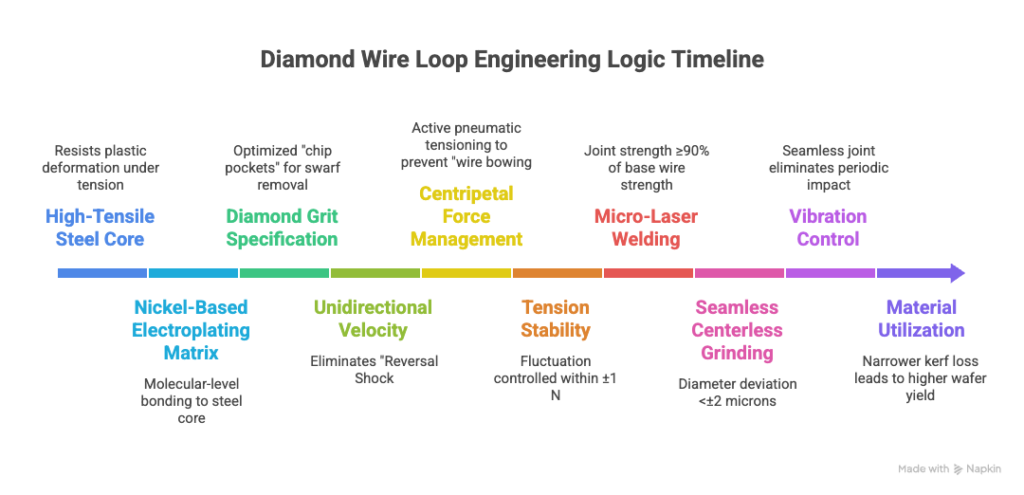
- High-Tensile Core: We utilize high-carbon steel with a tensile strength exceeding 3200 MPa. This ensures the loop structure resists plastic deformation during high-friction phases.
- Geometric Symmetry: Perfect symmetry is required to minimize radial run-out. Even a 5-micron deviation can induce resonance at high speeds, leading to edge chipping in brittle substrates.
3. Tension Dynamics: Fc = m * v^2 and Stability
Operating at 80 m/s introduces complex centripetal forces. As an engineer, you must account for the dynamic tension component, represented by the formula: Fc = m * v^2.
In our loop engineering level standards, we compensate for these forces through active pneumatic tensioning. This ensures the diamond wire loops follow a perfectly linear path, minimizing Total Thickness Variation (TTV) in high-value wafers.
4. Selection Guide: Grit Size vs. Material Hardness
Selecting the correct diamond wire loops involves matching abrasive density with material properties.
| Material | Hardness (Mohs) | Recommended Grit Size | Target Surface Finish (Ra) |
| Silicon Carbide (SiC) | 9.5 | 30 – 45 microns | < 0.3 microns |
| Sapphire | 9.0 | 40 – 60 microns | < 0.5 microns |
| Optical Glass / Quartz | 7.0 | 60 – 80 microns | < 0.8 microns |
| Technical Ceramics | 8.0 – 9.0 | 45 – 60 microns | < 0.6 microns |
5. Joint Integrity: The Seamless Weld Advantage
The loop joint design is the most critical structural feature. A joint with a diameter deviation can strike the workpiece dozens of times per second, causing catastrophic breakage in brittle materials. Our laser-welded joints are ground to within +/- 2 microns of the base wire diameter, providing a seamless transition that extends loop lifespan by 50% to 200%.
6. Case Study: E-E-A-T (Experience & Authority)
- Industry: Power Electronics (SiC Slicing).
- Challenge: High kerf loss and TTV using reciprocating multi-wire saws.
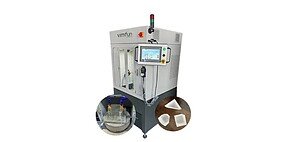
- Solution: Transitioned to Vimfun SGSM40 Endless Wire Saw technology utilizing 0.35 mm diamond wire loops.
- Result: 30% increase in slicing throughput and a 15% reduction in material waste due to the stabilized cutting path.
7. Why Loop Technology Outperforms Traditional Wire
| Performance Metric | Diamond Wire Loops | Traditional Reciprocating Wire |
| Linear Speed | Up to 80 m/s | 20 – 30 m/s |
| Tension Stability | +/- 1 N | +/- 10 N |
| Vibration Level | Minimal | High (at reversal points) |
| Maintenance | Lower (No spool reversals) | High (Constant re-spooling) |
8. Engineering Conclusion & Call to Action
The structural design of diamond wire loops is a synergy of metallurgy and kinetic control. By implementing these high-speed systems, manufacturers can lower their “Cost Per Cut” while ensuring the highest surface integrity.
Ready to enhance your precision cutting line?
- View the SGSM40 Endless Wire Saw Machine → [Internal Link]
- Request a Loop Specification Sheet → [Contact Form Link]
- Learn more about Loop Joint Methods →
9. FAQ
Q: What is the primary difference between diamond wire and a diamond loop?
A: A diamond wire is open-ended and requires reciprocating motion, whereas a diamond wire loop is an endless circle that allows for continuous, high-speed unidirectional cutting at 80 m/s.
Q: How does wire tension affect cutting accuracy?
A: Higher tension (150 – 250 N) reduces wire deflection (bowing), which is essential for achieving flat surfaces and low TTV in materials like sapphire and SiC.
Q: Can these loops be used on existing wire saw machines?
A: No, diamond wire loops require a specific machine architecture (Endless Wire Saw) designed for loop circulation and active tensioning.