
Faraday rotator garnet cutting to 1 arc-minute on a 5-axis diamond wire saw
We ran a trial cut on a customer's magneto-optic garnet boule. The slices came back from their own lab at 1 arc-minute azimuthal deviation and 2 arc-minutes perpendicularity, with thickness held inside 0.02 mm — the kind of accuracy Faraday rotator garnet cutting actually demands.
See the magneto-optic garnet cut on the SGRTS 20
Finished part off the saw: a mirror-smooth cut face, no edge chipping, 0.01 mm thickness variation, and a 0.03 mm feeler-gauge check that won't enter the edge — followed by the customer's lab result of 2′ perpendicularity / 1′ azimuth.
Why Faraday rotator garnet cutting is unforgiving
The crystal here is a magneto-optic garnet — the family used to build a Faraday rotator. Two compositions dominate: terbium gallium garnet (TGG, Tb₃Ga₅O₁₂) для мощных и свободнопространственных изоляторов, и железо-иттриевый гранат, замещенный висмутом (Bi:RIG) для телекоммуникаций 1550 нм. Оба являются кубическими гранатами, оба медленно выращиваются в виде булей или слоев, и оба должны быть разрезаны вдоль определенной кристаллографической оси. Ошибетесь с осью, и производительность Верде, коэффициент экстинкции и качество луча ухудшатся — деталь может пройти проверку размеров и все равно не подойти в качестве оптического изолятора.
Это реальное ограничение при резке граната для Фарадеевых вращателей: это в первую очередь задача ориентации, а затем уже задача размеров. Плоскость реза должна соответствовать направлению кристалла с точностью до нескольких угловых минут, а не нескольких десятых долей градуса. Кроме того, гранат имеет твердость около 8 по Моосу и хрупок, поэтому инструмент должен удалять материал, не нагружая край.
Картина спроса — вот что делает допуск коммерчески значимым. А Фарадеевский изолятор — это деталь, которая пропускает свет в одном направлении и блокирует отражение, возвращающееся обратно, и каждый высокоскоростной оптический модуль нуждается в нем. Поскольку каналы 800G и 1.6T масштабируются для оптической связи для ИИ и межсоединений центров обработки данных, спрос на магнитооптические кристаллы резко возрос — а були ротаторного класса дороги и медленно выращиваются, с мощностями, забронированными на годы вперед.
Подвох: на эти кристаллы нет бюджета на отходы. Ошибка ориентации в 0,1° или скол края — это не брак, который можно проигнорировать — это недели роста кристалла насмарку. Вот почему мы рассматриваем настройку ориентации, а не скорость резки, как то, что нужно сделать правильно.
Установка ориентации кристалла по пяти осям
Определение кристаллической плоскости в 3D-пространстве требует трех угловых параметров: одного вращения вокруг вертикальной оси (азимут) и двух наклонов вокруг перпендикулярных горизонтальных осей. SGRTS 20 имеет именно это поверх этапа нарезки Y/Z — всего пять осей.
В нашем испытании буль сначала был установлен в целевое кристаллическое направление с помощью поворотной оси и двух осей наклона. Проволока никогда не движется во время настройки ориентации. Только после фиксации плоскости этап Y/Z подает деталь в петлю алмазной проволоки. Поскольку выравнивание и резка осуществляются в одной жесткой установке, ориентация, которую вы устанавливаете, — это ориентация, которую вы режете — без переноса на второй зажим, без ошибки повторного зажима.
Поворотная ось и оси наклона каждая имеют точность позиционирования ≤1 угловой минуты (разрешение 0,1° / 6′). Результат поля 1–2′ точно соответствует этой спецификации; дополнительная угловая минута на перпендикулярность — это именно то, что можно ожидать — прогиб проволоки во время резки, зажим и собственное измерение заказчика — все это складывается в это число.
Measured results on the customer's crystal boule
The customer indexed the finished parts against the target crystal plane in their own metrology lab and recorded two deviation components: the in-plane (azimuthal) error and the cut-face perpendicularity. For reference, demanding oriented-crystal optical work is commonly specified within ±5′ (≈ ±0.08°).
Отклонение по азимуту 1′ соответствует спецификации позиционирования машины; перпендикулярность 2′ остается далеко в пределах диапазона ±5′, типичного для деталей с прецизионной ориентацией кристалла. Шкала: 0–5 угловых минут.
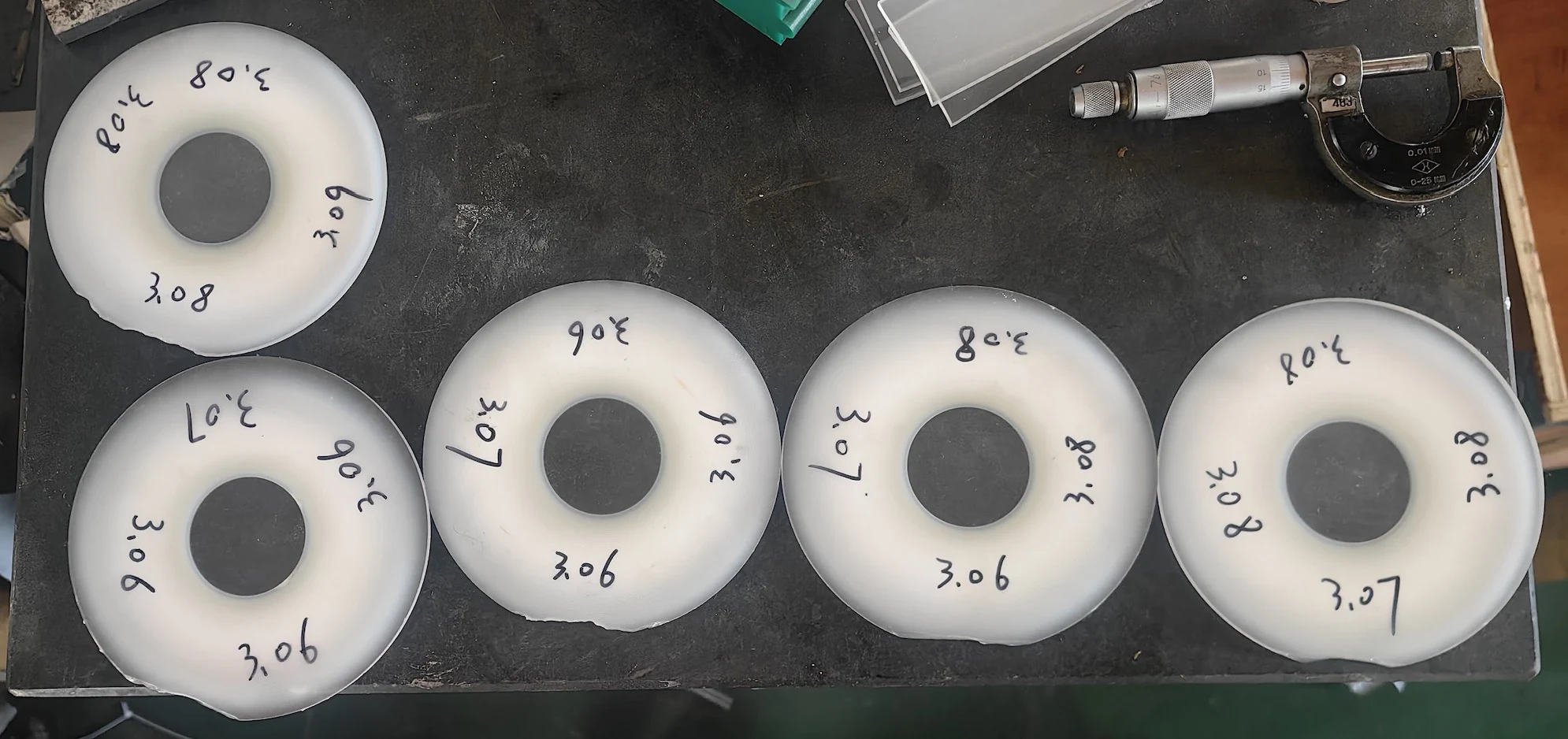
Толщина: пять деталей, проверка микрометром в четырех точках
Каждая готовая деталь была измерена в четырех точках по всей ее поверхности с помощью наружного микрометра с точностью 0,01 мм. Показания оставались в пределах диапазона 0,03 мм для всех пяти деталей, и ни одна отдельная деталь не отличалась более чем на 0,02 мм.
| Part | Мин (мм) | Макс (мм) | Разброс (мм) | Статус |
|---|---|---|---|---|
| P1 | 3.08 | 3.09 | 0.01 | ПРОЙДЕНО |
| P2 | 3.06 | 3.07 | 0.01 | ПРОЙДЕНО |
| P3 | 3.06 | 3.07 | 0.01 | ПРОЙДЕНО |
| P4 | 3.06 | 3.08 | 0.02 | ПРОЙДЕНО |
| P5 | 3.07 | 3.08 | 0.01 | ПРОЙДЕНО |
Измеренный диапазон по всем деталям: 3,06–3,09 мм · Прибор: наружный микрометр, разрешение 0,01 мм · 4 точки на деталь.
Во что превращаются готовые кристаллы
Разрезанные и отполированные, эти магнитооптические гранатовые пластины используются в поворотной ступени оптического изолятора или оптического циркулятора. A Тербиево-галлиевый гранат ротатор вращает поляризацию на фиксированный угол в магнитном поле; в сочетании с поляризаторами устройство пропускает прямой свет, блокируя отражение, которое в противном случае дестабилизировало бы источник лазера.
Эта единственная функция встречается на нескольких рынках. В оптической связи для ИИ и межсоединениях центров обработки данных, каждый трансивер 800G/1.6T и каждый волоконный усилитель нуждается в изоляции, чтобы отраженный свет не попадал на лазер. В промышленных и волоконных лазерах изоляторы защищают начальную и накачивающую ступени. В лидарной и медицинской фотонике тот же магнитооптический кристалл сохраняет чистоту сигнала. Различные длины волн требуют различных составов — Bi:RIG около 1550 нм для телекоммуникаций, TGG для более высокой мощности и свободного пространства — но проблема резки остается той же: удерживать ось кристалла, сохранять плоскостность и параллельность срезов.
SGRTS 20 — пятиосевая пила с бесконечной алмазной проволокой
Резка выше выполнялась на нашей бесконечная алмазная проволочная пила platform configured with five axes for Faraday rotator garnet cutting. The endless loop matters here: a continuous diamond wire keeps a thin, steady kerf and low edge load, which is what keeps brittle garnet from chipping at entry and exit.
Частые вопросы о резке магнитооптического граната
Может ли алмазный проволочный пильный станок резать ТГГ и магнитооптический гранат без сколов?
Да. Бесконечная алмазная проволока режет ТГГ и другие магнитооптические гранаты с тонким пропилом и низкой нагрузкой на край, что позволяет контролировать сколы при настройке скорости подачи, натяжения проволоки и охлаждающей жидкости для материала. Хрупкая, но не невозможная природа граната — это именно то окно, в котором хорошо работает проволочная пила.
Как вы сохраняете ориентацию кристалла во время резки?
Буля выравнивается по целевой оси с помощью поворотной оси и двух перпендикулярных наклонных осей перед началом резки, затем Y/Z-стол подает ее к проволоке. Одна жесткая установка как для выравнивания, так и для резки означает, что установленная ориентация — это ориентация, которая будет вырезана.
What thickness tolerance is achievable on garnet wafers?
В приведенном выше испытании пять деталей имели размеры 3,06–3,09 мм с вариацией внутри детали 0,02 мм или менее по микрометру 0,01 мм. Окончательная толщина и параллельность обычно достигаются при шлифовке и полировке; задача пилы — доставить плоские, параллельные, правильно ориентированные заготовки с минимальным количеством снимаемого материала.
Где этот подход имеет ограничения?
Проволочная пила оставляет пропиленную поверхность, которая все еще требует шлифовки и полировки, поэтому это начало процесса, а не весь процесс. Для очень тонких пластин (значительно менее 0,3 мм) или очень большого количества срезов на булю многопроволочные или внутренние методы могут выиграть по производительности. Для ориентированных, малообъемных, дорогостоящих заготовок, где каждый миллиметр кристалла имеет значение, пятиосевой однопроволочный маршрут является более безопасным выбором.
Отправьте образец для пробной резки
Если вы нарезаете гранат для фарадеевых вращателей, ТГГ или любой другой ориентированный магнитооптический кристалл и вам нужна ориентация с точностью до угловой минуты при строгой толщине, отправьте нам булю или тестовый образец. Мы проведем пробную резку на SGRTS 20 и вернем детали с измеренными данными ориентации и толщины — так же, как мы сделали здесь.
Запросить пробную резку →