
SGR 20 – Vision: Vision Alignment Diamond Wire Saw for Mark-Based Dicing
SGR 20 – Vision is a vision alignment diamond wire saw that finds the marks on your workpiece and cuts along them. Two cameras read the marks, the machine corrects the Y position and rotation, sets the origin and starts cutting — no manual line-up.
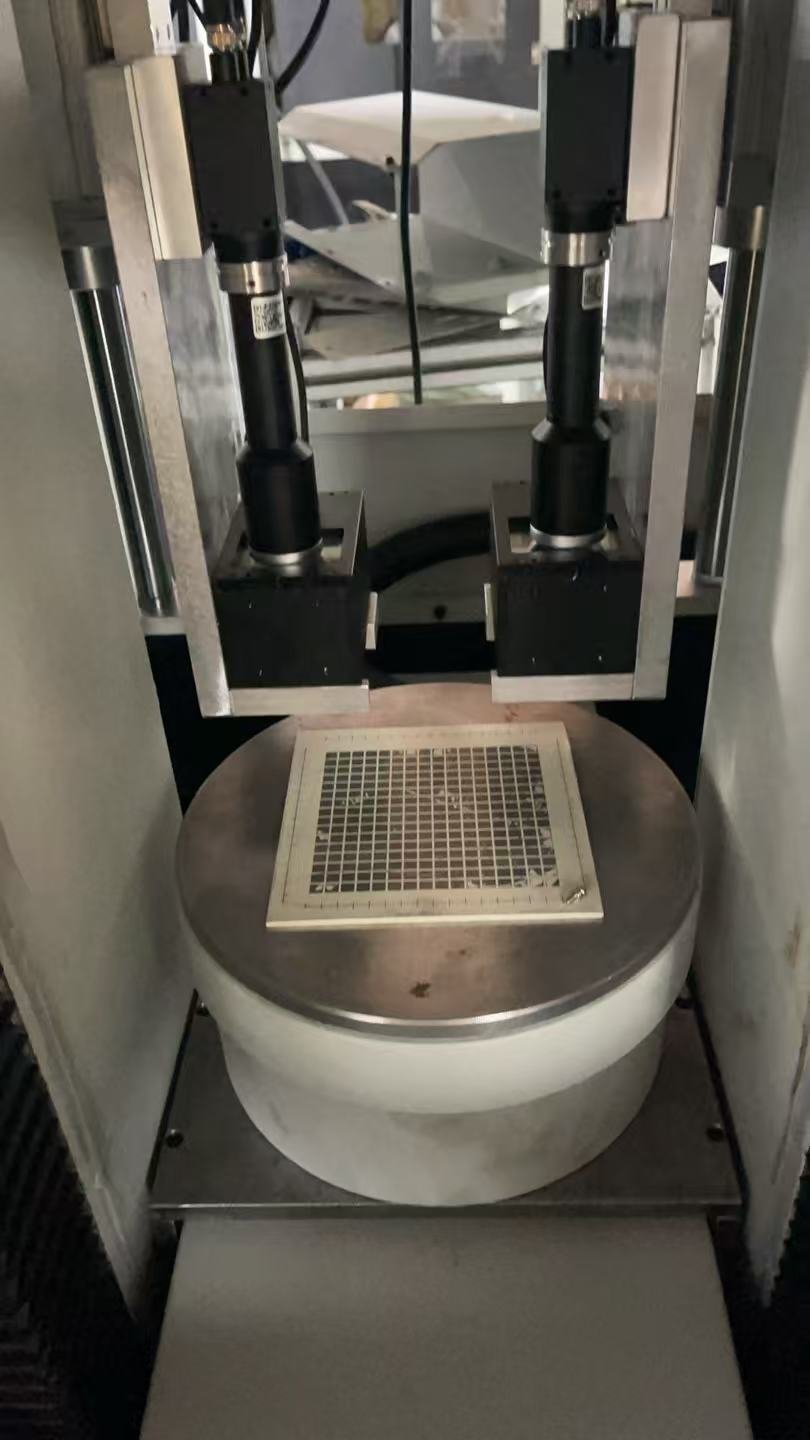
It is built for thin plates and small blocks of hard, brittle material: optical glass, quartz, sapphire, infrared materials, crystals, ceramics and magnetic materials. Typical jobs are grid dicing a substrate into small parts, cutting blanks along printed marks, and cutting at set angles. The base machine is our SGR 20 rotary wire saw; the vision alignment diamond wire saw adds a dual-camera system on top of it, so every part is aligned to its own marks instead of to a fixture.
Why Use a Vision Alignment Diamond Wire Saw?
When the cut position is defined by marks on the part — not by its outer shape — alignment becomes the slow, operator-dependent step. A vision alignment diamond wire saw moves that step to the cameras.
Manual line-up is slow and hard to repeat
Lining a mark up under the wire by eye is repeated for every part, and the result depends on the operator. On the SGR 20 – Vision, two cameras find the left and right marks with 0.015 mm repeatability, and the Y axis and rotary table correct the offset automatically. The same program runs the same way on every part.
Grid dicing needs two aligned directions
Dicing a plate into squares means cutting one direction, turning the part 90° and cutting again. Unclamping and re-aligning by hand adds error. Here the table rotates and the cameras align the second direction to the marks again, without removing the part. Any angle can be set, so diamonds and angled strips work the same way.
Thin, brittle parts need support
Thin plates are clamped between transparent glass, with the vision marks on the glass. The glass supports the part and is cut through together with it. Because the marks sit on the glass, a transparent or dark workpiece does not affect recognition on the vision alignment diamond wire saw.
How the SGR 20 – Vision Works
- Load the part, clamped between glass with two cross marks.
- Two 5 MP cameras search for the left and right marks.
- The system calculates the Y offset and the rotation offset (R).
- The Y axis and rotary table correct the offset and set the origin.
- The wire cuts the programmed lines; for a second direction the table rotates and aligns again.
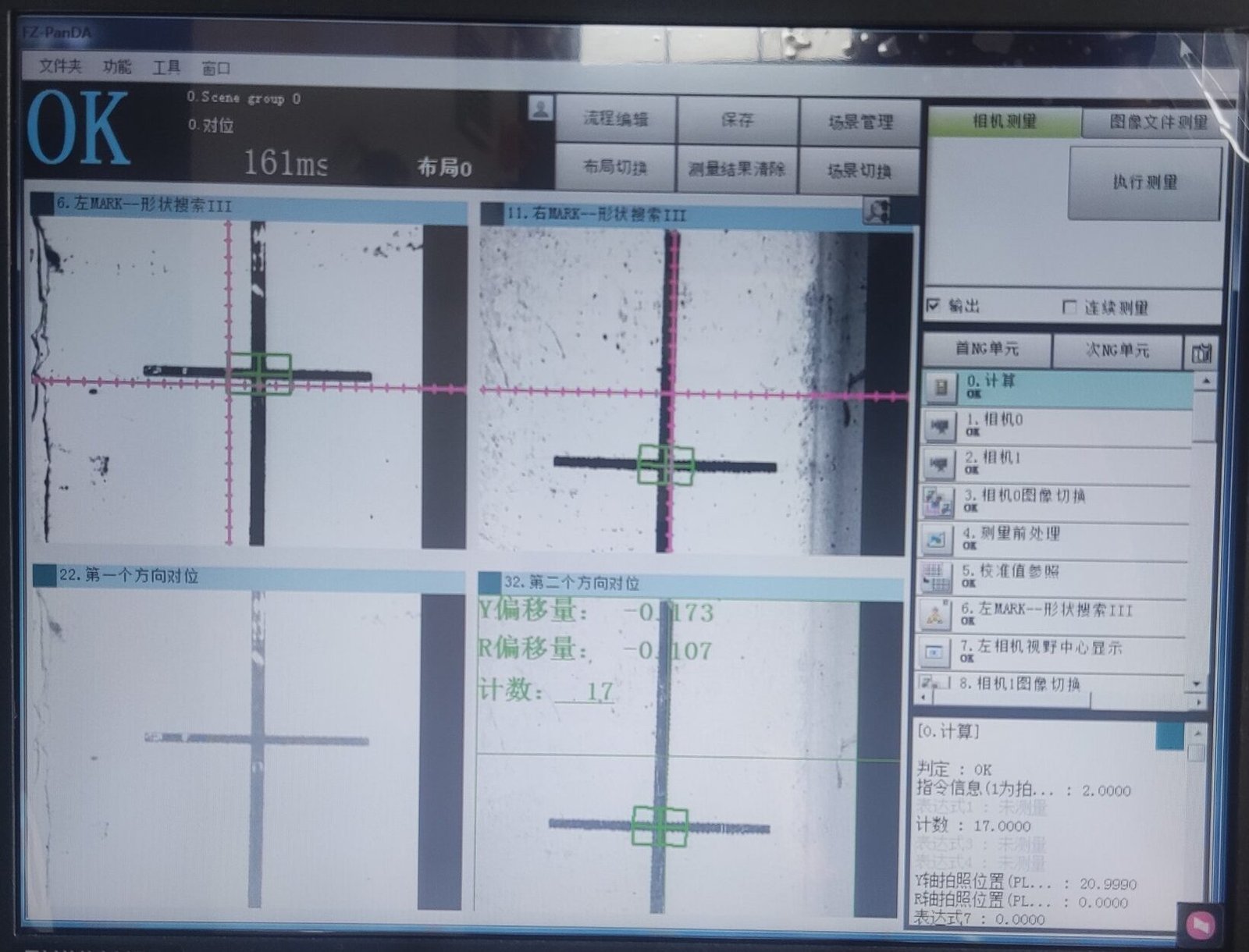
On the vision alignment diamond wire saw, alignment takes milliseconds; the cut itself takes minutes on hard, brittle material. So the vision alignment diamond wire saw adds almost nothing to cycle time — throughput is set by the cutting feed.
The cutting side is the same as on our rotary wire saws. An electroplated diamond endless loop runs in one direction at constant speed: π × 0.25 m × 4500 rpm ÷ 60 ≈ 59 m/s. With a loop of about 1797 mm, the same wire section returns to the cut every 1797 ÷ 59000 ≈ 30.5 ms. There is no reversal as with a reciprocating ワイヤーソー, so cut faces have no periodic reversal marks.
Key Specifications
Main data of the vision alignment diamond wire saw:
| Vision system | |
|---|---|
| Cameras | 2, one per mark (left / right) |
| Camera resolution | 5 MP per camera |
| Recognition repeatability | 0.015 mm |
| Recognition range | 200 × 200 mm |
| Alignment output | Y offset + rotation offset, corrected automatically |
| Marks | No special requirements |
| Without marks | Edge recognition, for parts with lower accuracy needs |
| Cutting and motion | |
|---|---|
| Worktable / max. part height | Ø200 mm / 200 mm |
| Y / Z travel | 200 mm / 200 mm |
| Y / Z repeatability | ±0.01 mm |
| Y / Z minimum feed | 0.01ミリメートル |
| Rotary resolution / accuracy | 0.1° / ±0.05° |
| Wire diameter / max. speed | 0.35–1.0 mm / 59 m/s |
| Load with rotation | ≤ 30 kg recommended |
| 電源 | 3-phase, 220–240 V, 50–60 Hz |
Full data, including footprint and consumables, is in the equipment recommendation for the vision alignment diamond wire saw — ask us for a copy.
Preparing Vision Marks
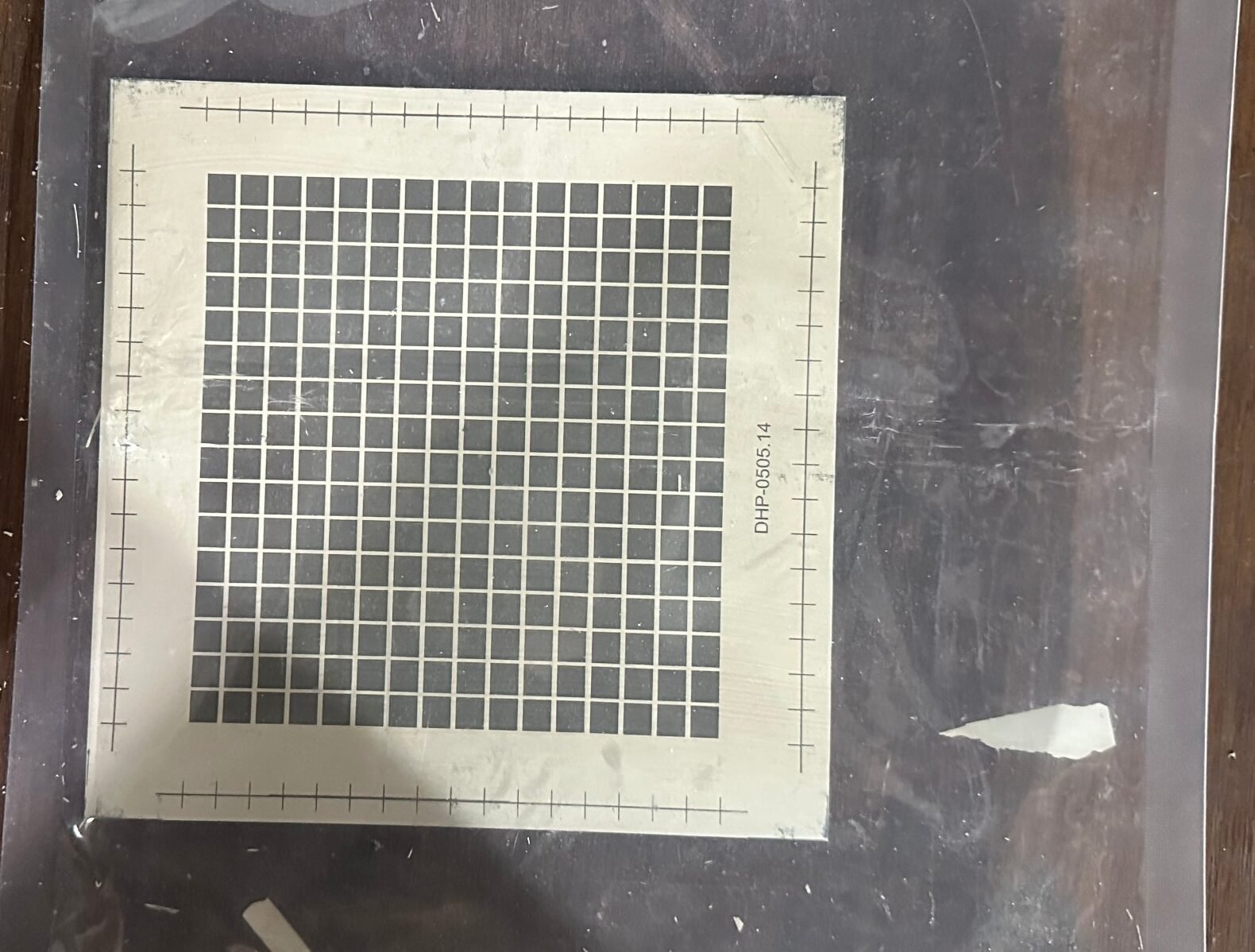
Standard method: clamp the part between transparent glass and put the marks — two crosses plus scale lines — on the glass. There are no special requirements for the marks or for the glass.
Mark position: one cross on each side, one per camera. The wider the spacing, the more accurate the angle.
No marks: the system can align to the part edge. Use this for parts with lower accuracy needs; a chipped or chamfered edge reduces the result.
Glass is a consumable. It is cut through with the part, so count it in part cost and set the feed for the total thickness of part plus glass. The mark method is the same on every vision alignment diamond wire saw job, whatever the material.
材料と代表的な部品
Any material softer than diamond can be cut. The best wire diameter, wire speed and feed differ widely between materials, so we recommend a test cut with your own parts on the vision alignment diamond wire saw.
| 素材 | Typical parts |
|---|---|
| 光学ガラス、石英 | Small optical parts, filter and array plates, prism blanks |
| サファイア | Window plates diced into small pieces |
| Infrared materials (germanium, silicon, ZnSe, ZnS) | Dicing infrared windows and thin plates |
| Piezoelectric and laser crystals | Strips, blocks and angled pieces cut along marks |
| Ceramics (alumina, aluminium nitride, silicon nitride) | Ceramic substrates diced along marks |
| 磁性材料 | Thin plate dicing |
| Research samples | Cores, minerals, composites cut at a set position and direction |
Cutting Modes
| Mode | What it does |
|---|---|
| Grid dicing | Align, cut, rotate 90°, align again, cut — the core application of the vision alignment diamond wire saw |
| Mark-based blanking | Irregular blanks and offcuts cut along their marks |
| Angled dicing | Diamonds, angled strips and polygons at any set angle |
| Prism cutting | Enter the angle; triangular to nonagonal prisms in one setup |
| スライス | Automatic slicing, different thicknesses in one program |
| Edge alignment cutting | No marks; aligns to the part edge for lower accuracy needs |
Slicing works as on our ガラス切断ワイヤーソー; the vision alignment diamond wire saw adds the camera-based modes.
What the SGR 20 – Vision Does Not Do
The vision alignment diamond wire saw is not the right machine for every job:
- No curved contours. It cuts flat faces only — straight cuts and rotary-indexed planes. Contour parts need our SGI 20 コンターカッティングマシン.
- No tilting. Vision corrects Y position and rotation in the horizontal plane, not tilt. Inclined faces, tapers and two-axis crystal orientation correction need the 多軸ダイヤモンドワイヤーソー (SGRT 20).
- Nothing over 200 mm. Larger parts need a bigger worktable, such as the SGR40 プリズムカットワイヤーソー.
- Not for high-volume regular parts. If a fixture can locate the part, a fixture is faster than vision. For high-volume slicing, use an oscillating multi-wire saw.
Watch the SGR 20 – Vision in Detail
See the full cycle: the cameras find the marks, the machine corrects Y and rotation, cuts the first direction, rotates and aligns again for the second.
よくあるご質問
Do the vision marks need special requirements?
No. The vision alignment diamond wire saw needs only two cross marks, one for each camera. They are usually put on the glass that clamps the part.
Can it cut without marks?
Yes. The system can align to the part edge. This suits parts with lower accuracy needs; edge chips or chamfers affect the result.
Is 0.015 mm the finished-part tolerance?
No. 0.015 mm is the mark recognition repeatability. Finished tolerance also depends on wire bow, kerf, clamping and the marks themselves, so confirm it with a test cut.
Which glass should I use, and is it reused?
There is no special requirement for the glass. It is cut through with the part, so it is a consumable.
What is the largest part it can handle?
Ø200 mm worktable, 200 mm part height, 200 × 200 mm recognition range; with rotation, 30 kg or less is recommended.
Can it correct crystal tilt?
No. It corrects rotation in the horizontal plane only. For tilt correction, see the multi-axis model.
How is it different from a standard rotary wire saw?
It adds two cameras and automatic alignment. The machine vision system replaces manual line-up, which makes the vision alignment diamond wire saw the better choice when cut positions come from marks.