Introduction : Le cerveau de la machine
Dans le monde de l'ingénierie de précision, Système d'alimentation de scie à fil diamanté Il ne s'agit pas simplement d'un mécanisme qui déplace le fil vers le bas ; c'est le cœur intelligent de l'ensemble du processus de coupe.
Un fil diamanté est flexible. Si la force d'avance n'est pas contrôlée, le fil se courbe, ce qui entraîne des erreurs de conicité ou une rupture. Pour obtenir une précision au micron sur des matériaux comme Germanium ou Verre Ohara, le Système d'alimentation de scie à fil diamanté doit gérer simultanément la force, la vitesse et la position.
Ce guide explore l'ingénierie sous-jacente à la commande de l'axe Z par servomoteur et à la logique adaptative qui caractérisent une technologie haut de gamme. Système d'alimentation de scie à fil diamanté.
1. Architecture matérielle : servomoteur vs moteur pas à pas
Le fondement de toute précision Système d'alimentation de scie à fil diamanté C'est son système d'entraînement. Alors que les machines économiques utilisent des moteurs pas à pas, les scies de haute précision utilisent Servomoteur à courant alternatifs.
1.1 Commande servo en boucle fermée
2. Mode de logique de contrôle A : Débit d’avance constant
Il s'agit du mode standard utilisé dans un système de base. Système d'alimentation de scie à fil diamanté.
2.1 Fonctionnement
L'opérateur fixe une vitesse constante, par exemple, 1,0 mm/min. L'axe Z descend exactement à cette vitesse, quelle que soit la résistance.
2.2 Quand l'utiliser
- Matériaux homogènes : Idéal pour Verre K9 (BK7) ou Silice fondue où la densité est uniforme.
- Sections transversales stables : Fonctionne bien avec les blocs carrés.
2.3 Le risque
Si le fil rencontre une inclusion dure, la résistance augmente brusquement. Un principe de base Système d'alimentation de scie à fil diamanté Le fonctionnement en mode constant forcera le fil vers le bas, entraînant une rupture immédiate de celui-ci.
3. Mode de logique de commande B : Alimentation adaptative (charge constante)
La marque distinctive d'un niveau avancé Système d'alimentation de scie à fil diamanté C’est la capacité de “ sentir ” la coupe. On parle alors d’avance adaptative ou de mode de charge constante.
3.1 L’algorithme “ de ressenti ”
La machine surveille en temps réel le courant de la broche principale (couple).
- Charge cible : L'opérateur définit une cible (par exemple, 3,5 ampères).
- Boucle PID : L'automate programmable ajuste dynamiquement la vitesse de descente.
3.2 Scénario : Découpe de germanium rond
Lors de la découpe d'un cristal de germanium rond, la longueur de contact varie continuellement. Un système intelligent Système d'alimentation de scie à fil diamanté volonté:
- Accélérer à l'entrée (faible résistance).
- Ralentir au centre (haute résistance).
- Accélérer à la sortie.
Cela empêche le fil de dépasser sa longueur maximale. limite de tension, protégeant ainsi vos précieux matériaux optiques.
4. Calcul de l“” angle de courbure »
Dans les systèmes de contrôle avancés, nous gérons le géométry du fil. Lorsque le fil coupe, les forces de frottement le repoussent, créant un Angle de courbure.
- Limite critique : Pour les optiques de précision, l'angle de courbure doit rester inférieur à 5°.
- Compensation algorithmique : Une prime Système d'alimentation de scie à fil diamanté Il calcule cet angle en temps réel. Si la courbure devient trop importante, l'axe Z cesse de descendre pour permettre au fil de se redresser. Cela évite les découpes en forme de “ ventre ” sur les grandes pièces. Verre Corning feuilles.
Conclusion
La différence entre une scie générique et un outil de précision réside dans la logique.
En intégrant des servomoteurs en boucle fermée à des algorithmes adaptatifs, notre Système d'alimentation de scie à fil diamanté Elle garantit que les paramètres de coupe sont adaptés aux caractéristiques réelles du matériau. Qu'il s'agisse de germanium délicat ou de quartz robuste, une logique de contrôle appropriée vous protège contre les pertes de rendement.
Besoin d'aide pour configurer vos paramètres de contrôle ? Téléchargez notre guide de configuration des paramètres.
6. FAQ
Q1 : Pourquoi le système d'alimentation de la scie à fil diamanté est-il important pour la qualité de surface ?
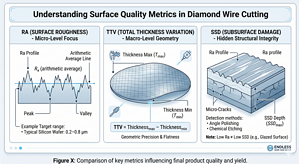
Un système d'alimentation instable provoque des vibrations ou des sauts du fil, laissant des marques ou des ondulations sur la surface du verre optique. Une alimentation fluide et servo-commandée garantit une finition miroir (Ra < 0,4 µm).
Q2 : Quel mode d'alimentation dois-je utiliser pour le verre optique ?
Pour les blocs standard de K9, l'alimentation constante convient. Pour les matériaux coûteux ou thermosensibles comme le germanium, utilisez toujours le mode adaptatif de votre imprimante. Système d'alimentation de scie à fil diamanté pour éviter les ruptures dues aux chocs thermiques.
Q3 : Puis-je moderniser mon ancien système de moteur pas à pas ?
C'est difficile. Passer à un système à servocommande est complexe. Système d'alimentation de scie à fil diamanté nécessite généralement de changer le Automate programmable, pilotes et vis à billes. Il est souvent plus rentable d'investir dans une nouvelle machine pour les applications de précision.