Introduction : Bien plus qu'une simple boîte
Pour un observateur non averti, une scie à fil diamanté ressemble à une simple armoire fermée. Mais pour un ingénieur de procédés, c'est une orchestration complexe de cinématique, de dynamique des fluides et de mécanique des structures.
Pour obtenir une rugosité de surface (Ra) inférieure à 0,4 µm sur du verre K9 ou du germanium, il faut bien plus qu'un bon fil diamanté. Cela requiert une structure de machine capable de supprimer les vibrations lors du déplacement d'un outil de coupe à 60 m/s avec une précision de positionnement submicronique.
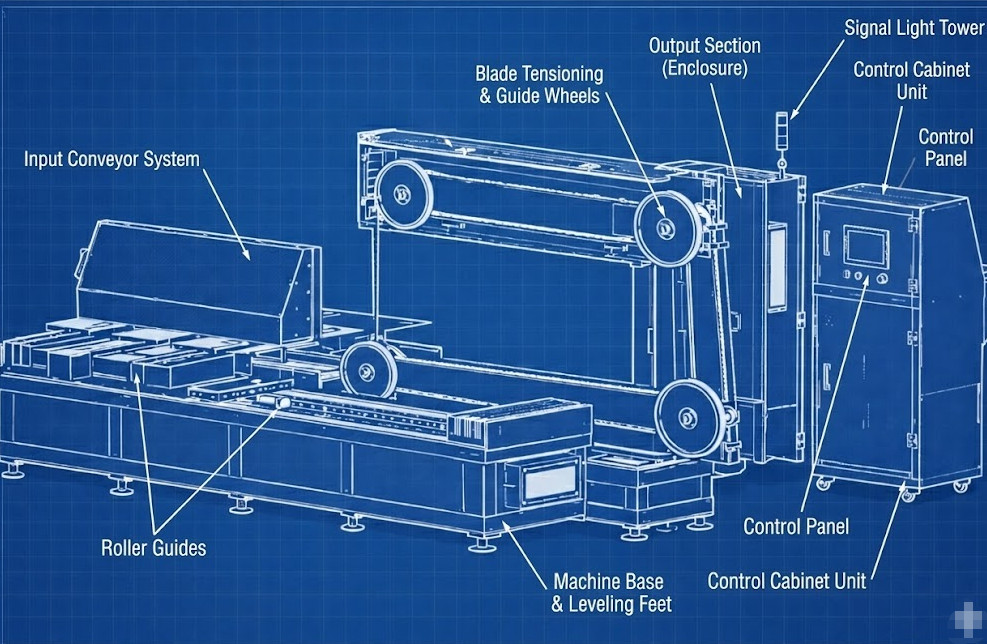
Le présent guide technique déconstruit le Scie à fil diamanté à boucle sans fin, révélant les sous-systèmes internes qui définissent sa précision : le Cadre, le Boucle de conduite, le Système de tension, et le Mécanisme d'alimentation.
1. La fondation : lit en fonte (l'amortisseur passif)
L'élément le plus important est celui qui ne bouge pas.
1.1 Physique des matériaux : Fonte HT250
Les scies haut de gamme n'utilisent pas de tubes en acier soudés. Elles utilisent Fonte grise vieillie (HT250).
- Pourquoi? L'acier est élastique ; il sonne comme une cloche lorsqu'on le frappe. La fonte contient des particules de graphite qui agissent comme amortisseurs de frottement internes.
- L'avantage : Lorsque le fil à grande vitesse génère des vibrations harmoniques (généralement de 200 à 500 Hz), le lit en fonte absorbe cette énergie, l'empêchant de se transférer à la pièce à usiner.
système de contrôle de la tension des câbles - Processus de vieillissement : Nos pièces moulées subissent un “ vieillissement naturel ” (à l'extérieur pendant plus de 6 mois) ou un “ vieillissement thermique ” pour libérer les tensions internes, garantissant ainsi que le lit ne se déforme pas au cours de 10 ans de service.
1.2 Le plan de montage
La surface supérieure du lit est rectifiée avec précision pour obtenir une planéité de 0,01 mm par mètre. Il s'agit du plan de référence pour tous les autres composants. Si cette base est tordue, la coupe sera inévitablement conique.
2. Le cœur cinétique : broche principale et système d’entraînement
Ce sous-système est responsable de l'entraînement du fil de diamant à des vitesses de 40-60 m/s.
2.1 La roue motrice principale
Généralement un fût en aluminium ou en acier de grand diamètre (Dia. 300 mm+).
- Transmission directe ou transmission par courroie : Nous utilisons un Entraînement par courroie synchrone système.
- Raisonnement: Un accouplement direct du moteur transmet les vibrations du moteur directement au câble. Une courroie fait office de filtre, isolant le câble des bruits parasites du moteur.
- Équilibre dynamique : La roue est équilibrée à Niveau G1.0. À 4 000 tr/min, même un déséquilibre d’un gramme crée des forces centrifuges qui détériorent la finition de surface.
2.2 Les roues de guidage (poulies)
Ce sont les points de précision qui définissent la structure métallique.
- Roulements : Nous utilisons Roulements à contact oblique de classe P4. Ces éléments sont préchargés pour éliminer le jeu radial.
- Tolérance de faux-rond : Le faux-rond radial total de la gorge de la roue de guidage doit être < 10 µm. Si la hauteur est trop élevée, le fil va “ marteler ” le verre optique fragile, provoquant des microfissures.
3. Le muscle : système de contrôle de la tension
Contrairement aux scies alternatives (qui utilisent une faible tension), les scies à boucle sans fin nécessitent haute tension (100 N – 180 N) pour maintenir la rectitude face à la force centrifuge.
3.1 Logique du “ ressort pneumatique ”
Les machines modernes utilisent un faible frottement Cylindre pneumatique actionnant une “ poulie de danseuse ” mobile.”
- L'avantage : L'air est compressible. Il agit comme un ressort instantané. Si le fil rencontre une aspérité dans un cristal de germanium, la tension augmente brusquement. Le cylindre d'air se comprime instantanément pour absorber le choc, empêchant ainsi la rupture du fil.
- Régulateur de précision : Un régulateur électropneumatique (transducteur E/P) contrôle la pression à l'intérieur ±0,01 MPa, assurant une tension constante tout au long de la durée de vie du fil.
3.2 Retour d'information du capteur
Un potentiomètre linéaire ou un capteur d'angle surveille la position du bras de tension. Si le câble s'étire (allongement) ou se rompt, le système détecte le changement de position en quelques millisecondes et déclenche un arrêt d'urgence.Dépannage des scies à fil diamanté
4. La main du cerveau : mécanisme d'alimentation de l'axe Z
Ce système abaisse le fil (ou relève la table) dans la découpe.
4.1 Vis à billes et guides linéaires
- Vis à billes : Nous utilisons Vis à billes de précision de classe C3.
- Préchargement : Les écrous sont précontraints afin d'éliminer le jeu (perte de mouvement). Ceci est essentiel pour des procédés tels que la découpe par étapes, où le fil peut avoir besoin de se déplacer verticalement.
- Guides linéaires : Des guides à rouleaux renforcés assurent une rigidité optimale. Même en cas de variation de la force de coupe, l'axe Z ne doit pas s'incliner.installation et alignement de la machine
4.2 Protection : Le soufflet
Dans la découpe du verre optique, le boue (poudre de verre + eau) est très abrasif.
- Scellage: Tous les composants de mouvement linéaire sont enfermés dans Soufflet d'accordéon ou des couvertures télescopiques.
- Pression positive : Les modèles haut de gamme injectent de l'air propre à l'intérieur du soufflet pour créer une pression positive, soufflant ainsi la poussière. dehors et en empêchant toute infiltration.
Conclusion : Une symphonie de systèmes
Une inspection interne révèle la vérité sur les capacités d'une machine.
- Fonte assure le silence.
- Roulements de précision fournir l'exactitude.
- Tension pneumatique assure la sécurité.
Lors de la sélection d'un scie à fil Pour les matériaux de grande valeur comme le verre Ohara ou le germanium, ne vous focalisez pas uniquement sur la structure interne. C'est la rigidité de cette structure qui détermine le rendement.
Découvrez les spécifications de notre machine. Consulter les fiches techniques
6. FAQ (Foire aux questions)
Q1 : Pourquoi utilisez-vous des courroies au lieu de moteurs à entraînement direct pour la roue principale ? Les moteurs à entraînement direct sont puissants, mais peuvent transmettre des vibrations magnétiques au fil. Une courroie synchrone amortit ces vibrations, assurant ainsi une surface de glissement plus lisse pour le fil, un facteur essentiel pour les finitions de qualité optique.
Q2 : Quelle est la durée de vie des roulements internes ? Avec un entretien approprié (et une étanchéité optimale), les roulements de broche de classe P4 sont conçus pour Plus de 10 000 heures de fonctionnement. Cependant, l'infiltration de liquide de refroidissement est la principale cause de défaillance des roulements #1, c'est pourquoi nous insistons sur la vérification des joints lors de la maintenance préventive.
Q3 : Un lit en granit est-il meilleur qu'un lit en fonte ? Le granit offre un excellent amortissement des vibrations, mais une faible conductivité thermique (il retient la chaleur). La fonte offre le meilleur compromis entre amortissement, rigidité et stabilité thermique pour les machines dynamiques dont les moteurs génèrent de la chaleur.