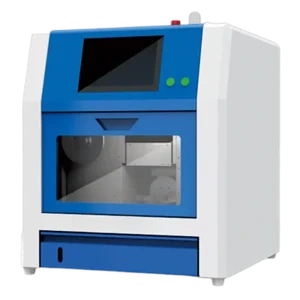
다이아몬드 와이어 톱 절단 기술: 원리, 매개변수 및 응용 분야

트위터
Facebook
LinkedIn
Pinterest

1. 소개

다이아몬드 와이어 톱 cutting technology is widely used for precision cutting of brittle and hard materials where minimal kerf loss, stable cutting forces, and controlled surface quality are required. Compared with blade-type cutting tools, diamond wire saws generate lower mechanical stress, allowing effective slicing of silicon, quartz, ceramics, glass, sapphire, and composite materials.

This page provides a technical overview of working principles, process parameters, system components, and industrial applications, serving as a reference for engineers and production planners.


2. Working Principles of Diamond Wire Saw Cutting

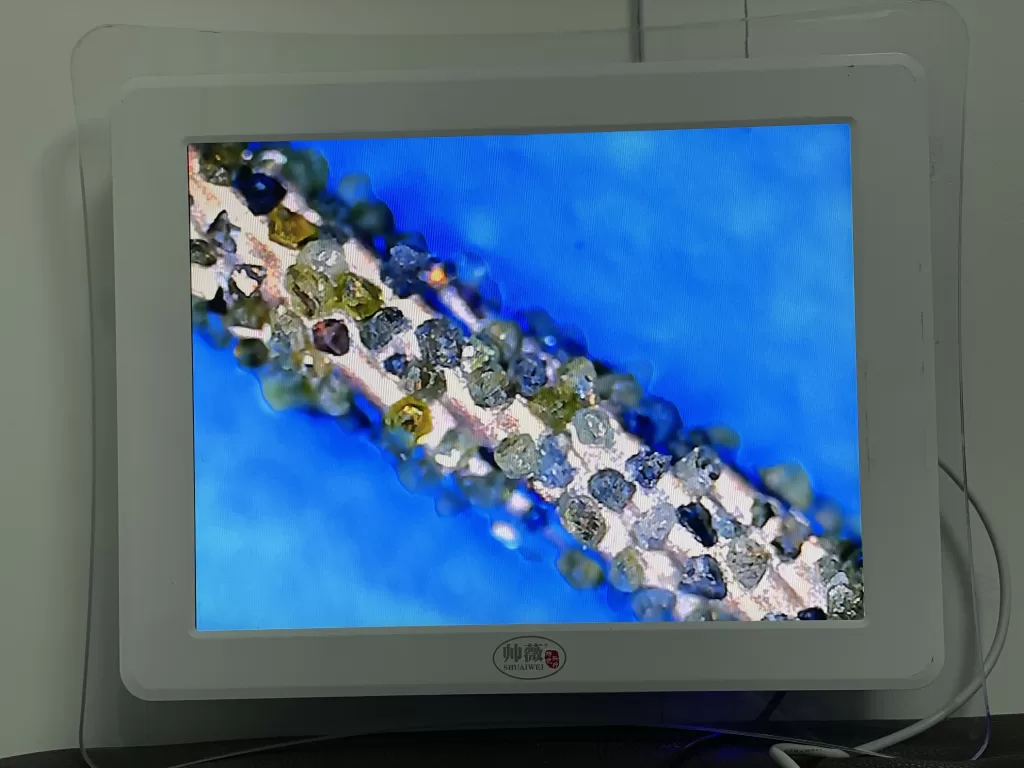
Diamond wire cutting operates through abrasive removal rather than chip formation. Industrial diamond grains are electroplated or sintered onto a high-strength steel wire. During operation, the wire is driven at high speed while maintaining controlled tension to remove material through micro-cutting and micro-fracture mechanisms.

2.1 Abrasive Cutting Mechanism

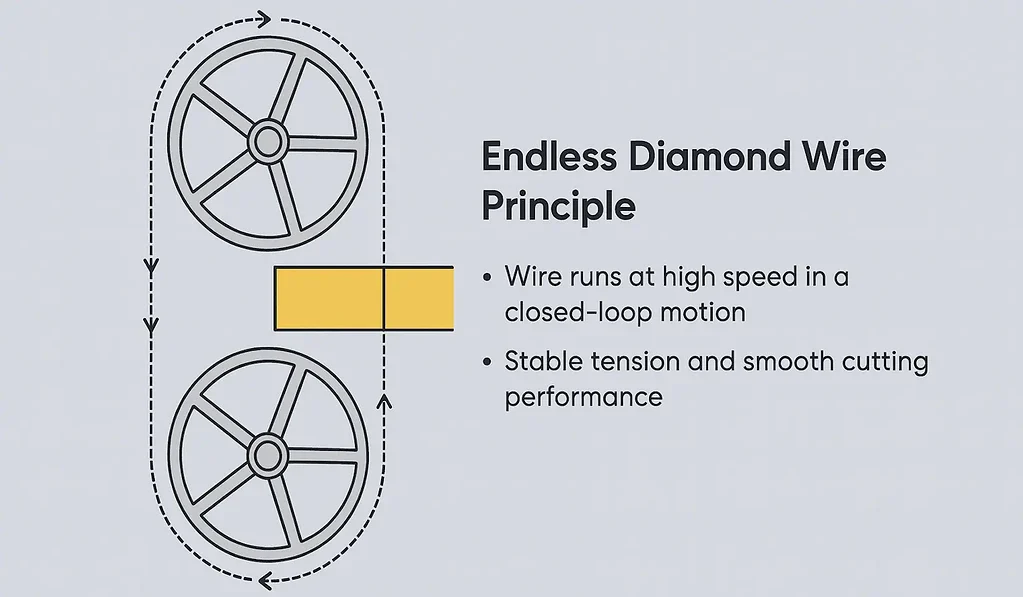
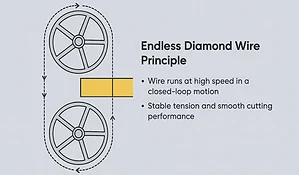
끝없는 다이아몬드 와이어
Diamond Wire Saw Surface

Material removal is achieved through:

  • Micro-indentation from diamond particles
  • Brittle fracture propagation under localized stress
  • Abrasive plowing and micro-scratching
  • Thermal softening when cooling is insufficient

The dominance of each mechanism depends on material hardness, grain size, and feed rate.


2.2 Core System Components

Vimfun Endless Diamond Wire Principle, Diamond Wire Saw Cutting Technology
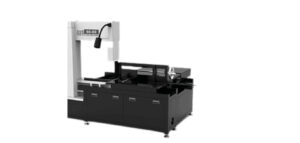
wire saw structure

다이아몬드 와이어 톱에는 일반적으로 다음이 포함됩니다.

  • Drive system: determines wire speed and loop stability
  • Tension control unit: maintains uniform wire tension to suppress vibration
  • Guiding pulleys: stabilize wire alignment and cutting trajectory
  • Feed mechanism: controls cutting load and material removal rate
  • Cooling and lubrication system: dissipates heat and removes debris

Process stability depends on synchronized control of these subsystems.


2.3 Endless vs Reciprocating Wire Systems

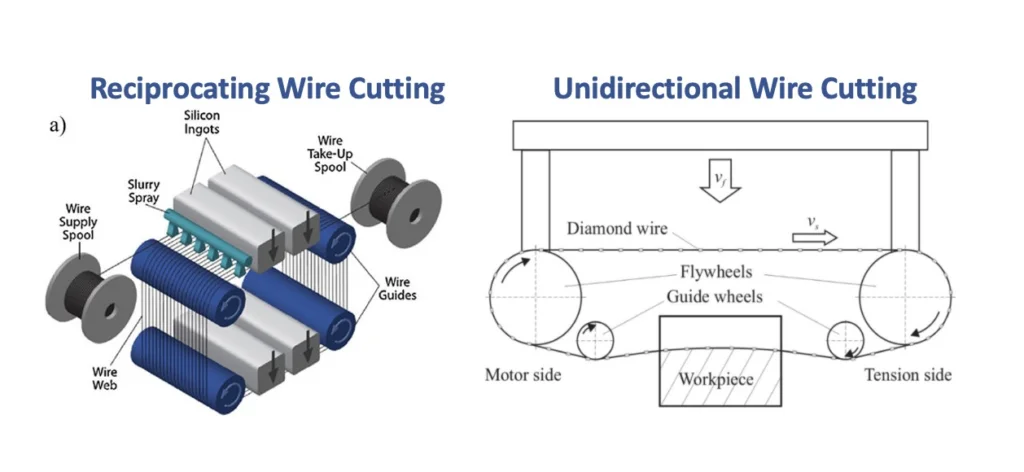
wire cut,  compare endless wire and spooled wire,Diamond Wire Saw Cutting Technology
흑연, 광학 유리 등을 위한 루프형 다이아몬드 와이어 톱.
기능끝없는 와이어 톱왕복 와이어 톱
운동연속 루프Back-and-forth motion
Wire LifeLonger (even wear)Shorter (localized wear)
표면 품질More uniformDependent on stroke changes
진동매우 낮음Higher during reversal
적합한 재료Silicon, quartz, ceramicsStone, large blocks

Endless wire saws are preferred in high-precision and high-volume production environments.


3. Key Process Parameters Affecting Cutting Performance

Cutting performance and surface stability depend heavily on a set of controlled engineering parameters.


3.1 Wire Speed (m/s)

Higher wire speeds reduce cutting force per particle and improve surface quality.
Typical ranges: 35–60 m/s, depending on material hardness.

Effects:

  • Too low → increased wire load, vibration
  • Too high → thermal damage, accelerated wire wear

3.2 Feed Rate (mm/min)

Feed rate must match material removal capability.

  • Low feed → stable kerf, slow throughput
  • High feed → wire deflection, increased kerf width, risk of wire breakage

Feed rate is often optimized through closed-loop feedback based on cutting load.


3.3 Wire Tension (N)

Tension directly influences:

  • Straightness of kerf
  • 절단 정확도
  • Wire vibration amplitude
  • Breakage probability

Higher tension improves straightness but increases tensile stress.
A typical working range is 100–300 N, depending on wire diameter and machine design.


3.4 Cooling and Lubrication

Cooling fluid serves three functions:

  • Heat removal
  • Lubrication of abrasive interface
  • Removal of cutting debris

Insufficient cooling leads to thermal micro-cracks and reduced surface integrity.


3.5 Wire Diameter and Grit Size

  • Thin wire (0.30–0.5 mm): minimal kerf loss, used for semiconductor slicing
  • Medium wire (0.60–0.80 mm): ceramics, graphite
  • Coarse grit: faster cutting
  • Fine grit: smoother surface

The correct combination depends on target precision and production rate.


4. Performance Characteristics and Process Advantages

Diamond wire cutting provides several engineering benefits compared with blade saws, slurry-based systems, and traditional machining.

4.1 Minimal Performance Factors

  • Low kerf loss: important for expensive materials such as silicon or sapphire
  • Reduced cutting force: enables thin and fragile workpieces
  • High dimensional accuracy: small kerf deviation and minimal wire bowing
  • Stable thermal behavior: limited heat-affected zones
  • Smooth surface morphology: reduced post-processing requirements

4.2 Technical Advantages

  • Suitable for difficult-to-cut brittle materials
  • High material utilization rate
  • Continuous production capability with endless loop systems
  • Lower vibration and improved cutting stability
  • Scalable for wafer slicing, glass substrates, ceramic panels, and composite blocks

5. Industrial Applications

Diamond wire saws are deployed across precision manufacturing industries where material value and cutting tolerances are critical.

5.1 Semiconductor and Photovoltaic Manufacturing

  • Silicon wafer slicing
  • Silicon carbide substrates
  • Cutting for power electronics
  • Minimizing kerf loss in large ingots

5.2 Optical Glass and Quartz Processing

  • LCD/LED glass panels
  • Fused silica blocks
  • 사파이어 부품
  • Optical-grade surface requirements

5.3 Advanced Ceramics and Hard Materials

  • Alumina, zirconia
  • 기술 세라믹
  • High-hardness components requiring minimal chipping

5.4 Stone, Composite, and Structural Materials

  • Marble and granite finishing
  • CFRP/GFRP composite trimming
  • Laboratory sample preparation

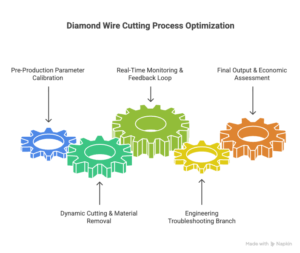
6. Challenges and Optimization Strategies

Although diamond wire cutting is effective, several engineering challenges must be controlled:

6.1 Wire Vibration

Excessive vibration leads to kerf deviation and surface waviness.
Controlled by:

  • Precise tension regulation
  • Optimized wire speed
  • Proper guiding path design

6.2 Wire Wear and Breakage

Caused by overload, improper grit selection, or misalignment.
Mitigation:

  • Load monitoring
  • Progressive feed algorithms
  • Balanced abrasive distribution

6.3 Cooling and Debris Removal

Poor cooling results in micro-cracks and accuracy loss.
System improvements:

  • Higher-flow cooling channels
  • Filtered recirculation
  • Cooling chemistry optimization

7. Summary and Technical Reference Value

Diamond wire saw cutting technology enables precise, stable, and economical slicing of brittle and hard materials. Through optimized parameters—wire speed, tension control, feed rate, wire diameter, and cooling—the process can achieve:

  • 낮은 커프 손실
  • High surface integrity
  • Reduced mechanical stress
  • Extended tool life
  • High throughput for industrial manufacturing

For equipment specifications and machine selection guidelines, refer to our 와이어 톱 페이지.

맨 위로 스크롤

연락하기

걱정하지 마세요! 고객의 요구에 맞는 커팅기를 구하는 것은 매우 어려운 일이라는 것을 잘 알고 있습니다. 당사의 전문 커팅 전문가가 언제나 여러분을 지원합니다: