Engineering Context
Cutting hard and brittle materials such as optical glass, sapphire, silicon carbide, and advanced ceramics is a recurring challenge in semiconductor, optics, and materials research environments. These materials are sensitive to mechanical shock, uneven cutting forces, and thermal stress, which often leads to chipping, subsurface damage, or poor thickness consistency during slicing operations.
In many production and R&D settings, wire-based cutting methods are selected due to their relatively low cutting force and material versatility. However, not all wire cutting technologies provide the same level of process stability, especially when surface quality and repeatability are critical.
Process Challenge
Traditional reciprocating wire saws rely on back-and-forth motion. Each direction reversal introduces transient changes in wire tension, contact force, and vibration. Over long cutting cycles, these fluctuations can result in:
- Inconsistent kerf width along the cutting path
- Directional surface marks caused by velocity changes
- Increased risk of micro-cracks in brittle substrates
- Higher dependency on post-cut grinding or polishing
For materials with low fracture toughness, even small variations in cutting force can significantly impact yield and downstream processing cost.
Technical Approach: Endless Diamond Wire Cutting
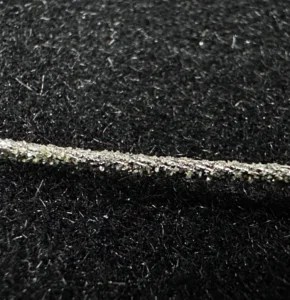
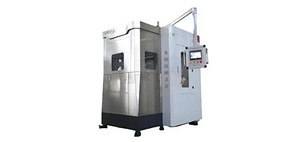
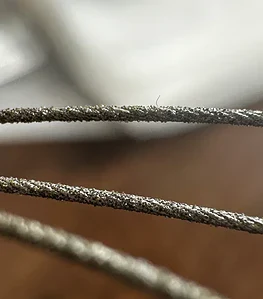
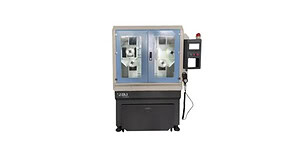
Endless (closed-loop) diamond wire cutting uses a continuous wire loop that runs in a single direction throughout the entire cutting process. Unlike reciprocating systems, the wire does not stop or reverse direction.
In a typical endless wire configuration:
- The wire loop length is relatively short (several meters rather than hundreds)
- Wire motion is unidirectional and continuous
- Tension is actively controlled within a stable operating window
- Linear wire speed remains constant across the cutting zone
This mechanical configuration allows the cutting system to maintain a steady interaction between the diamond abrasives and the workpiece surface.
Why This Method Is Used
From an engineering perspective, the primary advantage of endless wire cutting is process stability.
Continuous one-way motion eliminates the acceleration and deceleration phases inherent to reciprocating systems. As a result:
- Wire tension remains more uniform
- Vibration induced by motion reversal is minimized
- Cutting force distribution along the wire is more consistent
These factors contribute to more predictable material removal behavior. In practice, this often translates into:
- Reduced surface waviness
- More uniform slice thickness
- Narrower and more consistent kerf width
- Lower probability of edge chipping on brittle materials
Because the cutting process is smoother, endless wire systems are commonly selected when surface integrity and geometric consistency are more important than maximum material removal rate.
Engineering Considerations and Limitations
While endless Diamantdrahtschneiden offers clear stability advantages, it is not a universal solution for all cutting tasks.
Engineers typically evaluate the following before selecting this method:
- Material hardness and fracture behavior
- Required surface roughness and flatness
- Part size and cutting thickness
- Acceptable cutting speed versus quality trade-offs
Endless wire systems are especially suitable for precision slicing, research-scale production, and applications where downstream finishing needs to be minimized. For very high-throughput applications where surface quality is less critical, other cutting methods may still be considered.
Summary
Endless diamond wire cutting is widely adopted in applications where stable cutting conditions are essential for hard and brittle materials. By eliminating motion reversal and maintaining constant wire speed and tension, this method provides a more controlled cutting environment, helping engineers reduce variability, protect material integrity, and improve overall process reliability.